Home  >  News

May 18, 2026      News      9706

Researchers from Xi’an Jiaotong University and other institutions in China have used electric-field-driven (EFD) printing technology to fabricate 3D highly ordered microstructures with cell-scale features, successfully promoting the maturation of engineered cardiac tissues (ECTs).

This provides new solutions for cardiac repair, disease modeling, and drug discovery. The related findings were published by the Additive Manufacturing Sub-Society of the Chinese Mechanical Engineering Society.
ECTs derived from human induced pluripotent stem cell-derived cardiomyocytes (hiPSC-CMs) hold great promise, but their immature state limits clinical applications. The researchers adopted EFD printing technology (unlike traditional EHD printing, EFD eliminates the ground electrode and generates an electric field through charge polarization between the nozzle tip and the substrate). They successfully fabricated 3D highly ordered microstructures with fiber diameters of 10–20 μm and spacing of 60–80 μm, achieving a maximum fiber diameter/spacing ratio of 0.29.
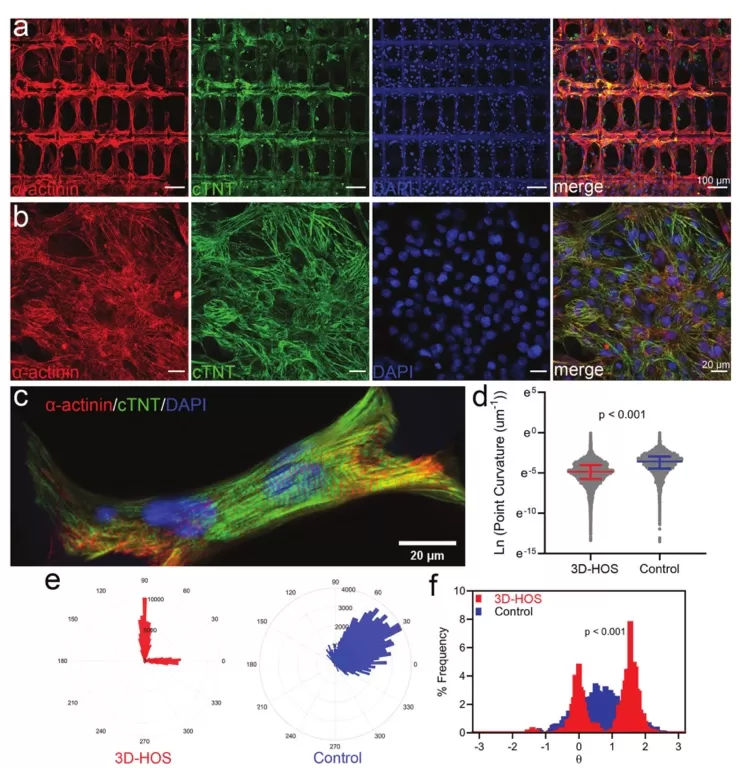
The fabrication process consists of three steps: first, printing a single-layer grid; second, reducing fiber spacing using a symmetric path approach; and finally, stacking multiple layers. hiPSC-CMs were cultured on these scaffolds (fiber diameter 20 μm, spacing 80 μm). The cardiomyocytes aligned highly oriented along the PLA fibers, forming regular myofibrils. Immunostaining showed good ECT alignment; calcium imaging revealed synchronous propagation, coordinated frequency, and similar amplitudes, along with high calcium handling efficiency, demonstrating significantly improved tissue maturation.
This EFD microscale printing strategy offers a new approach for scaffold fabrication, creating a suitable microenvironment to promote ECT maturation, and shows potential for application in cardiac tissue engineering.


©2025 3dptimes.com All Rights Reserved