Commercial space and 3D printing are moving from technical verification to large-scale production, with three core drivers: cost reduction, efficiency improvement, and innovation enablement.
Based on the 2026 China Commercial Space 3D Printing Technology Development Blue Book, we highlight the five most impactful application scenarios currently in play.
1. Integrated manufacturing of the Raptor thrust chamber – a decisive breakthrough
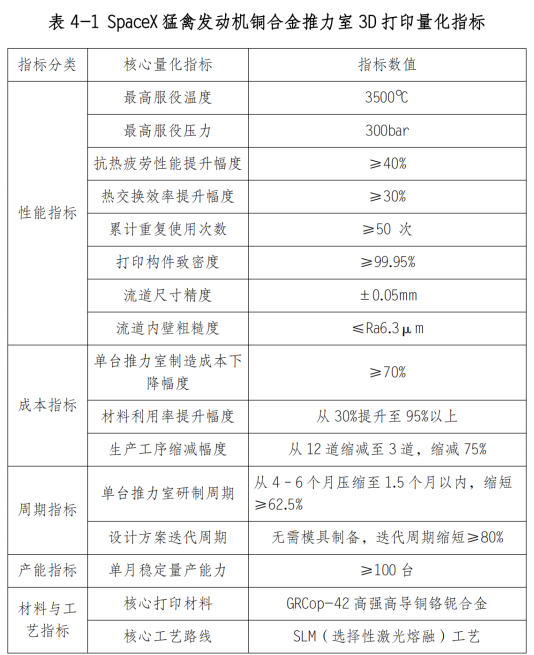
SpaceX's Raptor engine thrust chamber has completely abandoned the traditional welding approach of a copper-alloy inner wall and nickel-based outer wall. Weld‑free integrated forming eliminates cracking and leakage issues at the root. Material utilization soars from 30% to over 95%, per‑unit cost drops by 70%, the development cycle shrinks from 4‑6 months to just 1.5 months, and monthly production now exceeds 100 units. This is not merely a technological victory – it sets the benchmark for industrial‑scale mass production.
2. Mass production of meter‑scale nozzle extensions
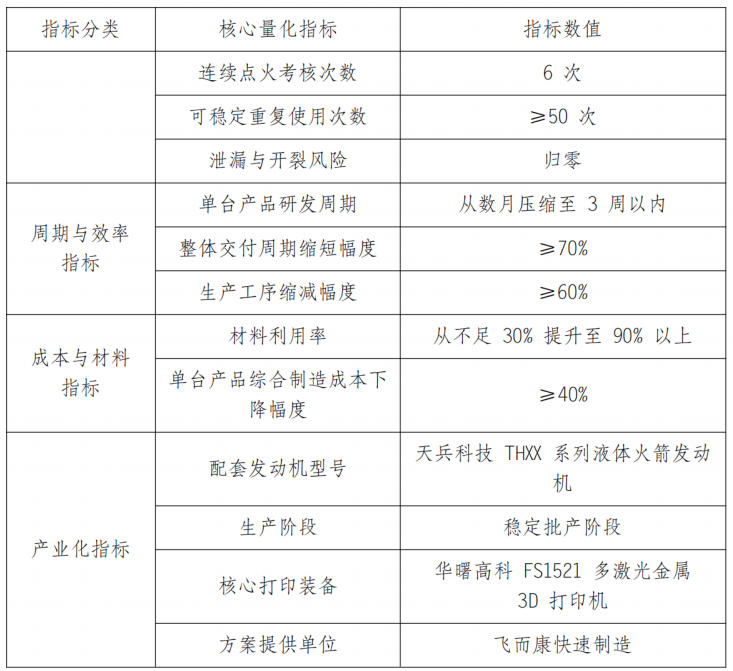
In China's commercial space sector, Feierkang, using Farsoon's equipment, has achieved integrated mass production of meter‑scale thrust chamber nozzle extensions. Made of 316L stainless steel, with a maximum build size exceeding one meter, complex cooling channels are formed in a single print. The weld risks inherent in traditional brazing are eliminated, delivery lead time is cut by 70%, and the parts have passed a 1,000‑second hot‑fire test, reliably supporting over 50 reuses. This marks a true breakthrough in large‑size core component 3D printing mass production in China.
3. Support‑free "magic" of aerospike engines
Hanbang Laser, in collaboration with LEAP71, has 3D printed a 200 kN‑class aerospike engine in one piece. Featuring an annular combustion chamber and a central spike, it does away with the conventional bell‑shaped nozzle. Even more impressive is the support‑free printing: support material usage drops by 90%, post‑processing costs are cut in half, cooling efficiency improves by 25%, and the development cycle shortens by 40% – truly achieving "print once, and it's done."
4. Lightweight revolution of satellite flat‑panel structures
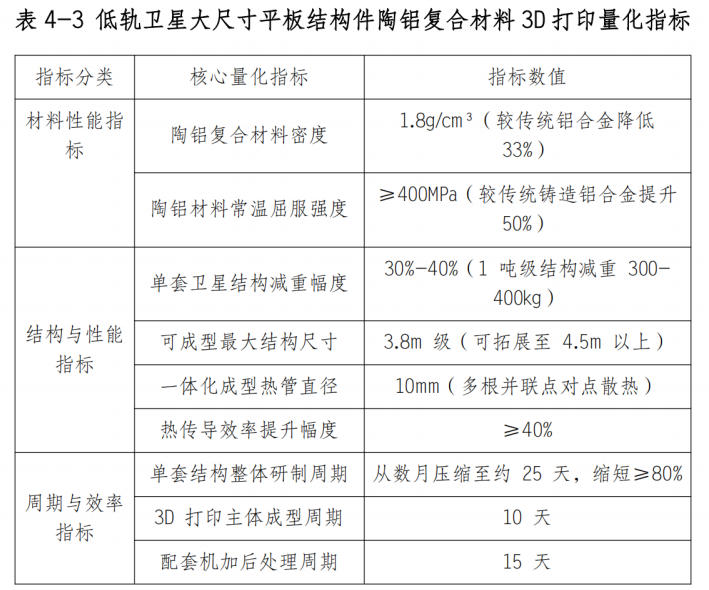
As LEO constellation construction accelerates, Hongqing Technology employs a nano‑ceramic particle‑reinforced aluminum matrix composite (dubbed "Tao Al") with a density of only 1.8 g/cm³ – 33% lighter than traditional aluminum alloys, yet with strength increased by 50%. The 3.8‑meter large flat‑panel structure now has its development cycle reduced from months to just 25 days, perfectly matching the high‑cadence batch deployment needs of satellite constellations.
5. First real‑world test of a space factory
ESA carried out the world's first in‑orbit metal 3D printing on the International Space Station, forming titanium alloy structural parts directly in microgravity, achieving a density over 99.9% and accuracy of ±0.1 mm. In the past, waiting for a spare part took 3‑6 months; now it can be completed within 24 hours. Transport weight is reduced by 80%, saving tens of millions of dollars per mission. By 2028, they plan to extend this capability to lunar orbit, and by 2030, to deploy manufacturing systems on the lunar surface.
These five technologies essentially outline the power‑train architecture and manufacturing logic that will drive commercial space over the next five years.