
Home  >  Materials

October 29, 2025      Materials      1049

Silicon Carbide Ceramic 3D Printing for Thermal Management: Guohong Tianyi Introduces New High-Thermal-Conductivity, Lightweight Solution

Monolithic Silicon Carbide Cooling Structure
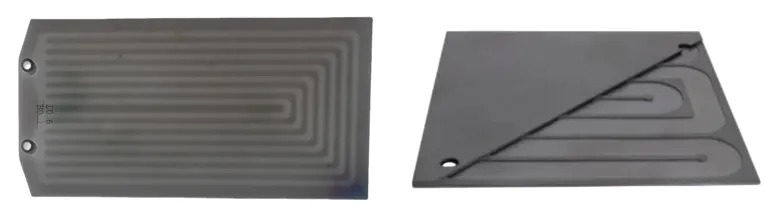
Driven by the rapid advancement of AI technology, which has led to an explosion in GPU cooling demands, metal 3D printed heat sinks have recently gained significant traction. Additionally, ceramic 3D printed thermal solutions are beginning to emerge.
Silicon Carbide Liquid Cold Plate
In fields such as high-end chips, 5G/6G communication base stations, aerospace electronics, and high-power IGBT modules, thermal management design is becoming a critical bottleneck limiting product performance improvements. Traditional metal heat sinks, constrained by material thermal conductivity and limitations in structural design freedom, struggle to meet the cooling requirements of high-power-density equipment. Silicon carbide (SiC) ceramic, with its excellent thermal conductivity (≥150 W/(m·K)), low coefficient of thermal expansion, high mechanical strength, and favorable lightweight characteristics, has become an ideal material for a new generation of high-efficiency thermal management components.

However, for a long time, restricted by the difficulties in shaping SiC ceramic and challenges in processing complex structures, high-performance SiC thermal components have largely remained in the laboratory stage, making industrial application difficult to achieve.

Xi'an Guohong Tianyi Intelligent Technology Co., Ltd., based on its self-developed ceramic stereolithography (SLA) 3D printing technology and high-performance SiC slurry, has achieved breakthroughs across the entire process from material formulation, structural design to printing and sintering. This provides the industry with a one-stop manufacturing solution for realizing complex, high-precision, high-performance SiC ceramic thermal components.

Guohong Tianyi Ceramic SLA 3D Printer JH-C420
1. Achieving High-Precision Manufacturing from 2D Microchannels to Complex 3D Multi-Cavity Structures

Traditional processing techniques struggle to achieve integrally formed 3D special-shaped flow channels, fractal flow channels, or multi-cavity cooling structures. Guohong Tianyi, through its JH-C250 high-precision SLA additive manufacturing system, can stably manufacture the following typical structures:

Special-shaped cross-section flow channels (e.g., Gyroid surfaces, bionic topological structures)

Multi-stage branched flow channel systems

High aspect ratio microchannels (aspect ratio ≥ 10:1)

Enclosed cavity and porous composite cooling structures

"Guohong Tianyi not only realizes the creation of complex structures 'from scratch,' but more crucially, achieves process control that ensures 'from existence to precision'," according to the Technical Director of Guohong Tianyi. Currently, this process can achieve dimensional accuracy of ±0.05mm and control post-sintering part warpage to <0.2%, meeting the assembly requirements for most precision electronics.

2. Key Performance Indicators Reach Industrial Application Levels, Batch Production Stability Verified

As a core prerequisite for industrial adoption, Guohong Tianyi Intelligent Technology Co., Ltd. has made substantial progress in material performance and process consistency. According to its published performance test data, 3D printed SiC ceramic components have reached the following key indicators:

Density: 3.05 – 3.12 g/cm³

Flexural Strength: ≥400 MPa

Thermal Conductivity: >150 W/(m·K)

Compressive Strength: ≥1000 MPa

Hardness: > HRA 90

This data indicates that its additively manufactured SiC ceramics already match the thermal and mechanical properties of materials produced by traditional methods, while surpassing them in structural design freedom.

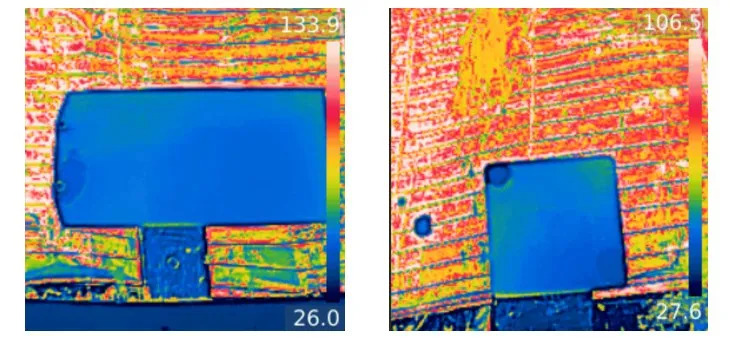
Measured Data of Silicon Carbide Liquid Cold Plate (Test condition: 100°C)
3. Targeting Typical Application Scenarios, Providing Customized Thermal Design and Manufacturing Services

Currently, Guohong Tianyi Intelligent Technology Co., Ltd. has initiated collaborations with multiple communication equipment manufacturers, aerospace organizations, and power electronics companies. It provides customized SiC ceramic heat spreader and cold plate solutions for different cooling needs, focusing on typical areas including:

⁠5G/6G Base Station Power Amplifier Cooling Modules

⁠Aerospace Airborne Electronic Equipment Cold Plates

⁠Electric Vehicle IGBT Module Heat Spreaders

⁠High-end GPU/CPU Liquid Cooling Structures

Through topology optimization and flow channel simulation, precise matching of thermal components to heat sources can be achieved, optimizing temperature distribution and improving cooling efficiency.

4. Integrated Design-Manufacturing Capability Shortens R&D Cycle

It is reported that this technology offers designers greater freedom, allowing for "Design for Additive Manufacturing" (DFAM) optimization based on heat source distribution, space constraints, and fluid performance, enabling structural innovations unattainable with traditional processes. Simultaneously, the cycle time from design to prototype can be shortened to one-third of that required by traditional processes, helping customers achieve rapid product iteration.

The silicon carbide ceramic additive manufacturing technology promoted by Xi'an Guohong Tianyi Intelligent Technology Co., Ltd. is moving from the laboratory to industrialization. It provides customized capabilities for producing thermal management components with complex structures, high performance, and high reliability for high-power electronics, communications, aerospace, and other fields. With the continuous optimization of material properties and the improvement of process stability, this technology is expected to become one of the key technological pathways for next-generation thermal management systems.


©2025 3dptimes.com All Rights Reserved