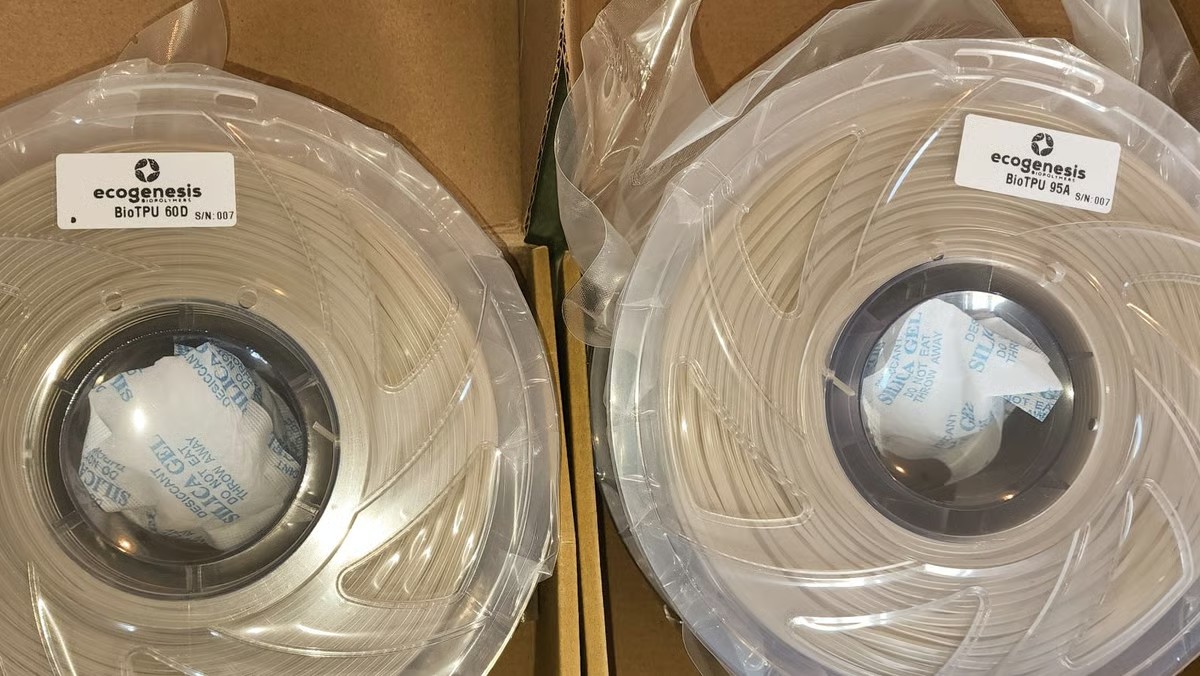
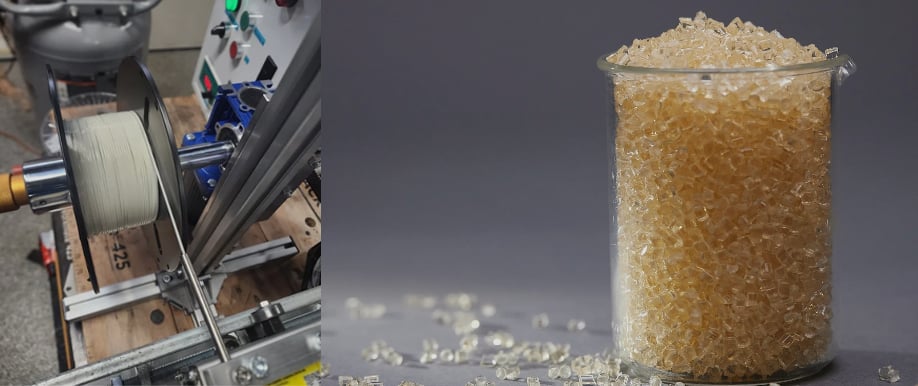
Ecogenesis Biopolymers has launched a new genTPU filament derived from algae and plant oils.
California-based material start-up, Ecogenesis Biopolymers, just launched a 3D printing TPU filament that is plant-derived and designed to “completely biodegrade in the most sensitive ecosystems, including our waterways and oceans,” the company says.
If you think that means you can start 3D printing beach flip-flops and chuck them in the ocean without an environmental care in the world, though, think again.
As exciting as this prospect is, a closer look at the scientific evidence the company provides on biodegradability reveals some nuance between laboratory definitions and consumer expectations, especially as this marks the company’s first consumer TPU product. But that shouldn’t dissuade you from potentially swapping out your fossil-fuel-derived TPU for an all-around more sustainable option.
The push toward consumers 3D printing their own shoes (a popular use of TPU) is beginning to scale, driven by companies like Bambu Lab, which are pairing shoe design collections with TPU filament, and reinforced by manufacturers such as 3D printing shoe company Zellerfeld, which has received $34.1M in investor funding since its launch in 2020. This combination suggests TPU use is poised to expand rapidly beyond industrial users to more consumers and small businesses.
What Is Bio-Based TPU Really?
First, let’s take a look at Ecogenesis and its genTPU.
Founded in late 2023 by Frank Pinczuk and Darlene Barbee, Ecogenesis Biopolymers is the official 3D printing market distributor of Soleic TPU materials made by a company called Algenesis Labs. Pinczuk told All3DP that the new filament is made from 99% Soleic TPU with “minerals such as calcium carbonate and food-grade plant oils at less than 1%. The balance of the materials are from Algenesis.”
California-based Algenesis Labs is a materials science company founded in 2016 with a “vision to help the planet recover from the pollution caused by petroleum-based products.” What began as a lab concept from a group of chemists, Stephen Mayfield, Robert Pomeroy, and Michael Burkart, grew into a materials business. With the backing of investors, the company launched its first proof-of-concept to show that its bio-based TPU — from algae and other plant oils that mimic petroleum plastics in performance — could actually work as a product. Its Blueview Shoe in 2022 showed that Soleic could be manufactured into a functional shoe sole that could stand up to daily use and still biodegrade (without creating microplastics) at the end of its lifetime.
What Does The Science Say
Algenesis has about 20 peer-reviewed scientific journal articles posted on its site, dating back several years and covering a wide range of investigations into bio-based TPU materials. One study found that bio-based polyester polyurethane foam (a foam form of Soleic), when submerged in the ocean, showed signs that natural marine bacteria and fungi could chemically break down the material with no engineered processing required.
Another study showed that a specific bio-based TPU material, when shredded and mixed with compost incubated at 45 °C, had 27% biodegradation after six months. This temperature may be high for typical backyard compost, but Mayfield told All3DP home compost piles in San Diego can maintain that temperature.
The prospects for this bio-based flexible material are exciting. There’s the potential to eliminate significant amounts of microplastics from entering the environment via footwear alone, which could be a sustainability game-changer in the nascent 3D printing shoe industry. Soleic is also available as an injection molding material, but has seen limited market uptake.
The prospects for this bio-based flexible material are exciting. There’s the potential to eliminate significant amounts of microplastics from entering the environment via footwear alone, which could be a sustainability game-changer in the nascent 3D printing shoe industry. Soleic is also available as an injection molding material, but has seen limited market uptake.