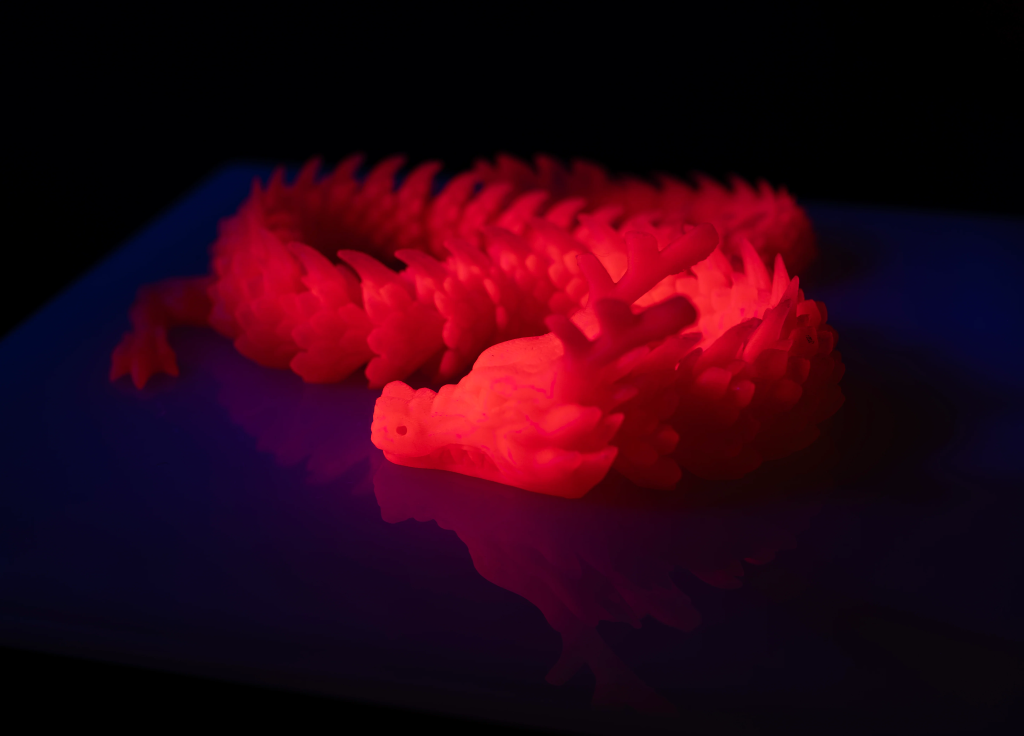
Proto-Pasta explores quantum dot technology in experimental 3D printing filament
3D printing filament manufacturer ProtoPlant, the maker of Proto-Pasta, has partnered with Quantum Light to develop a quantum dot-infused 3D printing filament. The material was unveiled at CES 2026 and incorporates semiconductor nanocrystals into a thermoplastic filament, enabling controlled color emission when exposed to ultraviolet light.
Quantum dots are nanometer-scale semiconductor crystals whose optical and electronic properties vary according to particle size, emitting light at specific wavelengths when excited and enabling precise color tuning. Due to quantum confinement effects, their electrons occupy discrete energy levels, a behavior often compared to that of isolated atoms. This property has led to the use of quantum dots in applications such as display technologies, bioimaging, and photovoltaic devices.
According to ProtoPlant, embedding quantum dots directly into filament enables color effects that are not achievable using conventional extrusion-safe pigments. Because the optical response is tied to emission rather than reflection, printed parts appear visually subdued under normal lighting and reveal their full coloration only under ultraviolet exposure. The company notes that this characteristic opens possibilities for functional markings, visual encoding, and design elements that remain hidden under standard illumination.
ProtoPlant also emphasizes that the quantum dots are dispersed within the filament matrix rather than applied as a surface coating, meaning the fluorescent response persists throughout the printed part rather than wearing off over time. While the company has not disclosed specific concentration levels or long-term photostability data, it positions the material as an early exploration of how quantum-scale optical phenomena can be translated into desktop-scale additive manufacturing materials. The quantum dot filament is being introduced through Proto-Pasta’s Endless Exploration subscription program, with multiple color variants planned as part of the initial rollout.
The project was developed in collaboration with Quantum Light, with materials research led by Olga Alexapoulou. Proto-Pasta also highlighted creative contributions from filament artist Daniel Bettencourt (Kaizen3D), whose work explores the visual potential of the material under ultraviolet illumination.
Quantum dots: optical potential and processing constraints
Research into colloidal semiconductor nanocrystals has shown that their most established functionality lies in optical emission rather than electronic transport. Quantum confinement enables these materials to produce highly saturated, size-tunable emission with narrow spectral bandwidths, while charge transport between particles remains constrained by surface ligands and interparticle spacing. As a result, nanocrystal-based materials have found their earliest commercial success in applications such as displays and lighting, where precise color control is required but high electrical conductivity is not.
More recent research into solution-processed, cadmium-free quantum dots highlights both the promise of these materials and the sensitivity of their optical performance when translated from laboratory synthesis to manufactured layers. In a 2025 study published in ACS Applied Materials & Interfaces, researchers demonstrated that indium phosphide–based quantum dots can retain strong photoluminescence when deposited using inkjet printing, provided that ink formulation, evaporation dynamics, and environmental exposure are carefully controlled.
The work shows that nanoscale emitters are particularly sensitive to aggregation, solvent behavior, and oxygen or moisture exposure during deposition, factors that can significantly affect emission uniformity and stability.
Quantum dots as functional additives in photopolymer printing
Beyond optical effects in extruded materials, quantum dots have also been explored in additive manufacturing research as functional nanoscale additives rather than visual emitters. In recent studies focused on stereolithography-based processes, quantum dots have been incorporated into photopolymer resins where they interact directly with ultraviolet curing light during photopolymerization. In this context, the particles influence how light energy is absorbed and distributed within the resin, affecting curing behavior and material formation.
Rather than producing visible fluorescence in finished parts, quantum dots in these systems are used to modify curing dynamics and material performance, contributing to improvements in mechanical or functional properties of printed components. This approach contrasts with ProtoPlant’s filament, where quantum dot behavior is applied primarily for controlled optical emission, illustrating the different ways nanoscale semiconductor materials are being adapted across additive manufacturing processes.