January 19, 2026      Applications      12135

Nike Unveils Air Max 1000 "Multicolor," the World's First Dual-Color Monolithically 3D-Printed Sneaker

Nike, in partnership with its long-term additive manufacturing collaborator Zellerfeld, has developed a new 3D printing technology: for the first time, it enables the simultaneous output of two colors within a single, seamless print job. This innovative technology has debuted on the new Nike Air Max 1000 "Multicolor," marking a crucial step towards the scalable, commercial production of full-color, multi-material additive manufacturing.
From Monochrome to Native Dual-Color
This launch represents a significant move in Nike and Zellerfeld's strategic shift from technical pilot programs to scaled production. Their collaboration began a decade ago with Nike's early push into 3D-printed footwear applications and was marked by a return in 2024 with the restart of its 3D printing business and the launch of the monochrome Nike Air Max 1000. Following this, Nike, alongside renowned athletes Kylian Mbappé (Real Madrid football), Léon Marchand (swimming), and Victor Wembanyama (San Antonio Spurs basketball), released the France-themed Nike Air Max 1000.

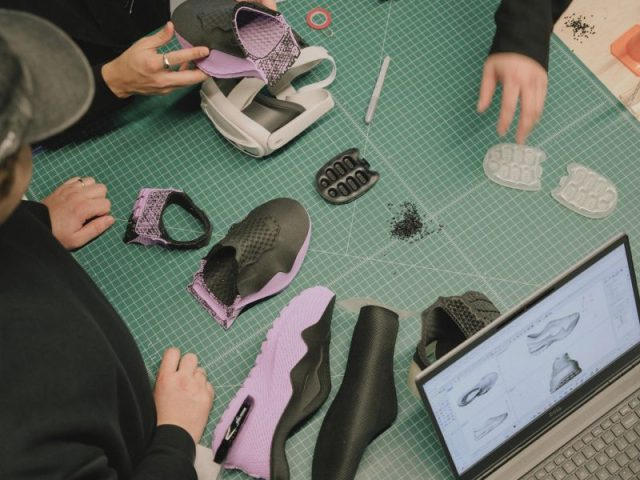
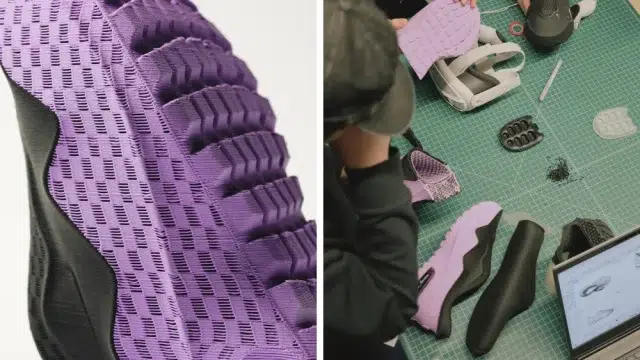
Unlike the earlier single-color 3D-printed Air Max 1000, the new "Multicolor" version integrates dual-color zones directly during the printing process. Color precision matches the geometric shapes, eliminating the need for post-processing steps like painting or assembly. Prototype images clearly show the color segmentation: a purple base extends from the sole to the upper, meeting black at the shoe's signature wavy contour line, while the heel features a contrasting black Air unit.

Nike highlights that this Air Max 1000 "Multicolor" is the world's first commercially available dual-color, monolithically 3D-printed footwear, opening new creative avenues for designers and brands. This technology enables vibrant color combinations without compromising the Air Max 1000's iconic monolithic mesh structure.

From Pilot to Scaled Production
This launch signifies the transition of the Nike-Zellerfeld partnership from small-scale pilots to scaled production, a strategic shift already demonstrated with the late-2025 launch of the Air Max 95000. That model first introduced Nike's "print-first" system, Project Nectar, which combines material formulation with toolpath control to enhance outsole durability, traction, and integrated detailing. Although the 95000 achieved multi-color effects through layered printing technology, its process differs from the single-print, dual-color technology now applied to the Air Max 1000.

Zellerfeld's Gen3 printer, used for the mass production of both models, enables complex, mold-free forming with parametric assembly capabilities, thereby improving repeatability and efficiency at retail production scale. According to both companies, this platform-based approach helps accelerate iteration, expand design freedom, and lay the groundwork for future customization.

The Air Max 1000 "Multicolor" is expected to release later this year, with more colorways and other Air Max models utilizing 3D printing technology to follow. As Nike increasingly integrates additive manufacturing into its footwear lines, dual-color printing represents a significant step in treating color as a native design parameter rather than an added feature.


©2025 3dptimes.com All Rights Reserved