Home  >  News

August 24, 2026      News      10034

During the Nürburgring 24-hour endurance race, Black Falcon’s Porsche 911 GT3 Cup took a heavy hit. This wasn’t a minor scrape—it was the kind of damage that demanded a full rebuild, not just a quick patch-up.

After the restoration, the engineers faced a thorny question: how could they be certain the repaired chassis structure was fully sound? Especially since the car was heading back to the Nordschleife, one of the most unforgiving tracks in endurance racing.
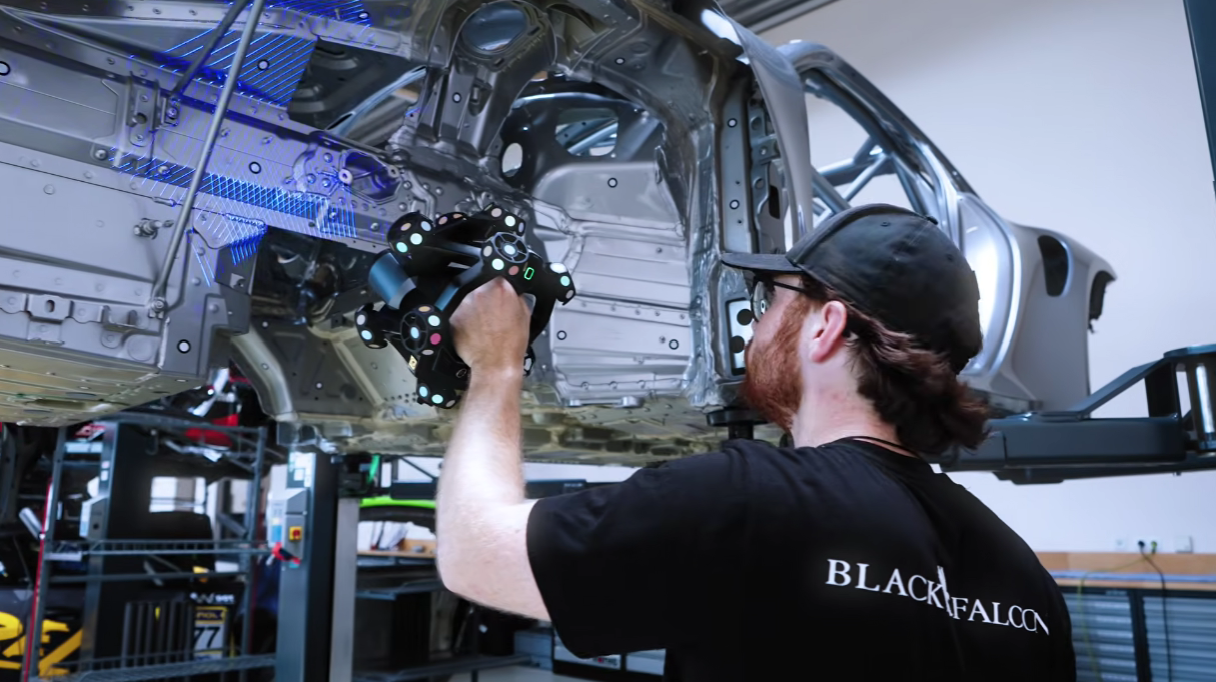
They didn’t rely on visual inspection alone or traditional calipers. Instead, the team brought out SHINING 3D’s FreeScan Trak Nova, a portable optical measurement system, and scanned every critical repaired component from end to end. With an accuracy of 0.02 mm maintained across a 12‑cubic‑meter working volume, they could quantify every geometric deviation down to the decimal. Whether the rebuild was up to standard became a matter of data, not gut feeling.
Behind this lies a deeper technical partnership. Black Falcon has been racing at the Nürburgring for over two decades, with two overall wins in the 24‑hour race and more than 300 class victories. Now they’re embedding digital tools into their engineering workflow across the board. From chassis and crash‑structure analysis to routine documentation of wear parts, scanning has become standard practice. Even the development of the front aerodynamic splitter has taken a new route—scanning the physical part and feeding the data directly into CFD simulations, which is far more cost‑effective than trial‑and‑error wind‑tunnel testing, and more realistic than manually rebuilding geometry from scratch in CAD.
The scanner itself is quite clever. The handheld unit works with a separate tracking module, runs wirelessly on swappable batteries, and weighs less than 3 kg in total—easy to carry in a portable case and move between the workshop and the pit lane. Wide‑area scanning captures the overall structure, while dynamic tracking zeroes in on local details. No sticky markers are needed; a calibration bar and real‑time video lock in volumetric accuracy. This design even earned an iF Design Award for 2026.
From Formula 1 to the World Superbike Championship, from Red Bull to NASCAR’s Olympic bobsled project, the signal is clear: 3D scanning is evolving from an occasional measurement tool into the everyday engineering language of the paddock. After a crash, no guesswork—just scan and know.


©2025 3dptimes.com All Rights Reserved