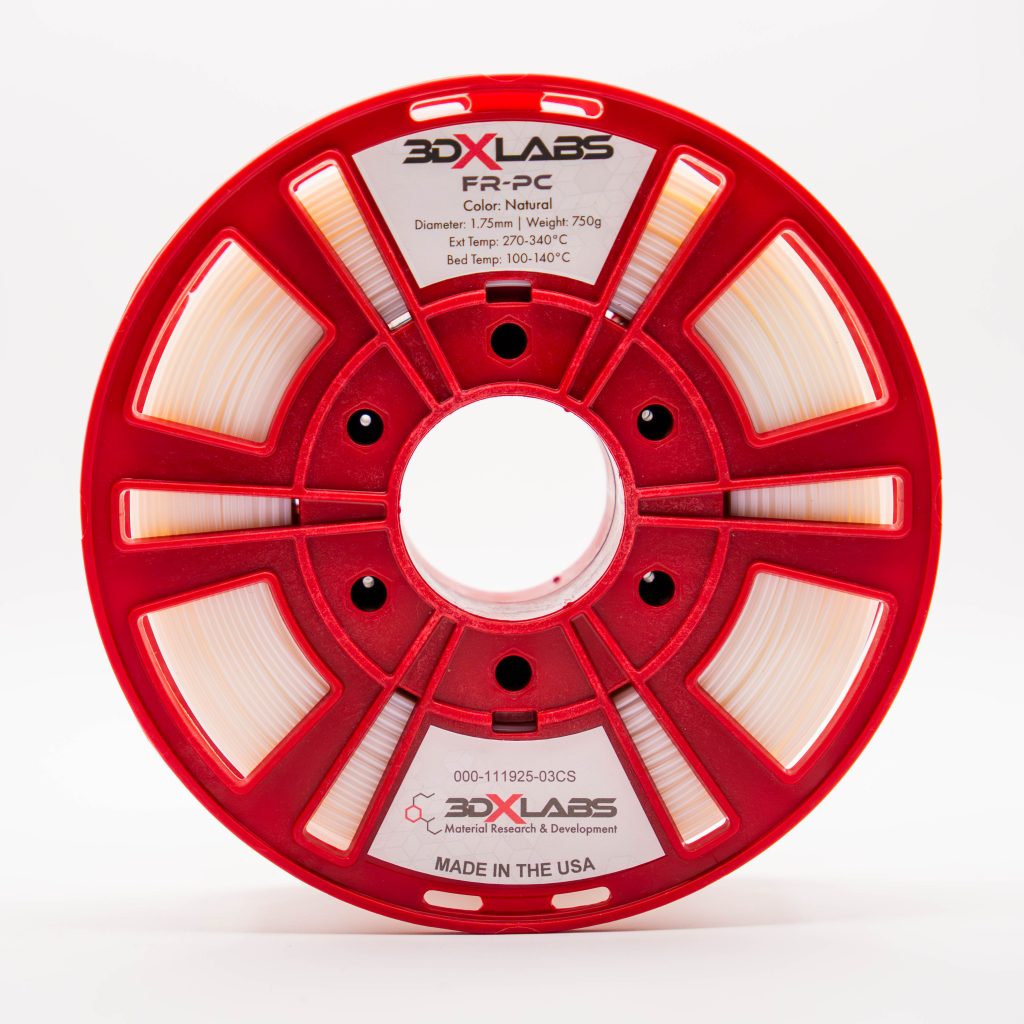
3DXTECH launches FR-PC, a flame-retardant polycarbonate for electrical/auto parts, achieving top UL94 & IEC60112 certifications.
3DXTECH, a Michigan-based manufacturer of high-performance 3D printing materials for fused-filament fabrication (FFF) systems, has expanded its 3DXLabs development platform with FR-PC, a new flame-retardant polycarbonate formulated for electrical and automotive applications. Developed collaboratively through the 3DXLabs ecosystem, FR-PC is designed to meet the safety and reliability requirements of high-voltage components and achieves top-tier certifications under UL94 and IEC60112 standards.
FR-PC attains a UL94 V-0 burn rating at 1.5 millimeters and an IEC60112 Comparative Tracking Index (CTI) of 600 volts, confirming its high resistance to ignition and electrical tracking. These performance levels make it suitable for housings, connectors, and enclosures within electric vehicles and other systems operating under sustained thermal and electrical stress. The formulation maintains dimensional accuracy and mechanical integrity under continuous thermal exposure, ensuring consistent part performance during long-term use.
Product Manager Rachel Rogers said the material originated from industry demand for a higher-performance alternative to the company’s existing FR-PC-ABS blend. “We saw an opportunity in our portfolio to build from our FR-PC-ABS and create something more sustainable in the EV market, especially as additive manufacturing continues to expand as a key solution in that industry,” Rogers explained. “Through the 3DXLabs platform, we have been able to fast-track materials like FR-PC by validating real-world needs directly with the engineers who rely on them.”
Launched in 2025, 3DXLabs is a collaborative R&D program that provides customers early access to experimental materials prior to full commercial release. Participants test these formulations in real manufacturing environments and share data that informs the final specifications of production-grade products. Feedback from this network enables 3DXTECH to refine materials for industrial, aerospace, automotive, and defense applications while maintaining alignment with mechanical, electrical, and thermal performance standards. Participants are acknowledged for their contributions to product validation, and FR-PC represents the latest material to emerge from this iterative process.
The Michigan-based company produces engineering-grade filaments that include carbon-fiber and glass-fiber composites, electrostatic-dissipative polymers, and flame-retardant blends. In-house compounding and quality-control systems allow precise adjustment of additive content and performance modifiers. Integrating these capabilities under the 3DXLabs framework enables shorter development cycles between laboratory testing and field qualification.
Advances in Polymer Performance and Environmental Accountability
Spain-based materials company Recreus recently advanced flexible polymer extrusion with the launch of its Filaflex 2.20 System, a complete filament and hotend solution designed to bring flexible 3D printing speeds in line with rigid materials such as PLA. The 2.20 mm filament geometry increases cross-sectional area by 58% and improves buckling resistance by 2.3 times compared to 1.75 mm formats, enabling faster, clog-free extrusion. Validated across systems including Bambu Lab’s P1 and X1 series and Prusa’s MK4 and XL printers, the system has undergone more than 1,000 hours of continuous testing without clogging. Recreus reports that components which once required eight hours to print can now be produced in under three, broadening applications in footwear, soft robotics, orthotics, and industrial damping.
In the UK, Filamentive introduced Material Sustainability Profiles (MSP) to standardize environmental data disclosure across 3D printing materials. Each profile details polymer origin, recycled content, packaging type, and end-of-life handling, alongside compliance with REACH, RoHS, ISO 9001, and ISO 14001 standards. The initiative addresses a long-standing lack of transparency in the sector, allowing users to compare materials objectively based on verified sustainability metrics. Filamentive plans to expand the framework to include Environmental Product Declarations (EPDs) and Material Passport documentation, advancing traceability and accountability within polymer supply chains.