
November 4, 2025      Applications      7460

HKUST researchers have developed an AI-powered 3D food printing system that simultaneously prints and cooks food using infrared heating.

Research team members from the HKUST Integrated System and Design Division (ISD)

The Hong Kong University of Science and Technology (HKUST) Integrated System and Design Division (ISD) research team has recently successfully developed an innovative AI-assisted 3D food printing solution. This approach combines extrusion-based printing with simultaneous infrared cooking technology, introducing a new production model for 3D printed food that is safer, more efficient, and visually appealing.
The related findings have been published in the journal Advanced Materials, under the title "Advanced 3D Food Printing Technology for Simultaneous Cooking and Generative AI Design" (Link).

Technology Development Background

Traditional 3D food printing processes often require additional post-processing steps, which can easily lead to uneven food composition, unstable shapes, and even risks of microbial contamination. To address these challenges, the HKUST team developed an integrated AI-enhanced system. It utilizes graphene heaters to achieve simultaneous infrared heating, precisely controlling the cooking process and ensuring starch-based foods maintain their ideal form and quality during printing.
The first author of the paper, HKUST PhD student Li Guanghui, stated: "By integrating technology and culinary creativity, we have reimagined the potential of 3D food printing. Our advanced integrated 3D food printing technology has the potential to revolutionize the way personalized food is produced."
Step-by-step process of 3D printed food manufacturing at HKUST
Everyone is a Food Designer

The system employs generative algorithms and Python scripts for complex food pattern design. The introduction of AI technology greatly simplifies the design process, allowing even computer novices to easily create personalized food designs. The research team stated that this technology not only enhances the shape retention capability and safety of printed food but also significantly reduces contamination risks. It holds promise for personalized nutrition and populations with specific dietary needs, such as those with swallowing disorders.
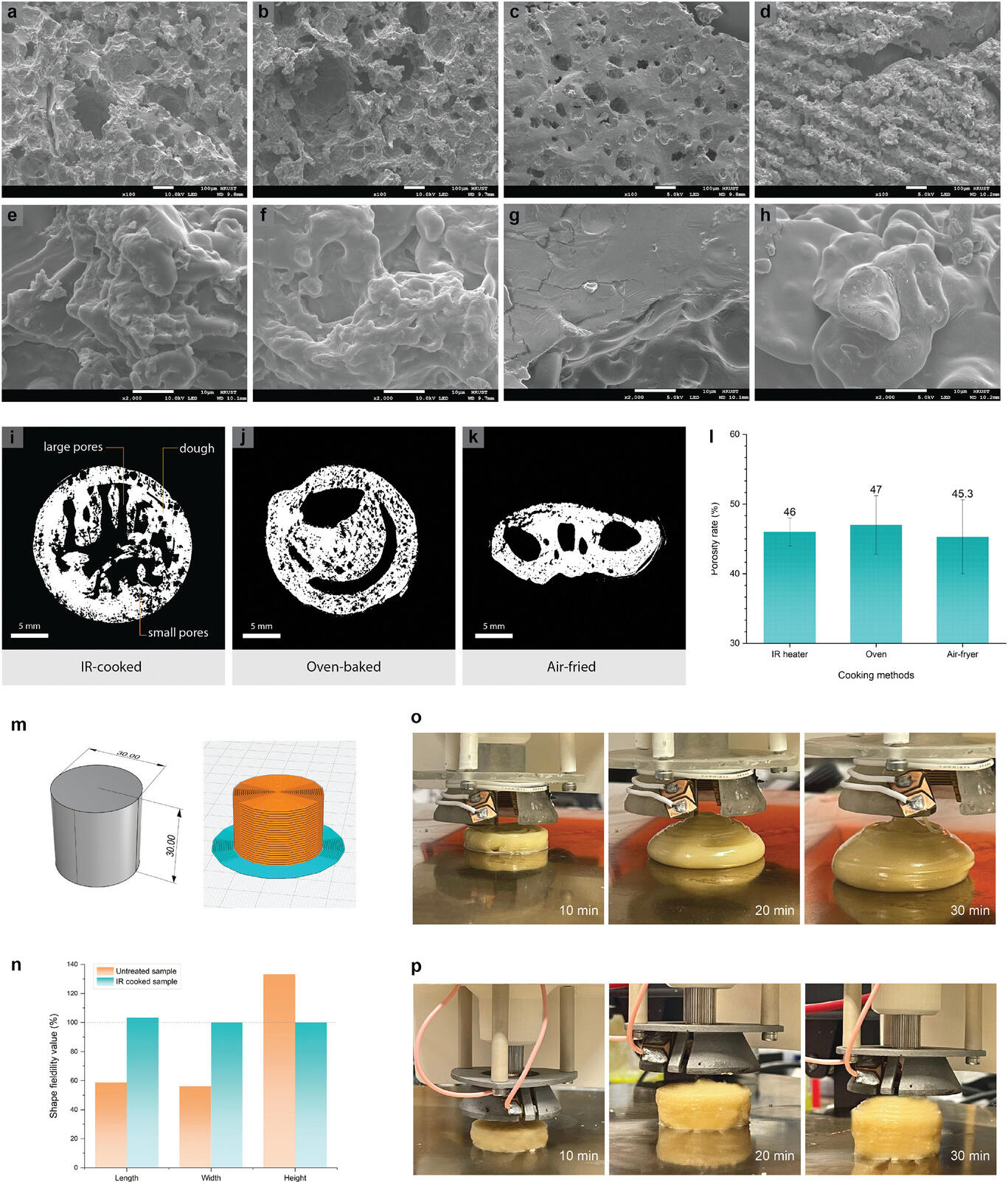
Microscopy and scanning revealed that 3D printed dough cooked using different methods exhibited varying internal structures and shape retention.
This research is the result of interdisciplinary collaboration, covering fields such as user-centered design, mechanical engineering, food science, chemistry, and artificial intelligence. This interdisciplinary approach brought together diverse expertise to address the complex challenges in 3D food printing.
AI design process optimization
Professor Li added: "We are excited about the potential of this technology to deliver customized, safe, and delicious food in an efficient and convenient manner. This represents a significant step forward in our concept of food creation."

Looking ahead, the research team plans to improve the technology by studying methods to preserve heat-sensitive vitamins and optimizing starch digestibility. Future research will also focus on consumer acceptance, conducting sensory evaluations with target users such as children or hospital caregivers, to ensure the system can be applied in practical scenarios.


©2025 3dptimes.com All Rights Reserved