Home  >  News

October 29, 2025      News      1309

Research on Color Matching Calibration Algorithm for FDM Full-Color 3D Printers

Xu Hongwei* Ye Wenbin Ma Shunyao Zhang Hang
School of Printing, Packaging and Digital Media, Xi'an University of Technology, Xi'an, 710048

Abstract: Experimental analysis was conducted on the color mixing effect of the developed full-color Fused Deposition Modeling (FDM) 3D printer, verifying the color mixing uniformity of the designed color mixing printhead. Based on this, an RGB-CMYKW color matching calibration algorithm using Polylactic Acid (PLA) filament for FDM 3D printing and a Backpropagation (BP) neural network was proposed. Four-color filaments (Cyan, Magenta, Yellow, White) were mixed in different proportions to obtain 529 color mixing samples. The SOFV-1xi image acquisition device was used under a standard D50 light source to extract the image color (RGB) information of the mixed color samples. Combined with a standard color checker, color correction was performed on the information extracted under the same acquisition conditions, resulting in 529 RGB-CMYW color conversion sub-samples. These sub-samples were trained to determine the full-color matching calibration algorithm for FDM 3D printing. Using the developed full-color FDM 3D printer, 24 color patches were printed, and the color difference between the printed patches and the corresponding patches of the standard 24-color checker was analyzed and calculated. The results showed that the color differences were generally small, indicating a good ability to replicate color characteristics. Additionally, an actual 3D color model was designed and printed, further verifying the reliability and practicality of the proposed color matching algorithm.

1. Principle of Color Matching

Currently, full-color Fused Deposition Modeling (FDM) 3D printing is one of the mainstream research directions. Printing typically involves extracting relevant model feature information from the 3D model's STL file or 3MF file. The 3MF file contains color information exclusively in the RGB (Red, Green, Blue) additive color space, whereas colors of substances in the natural world are generally synthesized using the CMY (Cyan, Magenta, Yellow) subtractive color primaries. Considering this, an RBF neural network was applied to establish a color space conversion model for the printer. This addresses the color matching problem between physical models printed with PLA material and the designed 3D models, ensuring that the printed physical models effectively replicate the color characteristics of the design models and achieve a "what you see is what you get" effect. This method saves memory space, offers relatively fast speed, and the color accuracy meets application requirements.

2. Structure of the Full-Color 3D Printer

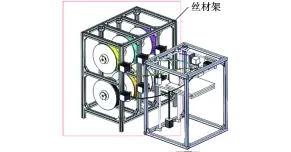
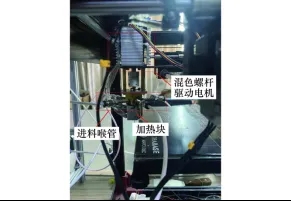
Considering that white cannot be achieved by mixing CMY colored materials in practical 3D printing, this study set the basic colors of the FDM 3D printer to five colors: CMYKW (Cyan, Magenta, Yellow, Black, White). The FDM full-color 3D printer, equipped with a five-filament spool rack featuring feeding functionality, is shown below.

FDM Full-Color 3D Printer
Five-color Mixing Printhead
Four types of filaments (C, M, Y, W) were used to print 15 mm × 15 mm × 2 mm sample patches. The filaments were mixed and printed according to a feed ratio of C:M:Y:W = 0.27:0.497:0.292:0.005. The printed samples are shown in the figure below.
Image placeholder: Mixed Color Printed Patches
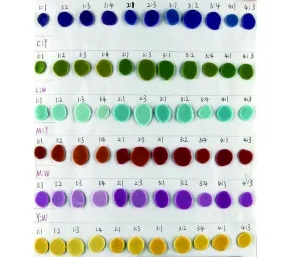
The printed samples show visible extrusion paths. Color was extracted from 10 uniformly selected detection points, revealing that the RGB values of these 10 points were similar. Excluding the influence of light, they can be considered consistent. Therefore, the developed full-color FDM 3D printer was used as the experimental platform for creating the mixed color sub-samples.

3. Color Matching Calibration Model

3.1 Production of Mixed Color Sub-samples

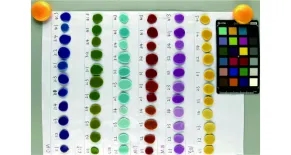
The feed speed for each color of PLA (C, M, Y, W) was divided into 4 levels. Single-color, two-color, three-color, and four-color mixtures were created according to different proportions. A total of 529 non-repeating sub-samples were calculated, as shown in the figure below.

Image placeholder: Partial Two-color Mixed Sample Patches
3.2 Data Extraction from Mixed Color Sub-samples and Color Information Correction

The Munsell standard 24-color checker (Colorchecker Classic) and the mixed color patches were photographed together under a constant light source box. The photo is shown below.

Image placeholder: Photo of Color Patches and Checker under Standard Light Source
All sub-samples were photographed, and initial color correction was performed on all digital images. An improved RGB color difference calculation formula was adopted. The RGB values of the standard and corrected gray scales were compared, calculating the color difference ΔE between both and the standard gray scale. Color correction was performed using the gray scales from the standard 24-color checker, and the color information was compared with the uncorrected results. It was found that the maximum color difference for digital photos captured under the standard light source was 20.7, exceeding the human eye discernible color difference threshold of 6. In contrast, the maximum color difference for the corrected color information was 1.4, significantly less than 6, thus meeting the requirements.

3.3 BP Neural Network Model

A single-hidden-layer BP neural network model for RGB-to-CMYW conversion was established, which is beneficial for saving time. The RGB values of the color patches served as the input layer (number of input nodes: 3), and the output values were the proportional relationships of the four colors C, M, Y, W (number of output nodes: 4). The calculated range for the number of hidden layer nodes was 4 to 13. In the experiment, 371 samples were used as the training set, 79 samples as the validation set, and 79 samples as the test set. Numbers between 4 and 13 were respectively tried for the hidden layer nodes, and the resulting mean square errors were compared to obtain a better training result. It was found that when the number of neurons in the hidden layer was 7, the error was minimized. Therefore, the number of neurons in the hidden layer was set to 7.

4. Experimental Verification

The standard color information from the 24-color checker was used as the input signal, and the trained model with 7 hidden layer neurons was used for prediction. The corresponding proportional relationships were obtained through model calculation. Printing was then performed according to these proportions, resulting in the corresponding 24-color sample patches. The sample patches and the standard 24-color checker were photographed under a standard light source to collect color information, as shown in the figure below.

Image placeholder: 24 Color Patches and Standard Color Checker
Color correction was performed on the 24 color patches and the standard color checker shown in the figure above. The RGB values of each color patch were extracted and compared with the RGB values of the standard color checker to calculate the color difference. For details, please refer to the original paper: "Research on Color Matching Calibration Algorithm for FDM Full-Color 3D Printers". It can be observed that patch No. 14 had the largest color difference, ΔE = 11.56; additionally, patches No. 6, 16, 18, 19, and 24 had color differences exceeding the threshold of 6. Among these, the black of patch No. 24 was created by mixing C, M, and Y. Since the filaments themselves have color differences, the mixed color exhibits a certain degree of color difference. Looking at the printed cyan patch No. 5, magenta patch No. 9, yellow patch No. 16, and white patch No. 19, the filaments themselves are not standard colors and have inherent color differences. The hues are basically consistent but relatively undersaturated. Overall, the color matching effect is good.

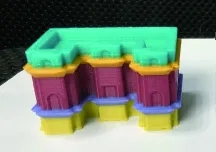
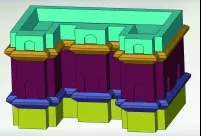
A 3D color model of a building was designed, and the 3D color model printed using the method described in Section 1 is shown in the figure below. Comparison shows that the colors are basically consistent, achieving a high degree of color replication between the printed 3D model and the designed 3D model.

Designed 3D Color Model
Printed 3D Color Model
Citation: Xu H W, Ye W B, Ma S Y, et al. Research on Color Matching Calibration Algorithm for FDM Full-Color 3D Printers [J]. China Mechanical Engineering, 2025, 36(9): 2081-2086.

Author Introduction:

Xu Hongwei* (Corresponding Author), male, born in 1968, Ph.D., Associate Professor. Main research directions: printing and packaging machinery and automation, 3D printing technology and control systems research. E-mail: xuhongwei@xaut.edu.cn.


©2025 3dptimes.com All Rights Reserved