Home  >  News

August 12, 2026      News      9710

Porous calcium phosphate ceramics, such as hydroxyapatite (HAP), are ideal bone repair materials—but they have a fatal flaw: poor mechanical strength.

The high porosity required for bone ingrowth further weakens these already brittle scaffolds, typically giving them a compressive strength of less than 3 MPa. That falls far short of human cortical bone (88–164 MPa), severely limiting their clinical application.
A team from Sichuan University in China has now achieved a notable breakthrough. By doping HAP with calcium sulfate and using DLP 3D printing technology, they successfully induced the "in situ" growth of whiskers—about 10 micrometers long—within the ceramic during sintering. These in-situ-grown "rebar" structures significantly reinforce the scaffold. Experiments show that with 30% calcium sulfate doping, compressive strength jumps from 8.87 MPa to 93.12 MPa, and elastic modulus rises from 273 MPa to 564 MPa—levels fully capable of withstanding surgical handling and loading.
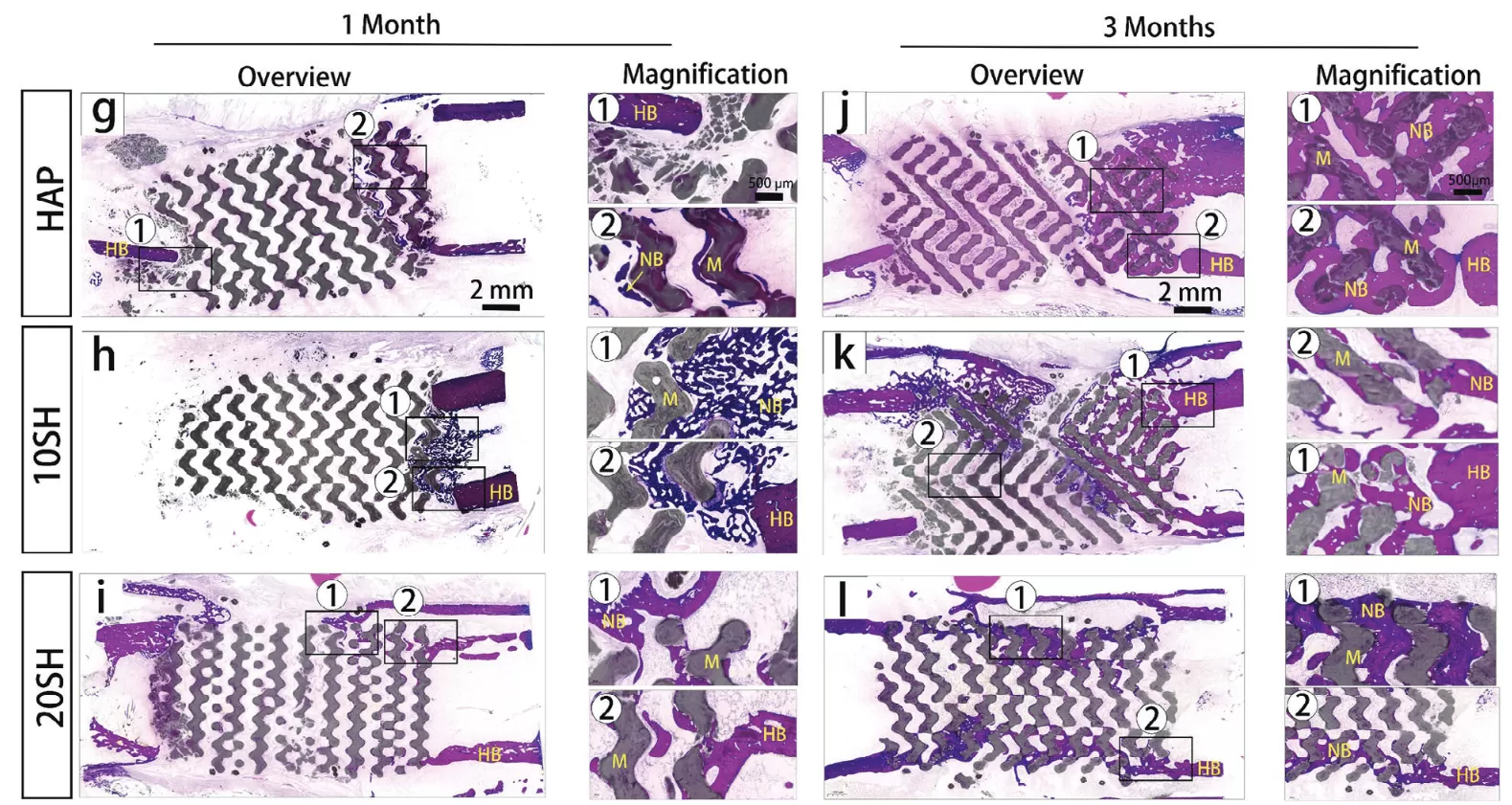
But the scaffold doesn't just get stronger; its biological performance also improves. Calcium sulfate degrades faster than HAP, accelerating calcium ion release and boosting the expression of alkaline phosphatase (ALP), an early marker for osteogenic differentiation. In a critical rabbit femoral defect repair test, the calcium sulfate–doped group delivered impressive results: within just three months, new bone had grown entirely through the scaffold and seamlessly fused with the host bone, showing significantly better bone regeneration than the pure HAP group.
This study elegantly combines "reinforcement" and "osteo-promotion" in one strategy. By using in situ whisker growth, it overcomes the long-standing trade-off between strength and bioactivity in calcium phosphate ceramics, offering a highly promising new approach for clinical repair of critical-sized bone defects.


©2025 3dptimes.com All Rights Reserved