
Home  >  Services

October 11, 2025      Services      Aerospace Mechanics      184

Inspired by Hakka Tulou's structure, researchers developed a "skeletal" nanoporous copper with enhanced strength and toughness through a novel dealloying approach.

Professor Gu Jianfeng, Tenured Professor at Shanghai Jiao Tong University, in collaboration with Professor Ma Qian, Distinguished Professor at RMIT University, published a paper titled "Skeletal High-Strength Nanoporous Copper and Metamaterials: The Hakka Tulou Design Heritage" in Advanced Materials. Inspired by the unique structure of Hakka Tulou's "bamboo-wood frame and rammed earth wall," the study proposes a design concept for "skeletal-type" nanoporous copper. By utilizing solidification segregation and selective dealloying processes, the research successfully constructed a multiscale structure combining a non-dealloyable skeleton with a dealloyable matrix, effectively enhancing the material's overall strength, toughness, and functional integration capabilities. This strategy overcomes the limitations of traditional dealloying techniques in terms of size and structural integrity, providing new insights for developing nanoporous metal metamaterials that combine high strength, lightweight properties, and multifunctionality.
Nanoporous metallic structures, characterized by interconnected nanochannels, possess high specific surface areas and multifunctional potential. However, their engineering applications have long been constrained by weak mechanical load-bearing capacity and insufficient structural integrity. Inspired by the long-term durability of Hakka Tulou’s "bamboo-wood framework–rammed earth wall" structure, this study proposes embedding a non-dealloyable, ductile, and tough three-dimensional skeletal phase within a dealloyable matrix. This approach compartmentalizes the porous structure, localizes localized failure, and enhances overall load-bearing capacity and integrity while preserving the advantages of structural functional porosity.

Figure 1 illustrates the inspiration behind the skeletal-type high-strength nanoporous copper metamaterial. By leveraging the spatial synergy between the "skeletal phase" and the "matrix phase," the architectural concept of "skeletal support/compartmentalized filling" from traditional construction is translated into the design of a dual-phase precursor for nanoporous copper. After dealloying, a composite architecture of "skeletal support + nanochannels" is achieved, enabling the decoupling and complementarity of functional porosity and load-bearing paths. Panel (a) displays a typical Hakka Tulou; Panel (b) provides a schematic cross-section of a microscopic unit of the Tulou, further detailing the wall structure where the skeletal framework is embedded within compacted yet still porous earth; Panel (c) maps the architectural principle to the material's microstructure.

Figure 1. Design inspiration of skeletal-type high-strength nanoporous copper metamaterial derived from the architectural structure of Hakka Tulou.
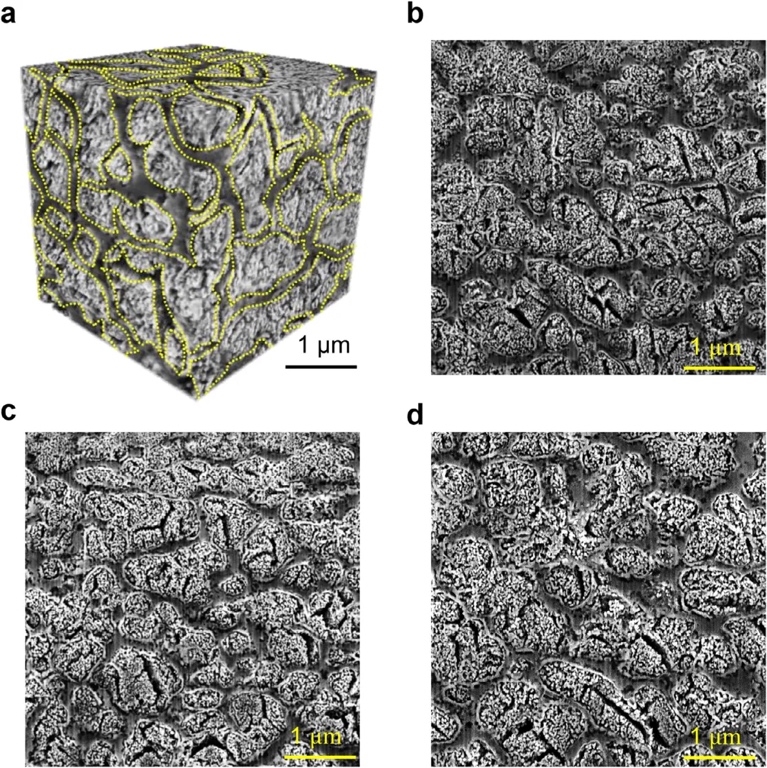
Figure 2 displays the "Tulou-inspired" three-dimensional microstructure after dealloying. Panel (a) presents the 3D volume reconstructed from 2500 FIB-SEM images, where the yellow dashed lines represent the non-dealloyable Cu-rich skeletal phase, demonstrating its three-dimensional interconnection characteristics at the micrometer scale. Panels (b)-(d) show microstructural views of the left-side, rear-side, and bottom surface slices of this cubic volume, respectively, further evidencing how the skeletal phase compartmentalizes the nanoporous copper matrix into a "compartment-like" structure.
Figure 2. Microstructure after dealloying of manganese-copper alloy fabricated by laser powder bed fusion.
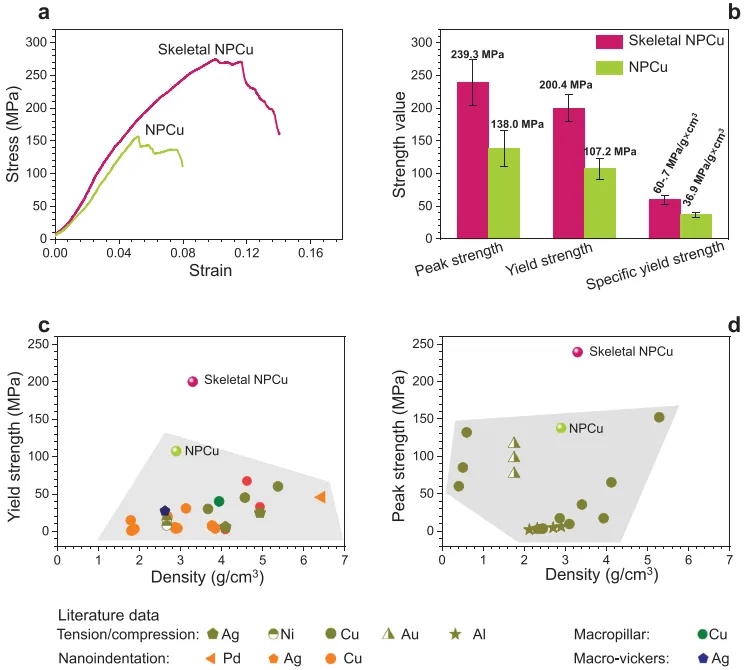
Figure 3 illustrates the comparison of mechanical properties between skeletal nanoporous copper structures and non-skeletal nanoporous copper structures. Panel (a) compares the compressive stress-strain curves of the two types of nanoporous copper structures. The curve of the skeletal structure is significantly "higher," with its yield point and peak strength markedly exceeding those of the non-skeletal sample, indicating that the skeletal phase functions as a "load-bearing wall" during compression. Panel (b) further presents a comparison of mechanical metrics between the two types of nanoporous copper. The yield strength of skeletal nanoporous copper reaches 200.4 ± 21.1 MPa, representing a 62% improvement over the non-skeletal sample; its peak strength reaches 239.3 ± 35.0 MPa, a remarkable 70% increase; while the specific strength improves by 60%, reaching 60.7 ± 6.5 MPa·cm³·g⁻¹. These specific numerical comparisons fully demonstrate the significant advantages brought by the skeletal design. Panels (c)-(d) extend the comparison to other existing nanoporous metals. It can be clearly observed that skeletal nanoporous copper not only far exceeds traditional nanoporous copper materials in strength parameters but also outperforms some specially designed and optimized porous systems. Additionally, the research team utilized microArch® S240 (accuracy: 10μm) from BMF Precision's Projection Micro Stereolithography (PμSL) technology to fabricate porous polymer topological structures to investigate the effect of the skeletal phase on crack propagation (see Figure 5).
Figure 3. Mechanical performance comparison of nanoporous copper with and without the embedded skeletal phase.
Figure 4. Investigation of the skeletal phase's effect on crack propagation using 3D-printed porous polymer topological structures.
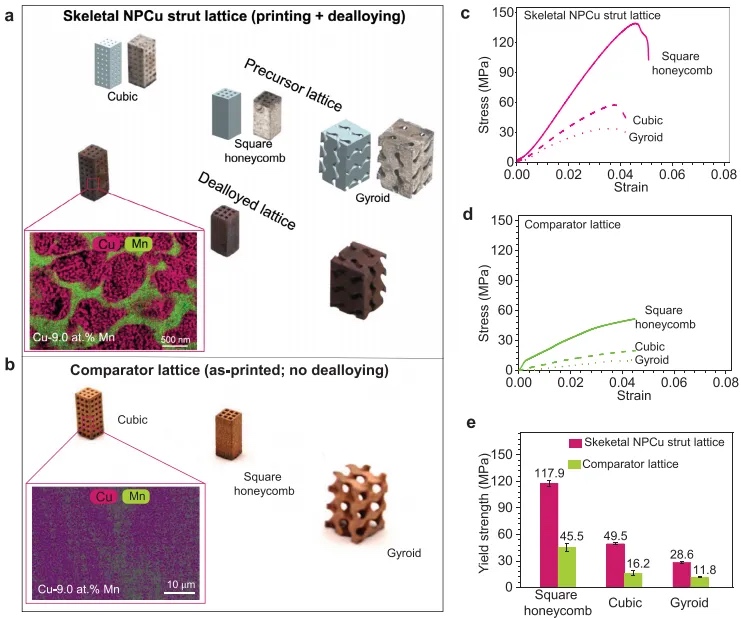
Figure 5 demonstrates the mechanical performance advantages of skeletal nanoporous copper in macroscopic lattice structures. Panel (a) presents the CAD design of the sample and a photograph of the as-fabricated specimen, showing that the research team successfully constructed a lattice structure with a skeletal-nanoporous hierarchy by combining additive manufacturing and selective dealloying processes. A locally magnified micrograph further reveals the hierarchical characteristics where the skeletal phase and nanoscale ligaments coexist. Panels (c)-(d) compare the stress-strain responses of the two types of lattices under uniaxial compression. Although their deformation modes are similar, the skeletal lattice exhibits a significant strength advantage, with a yield strength 2.4–3.1 times higher than that of the control lattice, indicating the critical role of the skeleton in enhancing macroscopic load-bearing capacity. Panel (e) further summarizes the strength differences among various lattice types. Notably, the square honeycomb lattice made of skeletal nanoporous copper performs exceptionally well, exhibiting a strength not only 800% higher than the theoretical model but also a specific strength surpassing that of the corresponding dense Cu–Mn alloy.
Figure 5. Mechanical performance advantages of the skeletal nanoporous copper lattice.
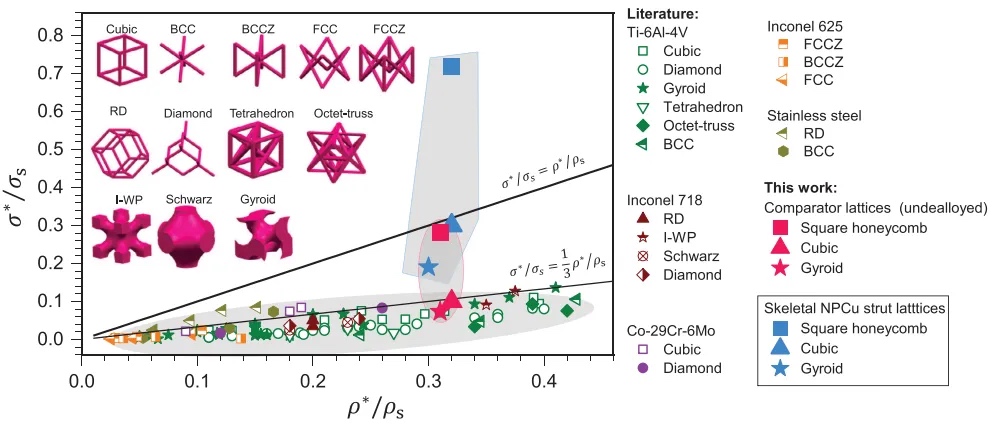
Figure 6 further reveals the "performance transcendence" of the skeletal nanoporous copper lattice in mechanical properties. This figure compares the experimental results with the classical Gibson-Ashby model, an empirical scaling relation used to evaluate the mechanical properties of porous metals. The model predicts a power-law relationship between yield strength and relative density, and most traditional metal lattice structures (including the control lattice in this study) fall on or below this theoretical curve. However, it is clearly observed that the data points for the skeletal nanoporous copper lattice lie far above this curve. This indicates that its strength-density relationship has broken through the conventional scaling law, no longer constrained by the inherent conflict where "increasing porosity leads to declining strength." Instead, it achieves exceptional high strength while maintaining low density.
Figure 6. Mechanical performance comparison between the skeletal nanoporous copper lattice and existing lattice structures.
Summary: Inspired by the architectural philosophy of "Hakka Tulou," this study proposes and realizes a novel design for skeletal nanoporous copper. By integrating additive manufacturing with selective dealloying, the research team constructed a hierarchical "skeleton-compartment" architecture within the material, comprising a non-dealloyable Cu-rich skeleton and a nanoporous matrix. Systematic characterization confirms that this structure effectively suppresses ligament coarsening and significantly enhances load-bearing capacity. Experimental results demonstrate a 62% increase in yield strength and a 70% increase in peak strength compared to non-skeletal structures, with a specific strength exceeding 60 MPa·cm³·g⁻¹. This performance surpasses not only traditional nanoporous metals but also some specially designed porous systems. Further validation at the lattice scale shows that the skeletal nanoporous copper lattice exhibits 2.4–3.1 times higher strength than the control group, even exceeding the empirical limits of the Gibson-Ashby model. This achieves an optimal combination of low density, high strength, and multifunctionality. The work not only addresses the long-standing "high porosity–low strength" dilemma in nanoporous metals but also opens new avenues for developing lightweight materials that integrate functional and structural properties.

Source: https://doi.org/10.1002/adma.202503701


©2025 3dptimes.com All Rights Reserved