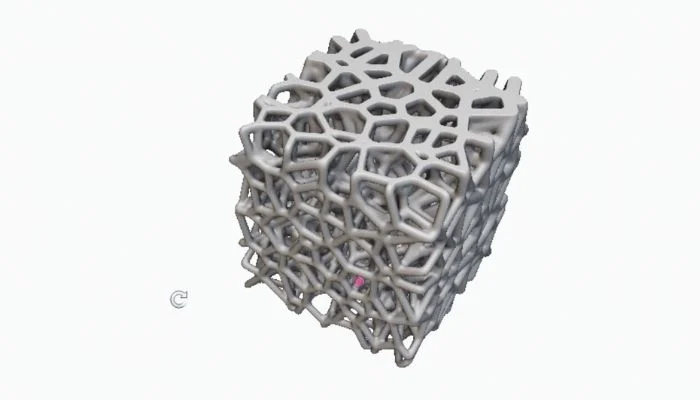
3D-printed biodegradable bone scaffolds, using stochastic lattice structures, mimic natural bone's strength and porosity to promote tissue regeneration and reduce follow-up surgeries.
Bones are deceptively complex. They are lightweight, porous, and strong—a combination that has long posed a challenge for engineers and clinicians attempting to replace or repair them. Metal implants and bone grafts remain standard solutions, but they rarely behave like real bones once inside the body.
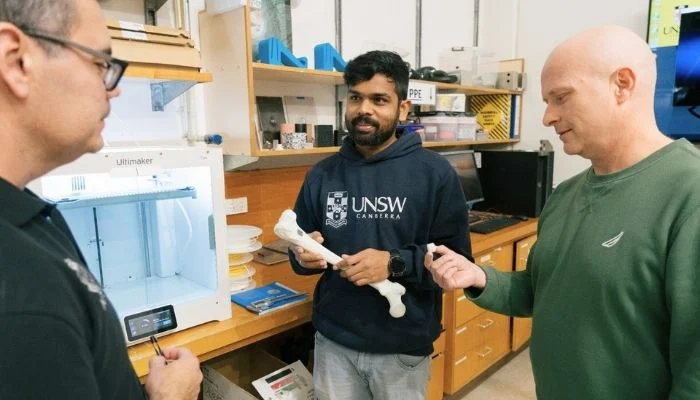
Researchers at UNSW Canberra are exploring whether 3D printing can help bridge this gap. Their work focuses on biodegradable bone scaffolds designed to better match the internal structure and mechanical response of bone, rather than simply filling a defect.
Moving Beyond Uniform Scaffold Designs
The team has developed 3D-printed scaffolds that replicate key features of natural bone, including its strength and porosity. Once implanted, these structures act as temporary supports, allowing new tissue to form before gradually dissolving. In theory, this could reduce the need for additional surgeries.
A major difference lies in the scaffold design. Instead of using uniform, repetitive patterns, the researchers turned to stochastic lattice structures. These irregular architectures more closely resemble bone, whose density varies depending on location and function. The scaffolds were printed using PLA (polylactic acid), a biodegradable polymer already widely studied for medical applications.
Testing Strength Under Realistic Conditions
To assess performance, the team printed scaffolds with different internal orientations—longitudinal, transverse, and diagonal. Mechanical tests showed that the structures performed better under sudden impacts than under slow, steady loads. Fracture behavior also varied with orientation, suggesting that internal architecture plays a more important role than previously thought.
“Under rapid loading, the material behaves in a more brittle manner, but it also absorbs energy more efficiently. This is particularly important for real-world scenarios such as falls or accidents,” explained Kaushik Raj Pyla, the study’s lead author.
Why Blood Flow Matters for Healing
Mechanical strength, however, is only part of the equation. The researchers also examined how fluids flow through the scaffolds—a crucial factor for healing. Blood and nutrients must be able to circulate freely to promote cell growth and regeneration.
“We found that certain designs performed particularly well in terms of strength and fluid circulation. This suggests implants can be tailored according to the stresses experienced by different bones,” added Pyla.
The scaffolds are not yet ready for clinical use, and further biological testing and regulatory work will be needed. Nonetheless, the results indicate that more patient-specific approaches could be adopted for bone repair. As medical additive manufacturing advances, studies like this highlight that design choices can be just as important as material selection.