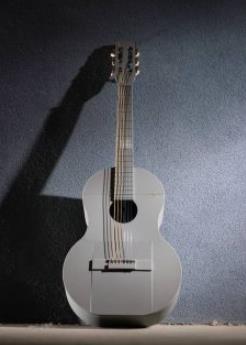
A Binghamton University student built a working 3D-printed acoustic guitar, inspired by his father's old instrument.
A mechanical engineering student from Binghamton University in New York state has created a functional 3D printed acoustic guitar using a desktop 3D printer from Prusa Research. The project began when student Timothy Tran found his dad’s old guitar in the attic and decided that rather than trash it or try to fix it, he’d follow the third path of making a new one.
“I saw it broke and I said, ‘I can make a new one for you,’” Tran explained. “I decided it would be a good thing to just try.”
In this personal project, Tran worked with William E. Schiesser, a lecturer at the university’s School of Computing, who provided guidance throughout the guitar’s development, helping him through various trials and challenges, particularly in the design stage. For instance, it took Tran several weeks to lock down the exact dimensions of his father’s old guitar to ensure that the final print would be a faithful reproduction.
Once the initial design was complete, the next step was to create a 3D model in Fusion 360 software and prepare it for 3D printing. In this preparation process, Tran had to subdivide the 3D model into separate sections so that they could be printed on a compact desktop 3D printer. For example, the fret board had to be printed in two pieces, while the back is made up of six pieces and the front plate is five pieces assembled together. To facilitate assembly post-printing, Tran integrated special connecting plates into the pieces so that they could be easily put together using a press-fit method.
“Putting it together was pretty easy. It only took one or two days,” he explained. “It was more just waiting for the glue to dry. The longest part was probably just waiting for parts to print. Bigger pieces might take six or seven hours to print.”
The acoustic guitar parts were all 3D printed on a Prusa MK4 3D printer, a desktop machine from Prusa Research with a build volume of 250 x 210 x 220 mm. The company has since released an updated version of this 3D printer, the MK4S, which features upgrades like 360° cooling, a high-flow nozzle, and a new app for remote monitoring.
At this stage, Tran has successfully created a playable acoustic guitar, however, there are still some elements that require finessing. For instance, he says that the action (i.e. the height of the strings above the fret) is a bit too high and thus goes out of tune faster than a traditional acoustic guitar. This is a problem Tran hopes to solve in a second prototype.
“I’m just trying to figure out a way to make the neck piece a little more uniform, and how to get the action lower,” Tran elaborated. “Just to get it to a more playable feel, because right now this is pretty tough to play. It doesn’t feel that comfortable.”
Looking forward, Tran and Schiesser hope that their 3D printed acoustic guitar will make the instrument more accessible to those looking to play. The guitar, which uses just a spool and a half of filament and required strings and tuning pegs, costs in the range of $25 to $30. In other words, they hope to make the design and print instructions open-source so that anyone can print it.
“If it were to become something really successful, I want it to be just something that can be free access for everyone,” Tran said. “Growing up, we didn’t have that much money … so if it’s just something that’s easy and accessible for people who need it, I think that’d be really cool.”
The acoustic guitar is far from the first 3D printed guitar ever made, but it is worth noting that most printed guitars we see are of the electric variety. Professor Olaf Diegel has been a pioneer of 3D printed electric guitars, having designed some truly impressive instruments, including a Beatles-inspired bass guitar and a 3D printed wood guitar. Recently, he launched his very own custom 3D printed guitar shop, ODD Guitars.