From consumer-grade to industrial-grade, Revopoint has taken another crucial step.
Over the past decade, 3D scanning technology has evolved from "marker-based targeting" to "intelligent tracking." Traditional scanners required attaching markers to objects for positioning, a process that was cumbersome and limited by the scenario. Now, with advancements in optical positioning, infrared tracking, and SLAM algorithms, tracking-style 3D scanners have emerged.
These scanners use an external positioning system to capture the scanner head's position and orientation in real-time, enabling free scanning without markers and real-time tracking, significantly improving efficiency and flexibility. However, constrained by high costs, this technology long remained in the professional high-end market.
Recently, Xi'an Revopoint Technologies Co., Ltd. launched the Revopoint Trackit, bringing the price down to under 50,000 RMB while delivering an experience comparable to equipment that previously cost over 100,000 RMB. This move brings 3D digitization from the laboratory to more application scenarios and signals the popularization of tracking scanning.
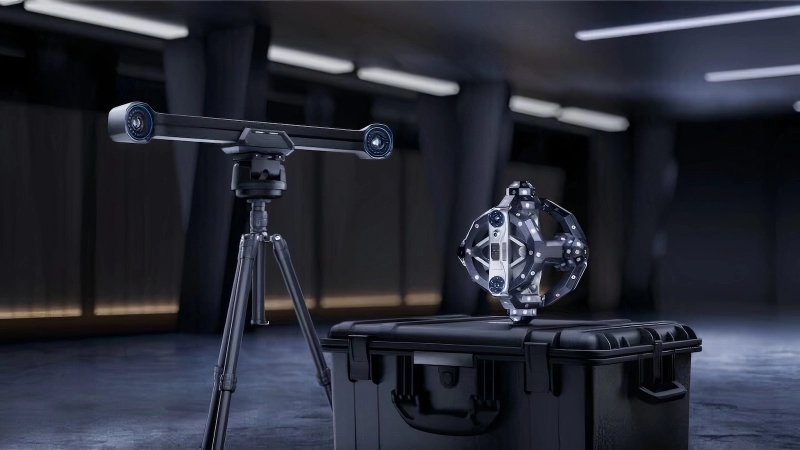
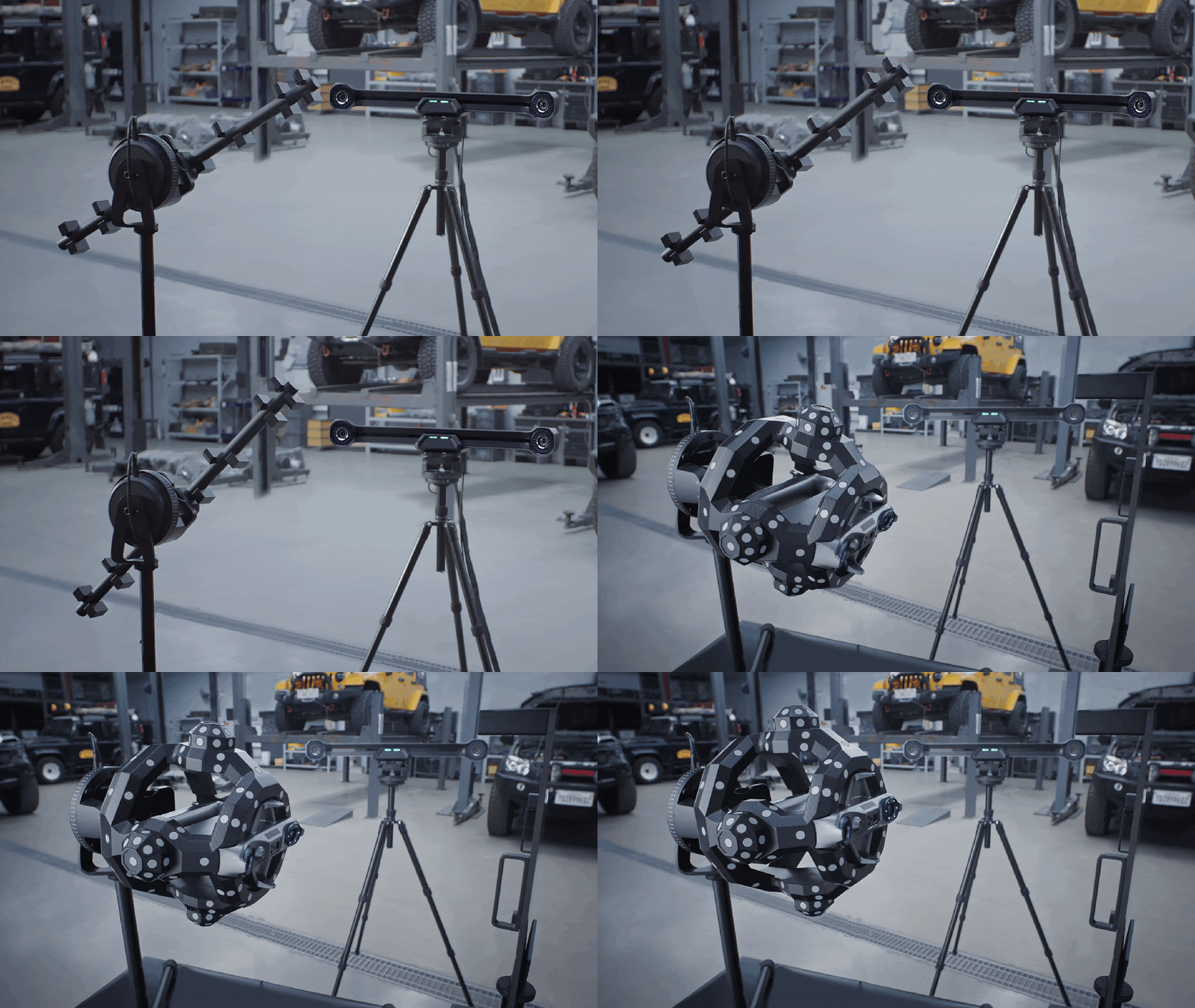
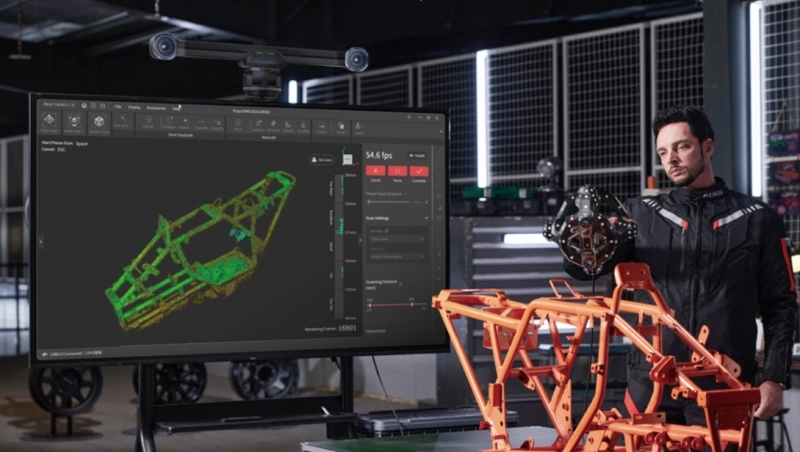
Reportedly, Trackit is Revopoint's first self-developed tracking 3D scanner, consisting of a high-precision 3D scanning unit (Scanner) and an optical tracking sensor (Tracker). This system targets the scanning and measurement of industrial-grade precision components. It can quickly acquire complete 3D data of an object's surface without needing markers, achieving efficient, precise, and intelligent digital capture.
1. No Markers Needed, Halving Scan Preparation Time
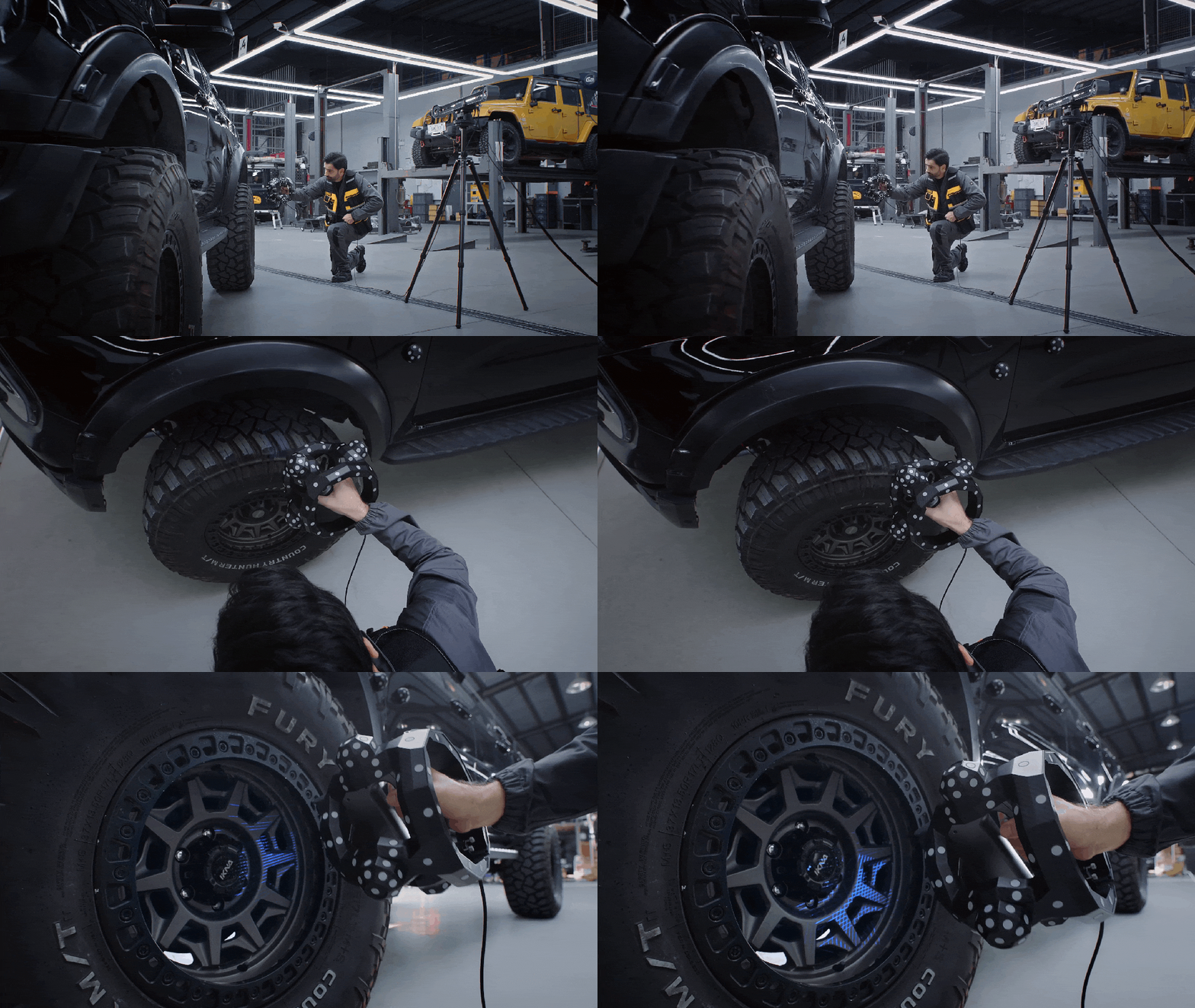
Traditional scanning required attaching numerous markers beforehand, which was not only time-consuming but also prone to shifts or detachment on curved or reflective surfaces, affecting accuracy. Trackit employs intelligent optical tracking technology, capturing the scanner head's spatial position in real-time without markers, enabling high-precision, marker-free scanning.
Coupled with global coordinate control and error compensation algorithms, it maintains stable accuracy even on large workpieces. Its binocular optical base stations have a maximum working distance of 4 meters, covering an area up to 3260×2845mm. The integrated carbon fiber body keeps the scanner weight at just 1.2 kg.
2. Dual-Mode Scanning & Multi-Purpose Use
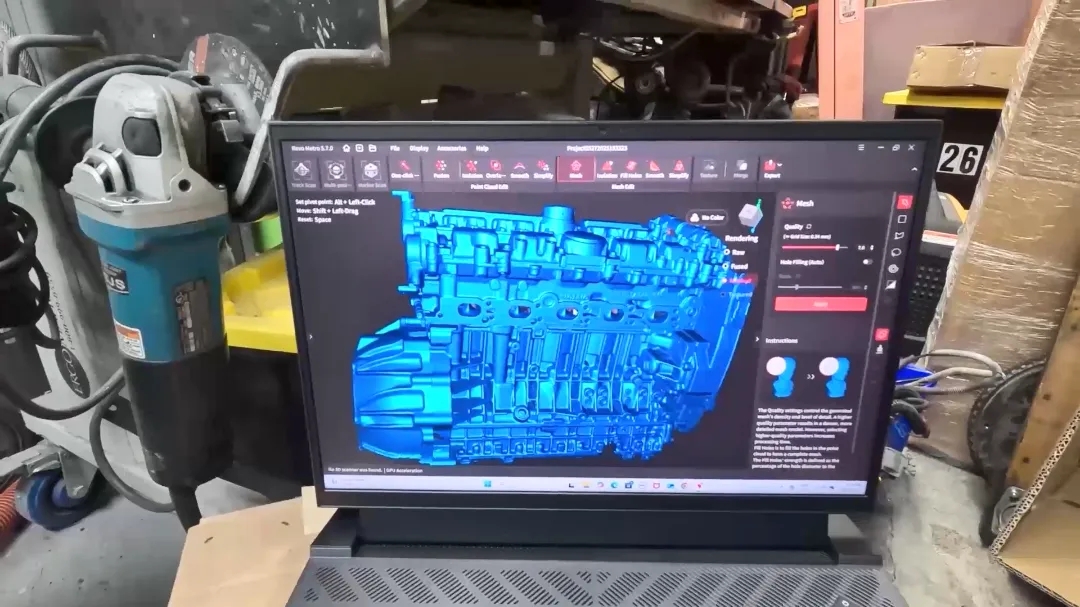
The Revopoint Trackit supports switching between two modes, easily handling challenging conditions like black or reflective surfaces and deep holes. The 30-beam blue cross-line laser mode is suitable for large targets like entire vehicles or large molds, efficiently capturing dark and reflective materials. The single-line laser deep hole mode is designed for detailed areas like holes and grooves, easily reproducing structures such as engine blocks and bearing housings, truly achieving "clear vision and complete scanning."
Furthermore, the Scanner unit can be used independently as a handheld scanner, offering flexibility for confined spaces, complex structures, or scenarios where setting up the Tracker isn't feasible, further expanding the equipment's applicability and operational freedom.
3. Smart Calibration & High Accuracy, "Ready-to-Use Out of the Box"
The Trackit features an intelligent automatic turntable calibration system that quickly performs calibration across 200+ positions and orientations, optimizing global accuracy. Users can quickly start working without complex operations, truly saving effort, time, and hassle.
The system's volumetric accuracy reaches 0.02 mm + 0.04 mm/m × L(m), with single-frame accuracy up to 0.02 mm, and it has passed CNAS industrial-grade certification. Whether capturing tiny structures with high precision or performing overall inspection of large molds, it provides stable and reliable data support.
It's worth noting that Revopoint has not only refined the hardware but also provides comprehensive, integrated software solutions.
Their self-developed Revo Trackit software integrates scanning, editing, processing, and calibration, supporting output in various mainstream model formats including STL, covering the complete scanning workflow. The optional Revo Design software efficiently converts scan data to CAD models, supporting mesh editing and reverse modeling. The upcoming Revo Measure software will provide high-precision measurement and error analysis, enhancing dimensional assessment and model comparison efficiency, further expanding industrial application scenarios.
Of course, a product's true excellence depends not just on the manufacturer's claims but also on real user feedback from practical applications.
Case 1: Replicating a Classic Car, Full Vehicle Scan in 40 Minutes
A user recently shared their experience using Trackit to scan a vintage Volkswagen Karmann Ghia.
Without needing any markers, they completed the scan of the entire vehicle body in just 40 minutes. Details like the roof curvature and smooth door surface transitions were accurately captured, with seamless stitching between the matte paint and chrome trim.
Using the 30-beam blue laser mode, the fan blade contours were captured in 3 minutes. After switching to the single-line laser mode, the deep grooves and bolt holes of the engine block were accurately identified, with complete data acquired in 15 minutes, demonstrating excellent stability.
The user stated: "Traditional scanners require markers, which is slow and can risk damaging the paint. The Trackit is completely marker-free, and the replicated parts are almost identical to the originals."
Case 2: Accurately Capturing Engine Details, Saving Two Hours
A sports car modification engineer shared his practical experience scanning an engine block. Previously, using traditional equipment, capturing deep groove details was challenging and inefficient. After adopting Trackit, using the single-line laser mode, tiny structures like the inner walls of spark plug holes were clearly visible. Combined with the 30-beam blue laser mode, high-precision modeling of the entire engine bay was completed in just 25 minutes.
He said: "The Trackit's automatic calibration saves effort and worry, and the data can be directly imported into CAD. It saves at least two hours compared to before, greatly improving efficiency."
Of course, Trackit's applications extend far beyond these examples.
In Automotive: It can scan entire vehicle components, like a Ford Mustang's air filter housing, for rapid modeling and structural inspection.
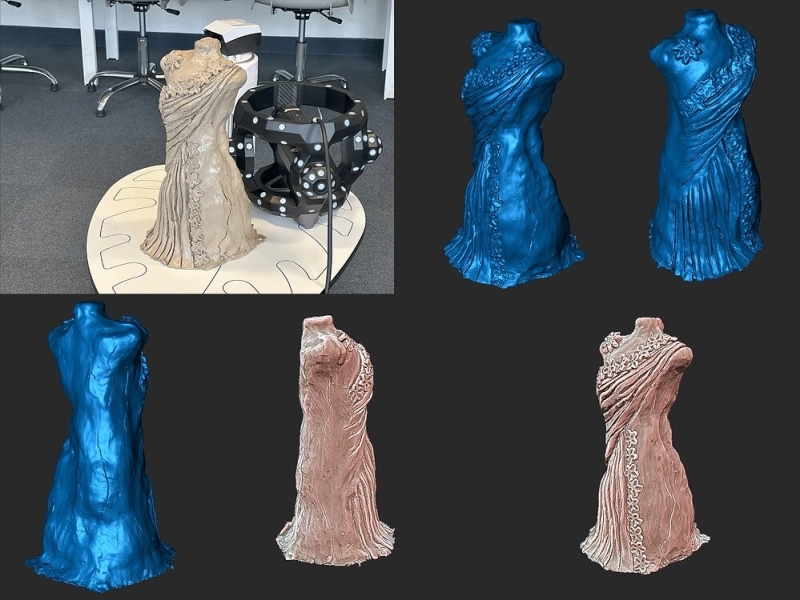
In Cultural Heritage: Artists and research institutions often use it to scan sculptures and artifacts for digital preservation and recreation.
In Healthcare: It can precisely capture human bones and organs, providing data support for rehabilitation aids and personalized medical solutions.
In Art Reproduction: Trackit can also reproduce the texture and color of oil paintings using color texture mapping, enabling high-fidelity digital display.
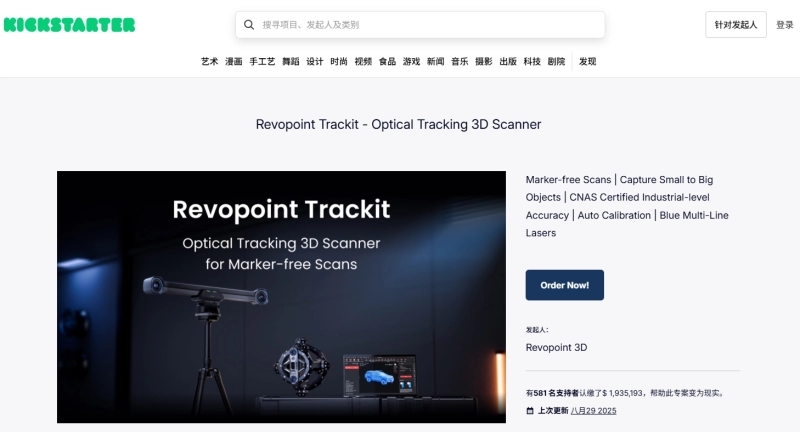
Another point to add is that after the Revopoint Trackit was launched on the overseas Kickstarter crowdfunding platform, it received an enthusiastic response. The project quickly exceeded its funding goal and finished with a total of $1.93 million USD (approximately 13.85 million RMB), fully demonstrating its recognition and appeal in the international market.
Finally, in the field of 3D scanning, "marker-free" has become an inevitable trend. However, truly popularizing it has always hinged on the price barrier. Now, Revopoint has made another strategic move, helping 3D scanning transition from a "professional tool" to being "accessible to everyone."