Home  >  News

November 7, 2025      News      10643

For deep space exploration, spacecraft require lightweight, complex, and durable components, but traditional manufacturing is constrained by gravity.

On November 7, 2025, it was learned that a research team led by Professor Chen Jimin from Beijing University of Technology (BJUT) has developed an innovative suspension 3D printing technology, named Zero-Gravity Shear-Induced Thermal Curing 3D Printing. With core advantages including support-free freeform fabrication, high material utilization efficiency, and multi-scenario adaptability, this technology is driving a comprehensive transformation in the aerospace sector—from ground-based manufacturing to in-orbit production, and from part fabrication to deep-space infrastructure development—providing a new manufacturing pathway for humanity's exploration of the universe.
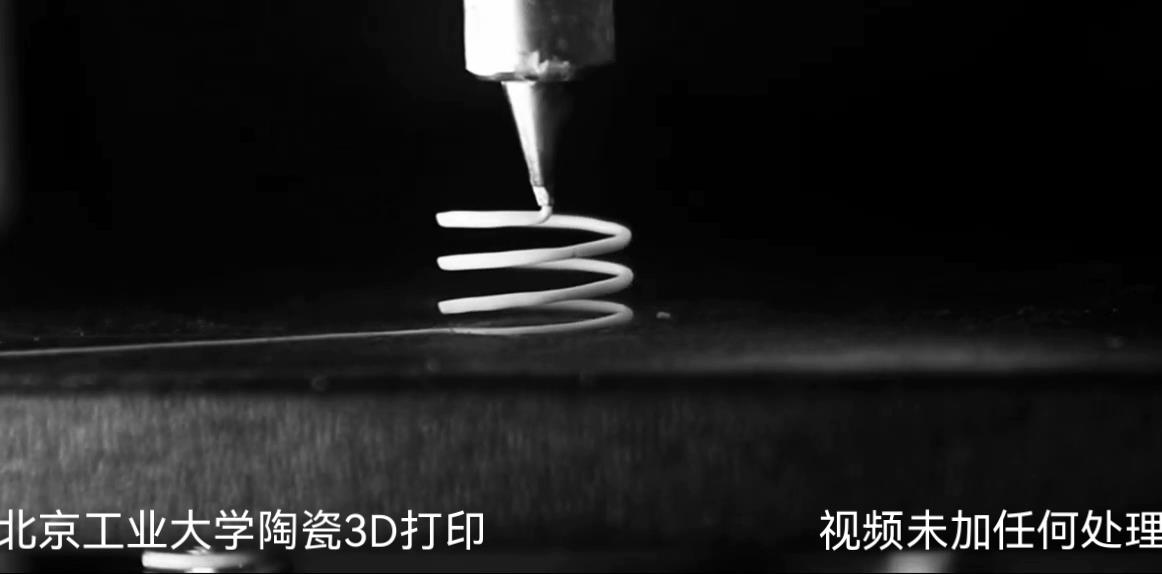
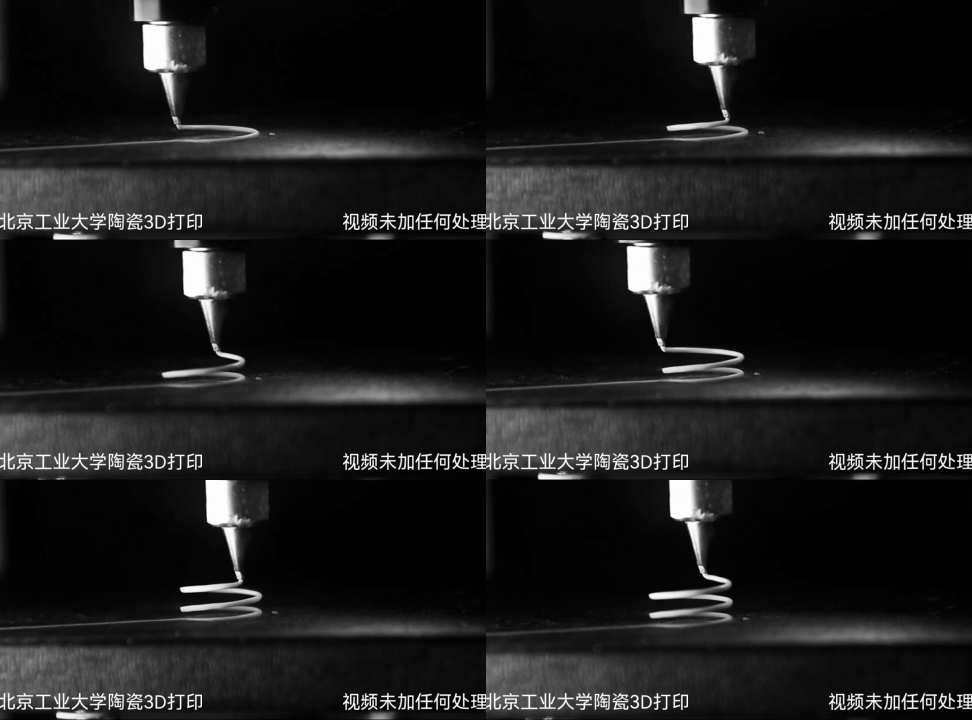
In a video, the printhead of a 3D printer was seen performing ceramic printing. The printed structure, resembling a spring, spiraled upwards. The printed object was created without any added supports, printed directly in mid-air, with no support medium surrounding the printhead.
Professor Chen Jimin from Beijing University of Technology stated: "The key lies in the design of the support-free medium and the shear-induced thermal curing mechanism. The 'suspension environment' simulates a zero-gravity effect, counteracting tensile deformation in complex structures and providing stable constraint for material deposition under space microgravity conditions, akin to creating an 'invisible scaffold' for the printed component. Furthermore, the shear heat generated during the extrusion of multi-component materials triggers instant curing, eliminating the need for additional heating equipment. This avoids safety risks associated with high temperatures in the space environment while simultaneously addressing the issue of weak interlayer bonding in traditional printing. This mode of 'medium constraint + spontaneous curing' liberates component shaping from gravitational direction restrictions. It enables the fabrication of large-scale structures while ensuring high precision. The printing size can be set based on the machine tool's travel range, whereas the printing precision depends solely on the nozzle diameter, achieving a perfect unity of large size and high accuracy."
The core challenges in aerospace manufacturing have always revolved around "gravity limitations" and "extreme requirements." In ground-based manufacturing, complex components often rely on intricate support structures, leading to material waste and loss of dimensional accuracy. In the space environment, the microgravity state causes uncontrolled flow in traditional printing materials, preventing stable. The innovative technical rationale of Zero-Gravity Shear-Induced Thermal Curing 3D Printing fundamentally resolves this dilemma.


©2025 3dptimes.com All Rights Reserved