
Home  >  Hardware

November 3, 2026      Hardware      By 3DPTimes Editors | November 3, 2026 | Sources: Bambu Lab launch announcement and technical briefings.      15

Launched November 3, the H3C combines nine ready-to-use tools, dual-diameter filament feeding and integrated material management. 3DPTimes examines the engineering benefits and the tests that will determine practical value.

The H3C’s nine-position tool rack. Manufacturer product image: Bambu Lab.

A printer built around material changes

Bambu Lab introduced the H3C on November 3, placing a nine-tool Swaptek system at the center of its desktop manufacturing platform. Each PrintTool has its own filament path and heating system, allowing materials to remain loaded between changes.

For 3DPTimes, the useful question is what this architecture lets a designer combine in one part: different polymers, support materials and nozzle diameters. The tool count describes capacity; the value comes from a workable combination of materials, geometry and process settings.

This also changes how a job should be evaluated. A multicolor display model and a functional part with flexible regions can impose very different demands on the same printer.

H3C with its top-mounted AMS 3H filament-management system. Manufacturer product image: Bambu Lab.

Read the six-second claim as a workflow measurement

Bambu Lab’s technical explanation describes a material change from printing with one tool to printing with the next in under six seconds. Active Pre-Heat reads ahead in the G-code and heats the incoming tool while the current tool is still working. A retractable rack manages the guide tubes during printing and presents the tools for docking.

Over a job with many changes, small differences in changeover time can accumulate. A useful independent benchmark should measure the complete job, including calibration, priming, travel and any recovery interruptions. Priming, startup routines and supports also belong in whole-job waste accounting.

The other test is repeatability: tool-offset accuracy, consistent first layers after changes and reliable docking across long prints. These are the measurements that would turn a fast demonstration into evidence of dependable operation.

Bambu Lab’s visualization of preheating the next tool while another is printing. The displayed 220°C is an illustrative setting. Image: Bambu Lab.
Flexible materials and mixed nozzles expand the design brief

FlexFeed supports 1.75 mm and 2.85 mm filament. Bambu Lab says dedicated 2.85 mm TPU can support materials as soft as 75A and deliver up to three times the flow rate of a conventional printer. That is a manufacturer flow-rate claim; finished-part time will also depend on the model and print settings.

The thicker feedstock addresses the difficulty of pushing very soft filament through an extrusion system. For product development, it creates an interesting route to flexible sections alongside more rigid features. Adhesion between materials, dimensional consistency and repeated deformation still need application-specific testing.

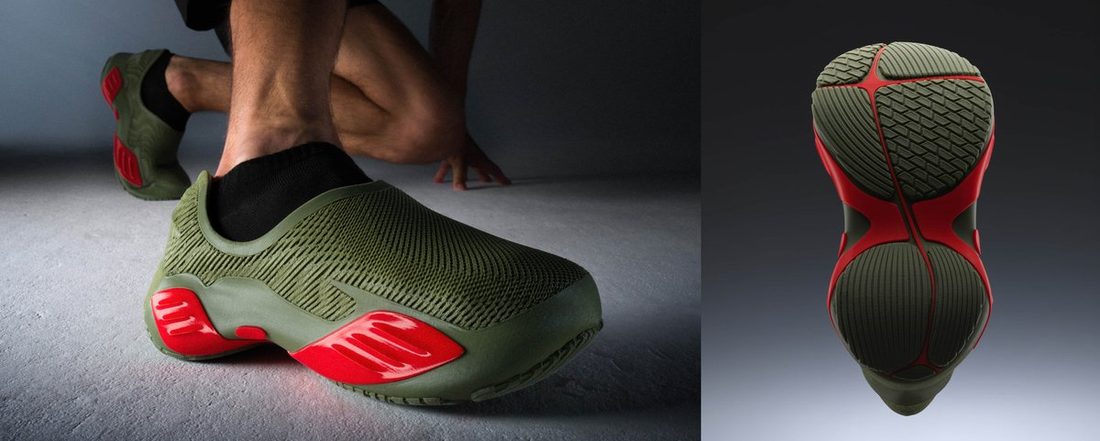
Mixed nozzle sizes offer a second route: reserve a fine nozzle for small details and use a larger one where geometry allows. Bambu Lab illustrates this with a printed watch combining fine dial features, a structural body and a flexible strap. Its footwear demonstrator suggests another application direction, without establishing footwear durability or production readiness.

Optional crafting tools extend the platform to cutting, drawing and debossing. Bambu Lab’s technical account says 3D printing and 2D operations currently use separate software environments, so they cannot yet be combined into a single job.

A footwear demonstrator illustrates combining flexible materials and different functional regions. Manufacturer application image: Bambu Lab.

Material handling, specifications and the production test

The integrated AMS 3H has nine feed positions and two dedicated drying slots, with a maximum drying temperature of 85°C. Bambu Lab describes drying during printing for supported configurations. Material conditioning therefore deserves attention alongside tool-changing speed.

Published specifications include a 330 × 320 × 325 mm build volume, nozzle temperatures up to 350°C, a bed up to 120°C and active chamber heating up to 65°C. These are equipment limits, rather than a shared process recipe for every polymer.

The November 3 launch announcement lists the printer with AMS 3H at US$2,499 before tax in the United States and €2,499 including tax in the European Union. Accessory and material bundles have separate prices.

3DPTimes would assess the platform through representative parts: dimensional results after repeated tool changes, inter-material bond strength, flexible-part consistency and the total cost of completing a good part. Those results would provide a stronger basis for comparison than a single headline speed.

Sources
Bambu Lab official launch announcement, November 3, 2026:
https://blog.bambulab.com/tool-changer-game-changer-bambu-lab-presents-h3c-the-defining-new-generation-of-3d-printers/

Bambu Lab, “SWAPTEK SYSTEM — how does it work,” November 3, 2026:
https://blog.bambulab.com/swaptek-system-how-does-it-work/

Bambu Lab, “What H3C brings to Makers,” November 3, 2026:
https://blog.bambulab.com/what-h3c-brings-to-makers/

Original editorial analysis: 3DPTimes. Manufacturer specifications and performance claims are attributed to Bambu Lab. Images: Bambu Lab product and application visuals. Sources reviewed November 3, 2026.


©2026 3dptimes.com All Rights Reserved