This is the first canal in China since the founding of the People's Republic that connects rivers to the sea under national-level coordinated construction. Ships of 5,000-ton class can now travel from the Xi River directly to the Beibu Gulf.
Behind this milestone, one 3D printing technology played a key role.
The Madao hub on the Pinglu Canal holds three world records for an inland water-saving ship lock: largest under construction, highest water head, and fastest operating speed. A world-leading natural water head of 29.6 meters means a 70-ton giant valve must open in one minute, close in 30 seconds, and come to a smooth stop in the final 28 centimeters — making the buffer sleeve a critical bottleneck.
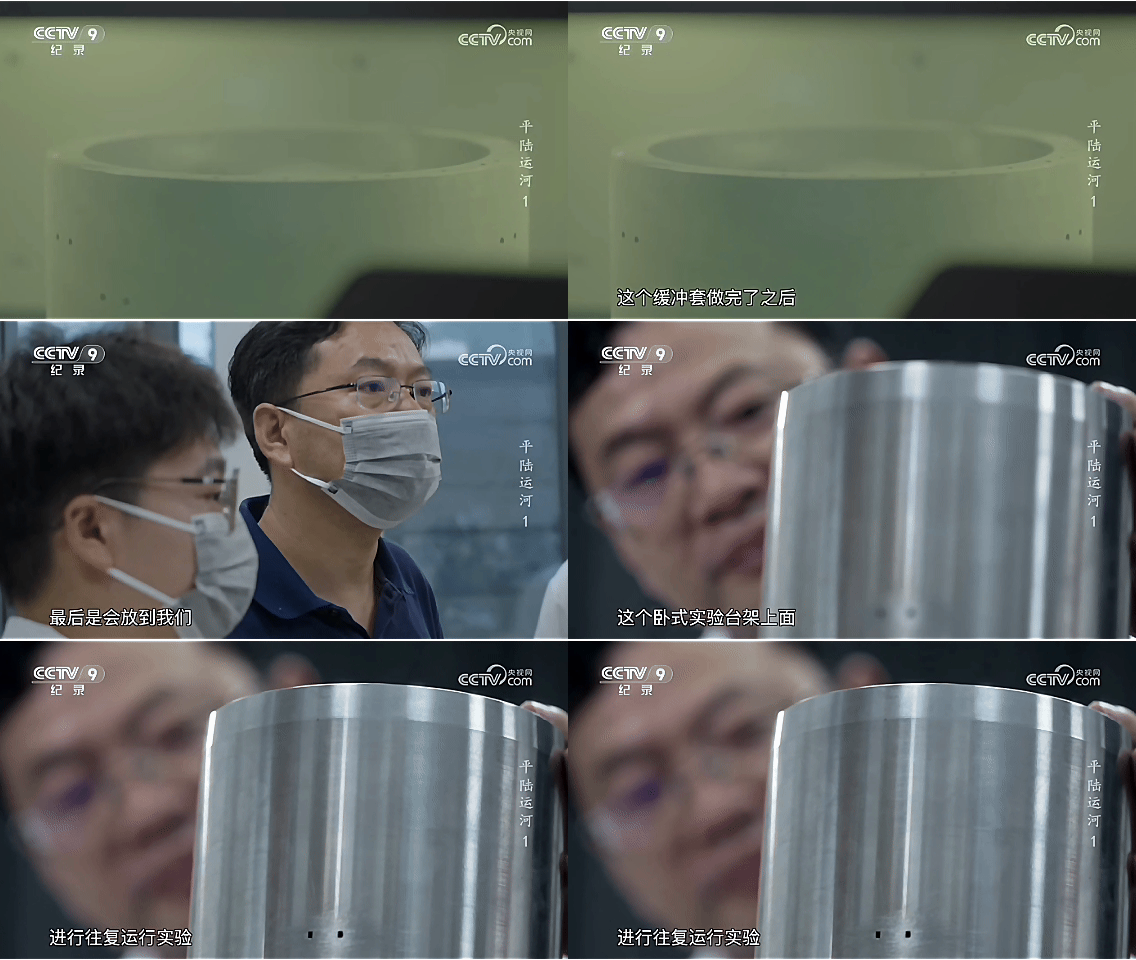
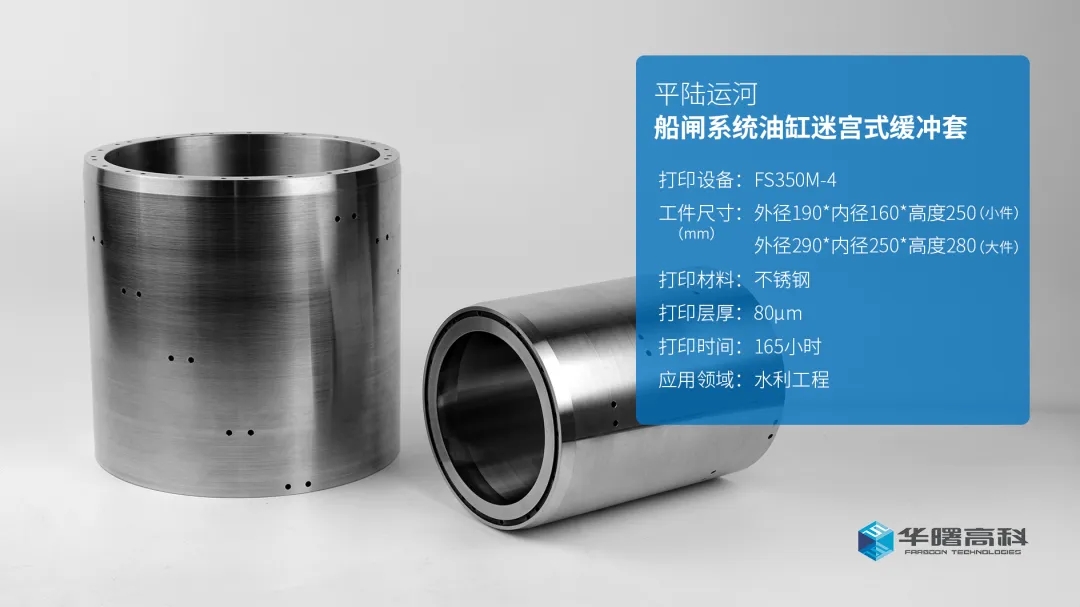
Traditional hydraulic buffer structures suffer from large pressure fluctuations and poor linearity, and they rely heavily on the fit clearance between components. Once machining errors appear, repeated adjustments become necessary. The labyrinth-style buffer sleeve designed for high-speed operation has complex, winding internal flow channels that cannot be produced by turning, milling, casting, or forging.
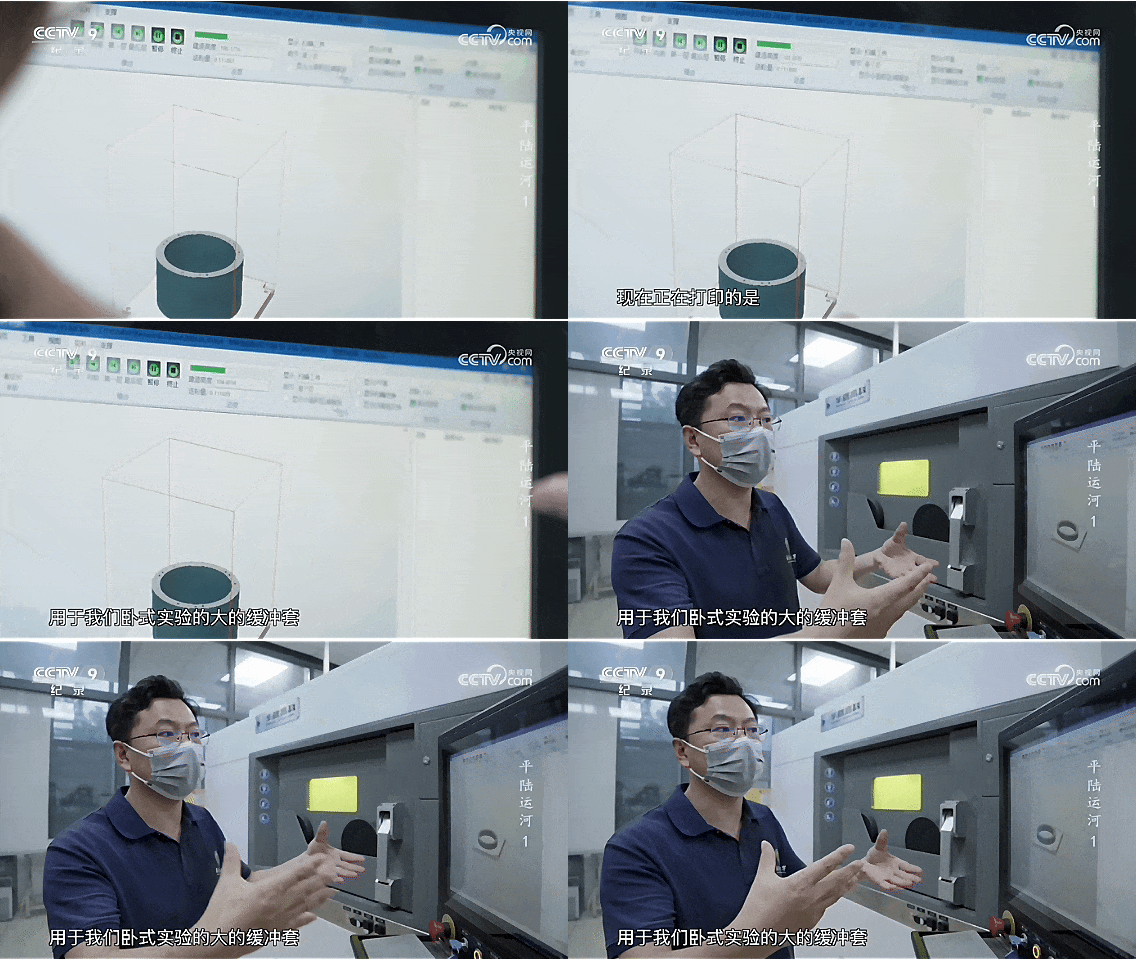
Professor Chen Yun's team at Wuhan University of Technology took a different approach: using an Farsoon 4-laser FS350M system, they continuously printed two specifications of labyrinth-style buffer sleeves in 165 hours as a single integrated piece. The technology passed acceptance in 2025.
The results were straightforward: complex flow channels no longer require assembly, improving structural stability; dependence on fit clearance is reduced, so assembly no longer requires repeated fiddling; and development cycles are significantly shortened, keeping pace with the project schedule.
More critically, the real-world performance proved its worth. Precise flow channel control allows hydraulic oil to flow at high speed with smooth regulation. The 70-ton valve opens and closes at high speed, while the final 28 centimeters achieve a "gentle brake" through mechanical buffering inside the cylinder — no additional hydraulics or motor frequency control needed, avoiding impact wear.
This marks the first application of metal 3D printing to a core component of a ship lock cylinder in hydraulic engineering. From canals to major national infrastructure, additive manufacturing has expanded its boundaries once again.