Researchers demonstrated biodegradable printed circuit boards made with zinc, offering up to 79% lower global warming potential and 90% less resource depletion than conventional designs
Researchers at the University of Glasgow have developed a new type of biodegradable PCB that could significantly reduce the environmental footprint of electronic waste. The innovation uses a zinc-based additive manufacturing process to print electronic circuits on environmentally friendly surfaces such as paper and bioplastics, with almost all materials recoverable or compostable at end of life. Their work was published in Nature’s Communication Materials journal.
Biodegradable electronics
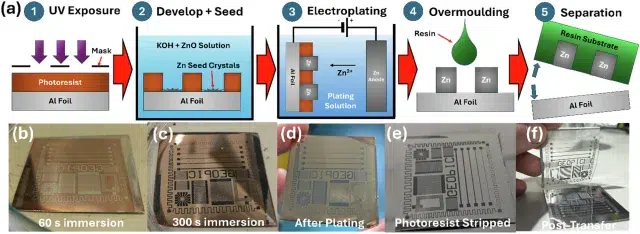
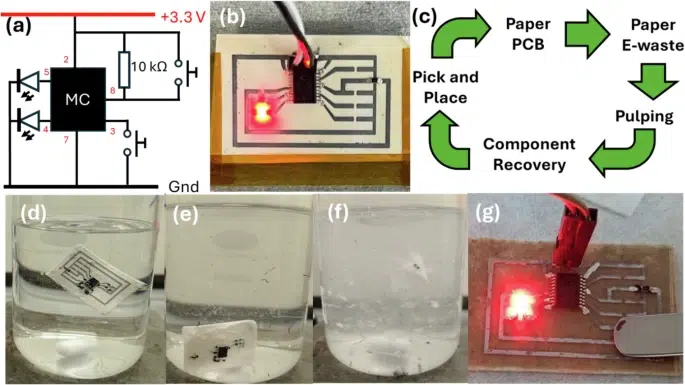
The research team’s process, described in Communications Materials, replaces traditional copper conductors with zinc and uses a “growth and transfer additive manufacturing” method. Conductive zinc tracks just five microns wide are first electroplated onto a temporary carrier, then transferred onto a biodegradable substrate. Once the circuits are no longer needed, 99% of their materials can be safely composted in soil or dissolved using common chemicals such as vinegar.
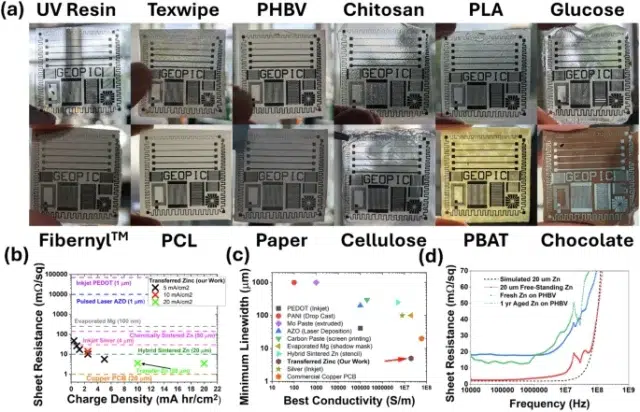
Testing showed that the circuits perform comparably to conventional boards and remain stable for more than a year under ambient conditions. The researchers demonstrated their use in devices including tactile sensors, LED counters, and temperature sensors.
electronicsEnvironment-first
A life cycle assessment comparing the biodegradable boards with conventional PCBs found that the new method could cut global warming potential by 79% and resource depletion by 90%. These findings point to substantial sustainability gains for industries dependent on short-lived or disposable electronics.
Dr. Jonathon Harwell, first author of the study and researcher at the University of Glasgow’s James Watt School of Engineering, said the work represents “a major step toward circular electronics, where devices are designed from the outset for reuse, recycling, or safe degradation.” He added that with tens of millions of tonnes of e-waste generated annually, the technique could benefit sectors ranging from consumer electronics to Internet-of-Things (IoT) devices and disposable sensors.
Professor Jeff Kettle, corresponding author and also of the James Watt School of Engineering, noted that the process can be adapted for a wide range of substrates. “Almost any material can be used, from paper and bioplastics for practical applications to chocolate for more playful demonstrations,” he said. The team is now exploring potential uses in moldable electronics and biosensing.
Circular circuitry
The project forms part of the University of Glasgow-led Responsible Electronics and Circular Technology Centre (REACT), one of five UK Green Economy Centres supported by more than £6 million ($7.6 million) in funding from UK Research and Innovation (UKRI). The Centre focuses on developing sustainable approaches to electronics manufacturing, processing, and recycling through complementary research and industry collaboration.
The study, titled “Additively manufacturing printed circuit boards with low waste footprint by transferring electroplated zinc tracks,” was funded by UKRI and the Engineering and Physical Sciences Research Council (EPSRC).