Home  >  Materials

October 4, 2025      Materials      177

Tiangong University researchers developed a fiber-scale material twin model that accurately simulates 3D stitched composites' mechanical behavior and damage process.

1. Introduction

3D stitching technology is a key manufacturing process for composite fiber preforms. By introducing continuous through-thickness yarns via stitching, it significantly enhances the composite's delamination resistance and overall mechanical properties. However, the puncture of the stitching needle and the introduction of the stitching thread cause the fiber architecture of the layered fabric to rearrange, forming stitch holes of various complex shapes. Current numerical models for 3D stitched composites are mostly established at the meso-scale, involving significant simplifications of the real fiber architecture. This makes it difficult to accurately reflect the complex fiber structural characteristics at the stitch region and fails to meet the requirements for high-precision simulation modeling. Developing a simulation model that can precisely reconstruct the stitched structure at the fiber scale and accurately predict the composite's mechanical properties has become a major challenge in 3D stitched composites research. Recently, the "Journal of Manufacturing Processes" published the latest research findings from the team at the Advanced Composites Research Institute of Tiangong University, titled “Numerical simulation of 3D stitched composite based on novel fiber-scale material twin modeling approach”. This research employed a Virtual Fiber-Embedded (VFE) method to successfully construct a fiber-scale "Material Twin" model for 3D stitched composites, achieving high-precision simulation of the entire process from preform manufacturing to composite damage and failure.

2. Content Summary

The core innovation of this research lies in establishing a fiber-scale "Material Twin" model. The technical approach primarily consists of two main parts: preform stitching process simulation based on Virtual Fibers, and composite material modeling using the Virtual Fiber Embedded (VFE) method.

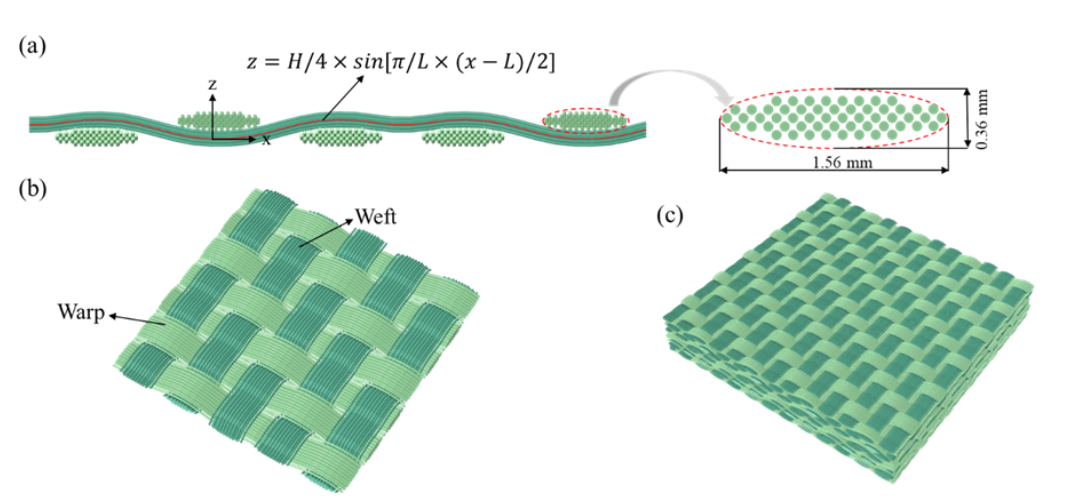
First, virtual fibers were constructed to simulate the mechanical behavior of quartz fibers. These virtual fibers were bundled into yarns and woven into virtual fabric according to the weave pattern of the layer fabric. Then, the processes of layer stacking, stitch puncture, and stitching thread insertion were simulated, achieving a full-process simulation of the stitching procedure. This process realistically reflects complex microstructural variations such as yarn path changes, cross-sectional deformation, and interlayer nesting effects, resulting in a high-fidelity geometric model.

Figure 1. Geometric model of the twill weave fabric.
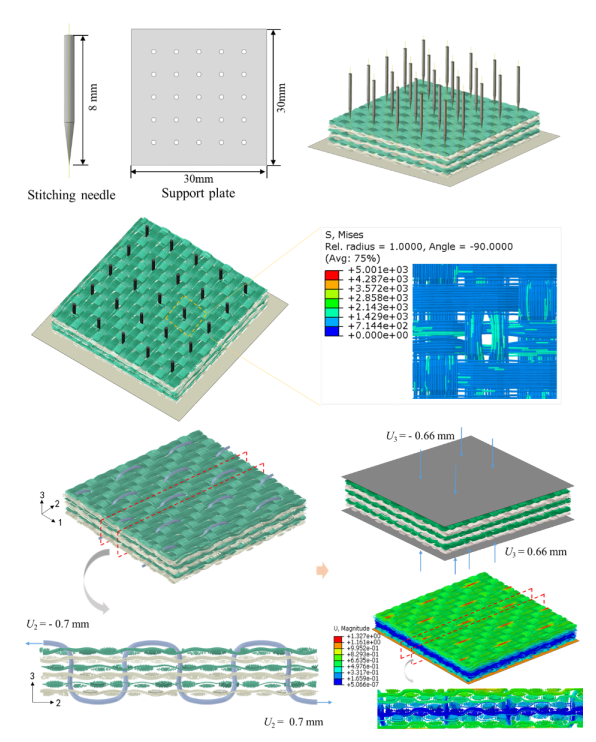
Figure 2. Numerical simulation of the stitching process.
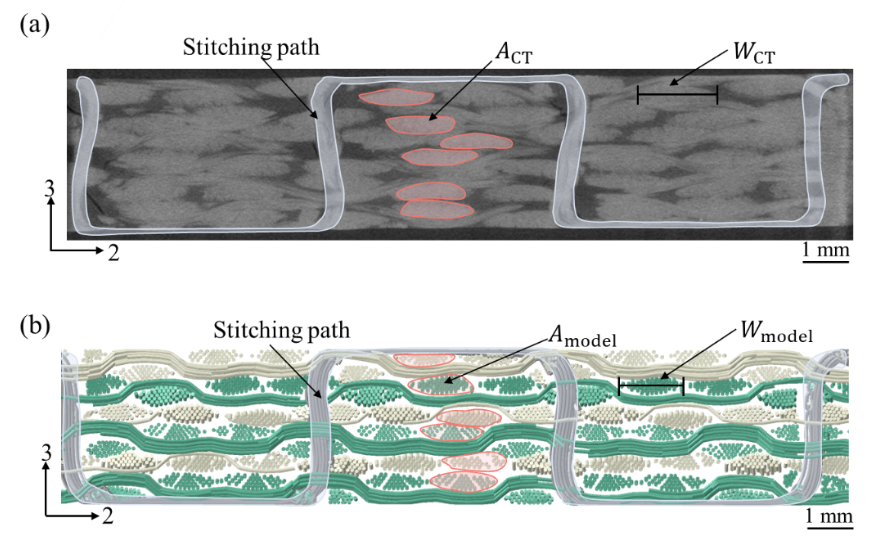
Figure 3. (a) Micro-CT image and (b) geometric morphology of the stitching yarn in the virtual fiber model.
Figure 4. Comparison of geometric parameters from Micro-CT results and the virtual fiber structure.
A quantitative statistical analysis of the virtual fiber model was conducted using Micro-CT scans. The results showed that the error between simulated and experimental values for key geometric features—including yarn cross-sectional area, width, stitching thread path, and fiber orientation distribution—was less than 5%, fully demonstrating the reliability of the fiber-scale twin model.

To address the modeling challenges of composites with complex fiber architectures, the VFE method was used to embed the virtual fiber structure into a voxel mesh of the matrix material, avoiding cumbersome geometric modeling and meshing. A VFE unit stiffness correction method was proposed, which accurately corrects the longitudinal and transverse stiffness properties of the embedded units by modifying the elastic parameters of the matrix units, ensuring the computational accuracy of the model.

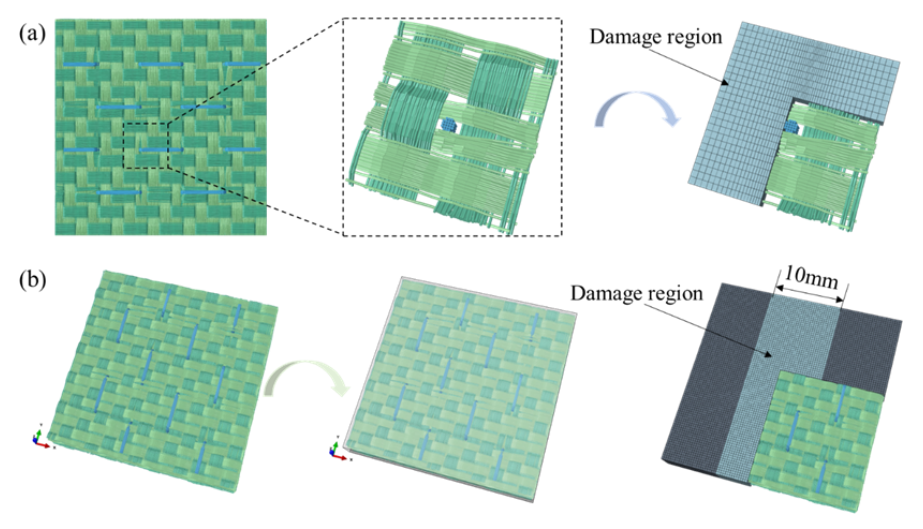
Figure 5. VFE model of the 3D stitched composite: (a) Single-layer RVE model and (b) Full-scale model.
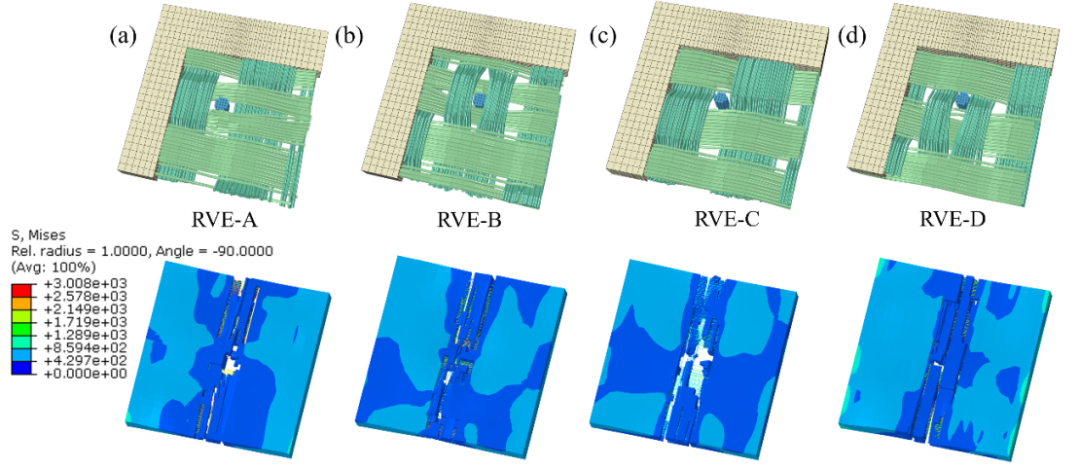
A multi-scale analysis model was constructed. Four single-layer Representative Volume Element (RVE) models (RVE-A to RVE-D) were used to characterize the local mechanical behavior at different stitch locations. Furthermore, a full-scale model (25 mm × 25 mm × 3 mm) containing a 4×4 array of stitch points was established to simulate the tensile damage and failure process of a full-scale mechanical specimen.
Figure 6. Tensile failure morphology of the single-layer RVE models.
The tensile simulation results of the full-scale model showed excellent agreement with experimental data. The prediction errors were 2.64% for tensile strength, 2.37% for Young's modulus, and 0.37% for failure strain. Simultaneously, the model accurately replicated the complete damage evolution process, from matrix cracking and crack propagation to fiber fracture. The simulated fracture morphology (crack width of 8.88 mm) was highly consistent with the experimental result (crack width of 9.72 mm), demonstrating the reliability of this method for predicting the damage behavior and mechanical performance of 3D stitched composites.
Figure 7. Simulation of the failure process of the 3D stitched composite under tensile load.
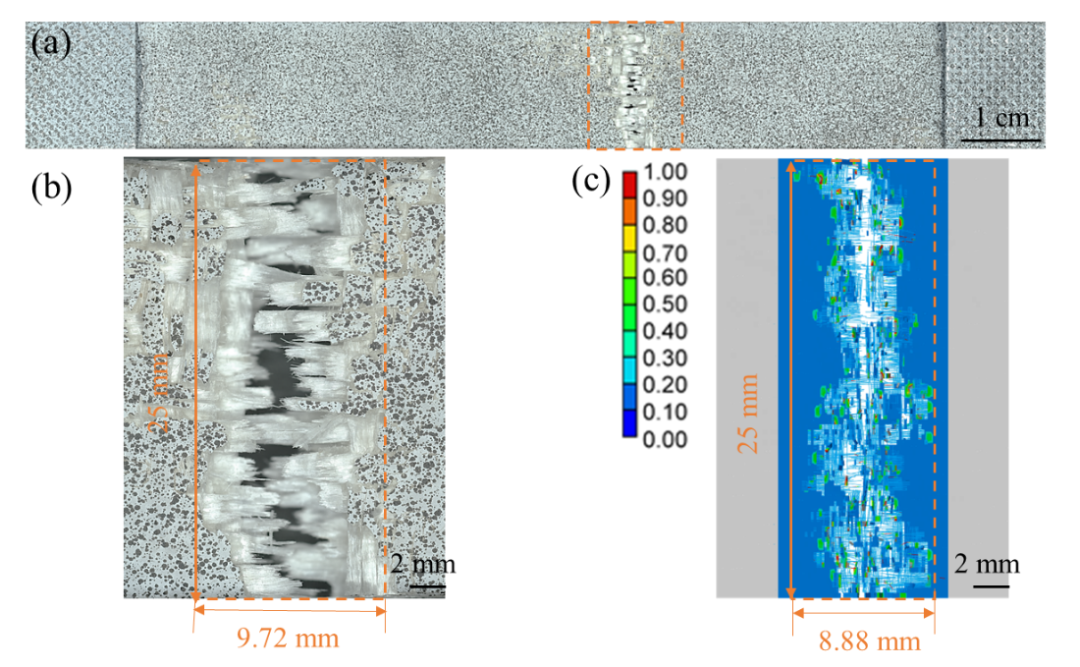
Figure 8. Comparison between the tensile failure morphology predicted by the VFE model and the actual specimen.
3. Summary

This research developed a novel material twin modeling method based on the fiber scale. It utilized virtual fiber technology to accurately reconstruct the complex micro- and meso-structure of 3D stitched composites and successfully achieved high-precision, high-efficiency prediction of their tensile mechanical behavior and damage process through the VFE method. This approach breaks through the accuracy limitations of traditional models and provides a powerful simulation tool for the digital design, performance evaluation, and process optimization of 3D stitched composites, holding significant theoretical importance and engineering application value.

Original Article Link:
Jingjing Wang, Lin Yang, Jingyan Liu, Wei Jiao, Li Chen, Junbo Xie, Zhongwei Zhang. Numerical simulation of 3D stitched composite based on novel fiber-scale material twin modeling approach, Journal of Manufacturing Processes, 153 (2025) 235-246.
原文链接: https://doi.org/10.1016/j.jmapro.2025.09.005


©2025 3dptimes.com All Rights Reserved