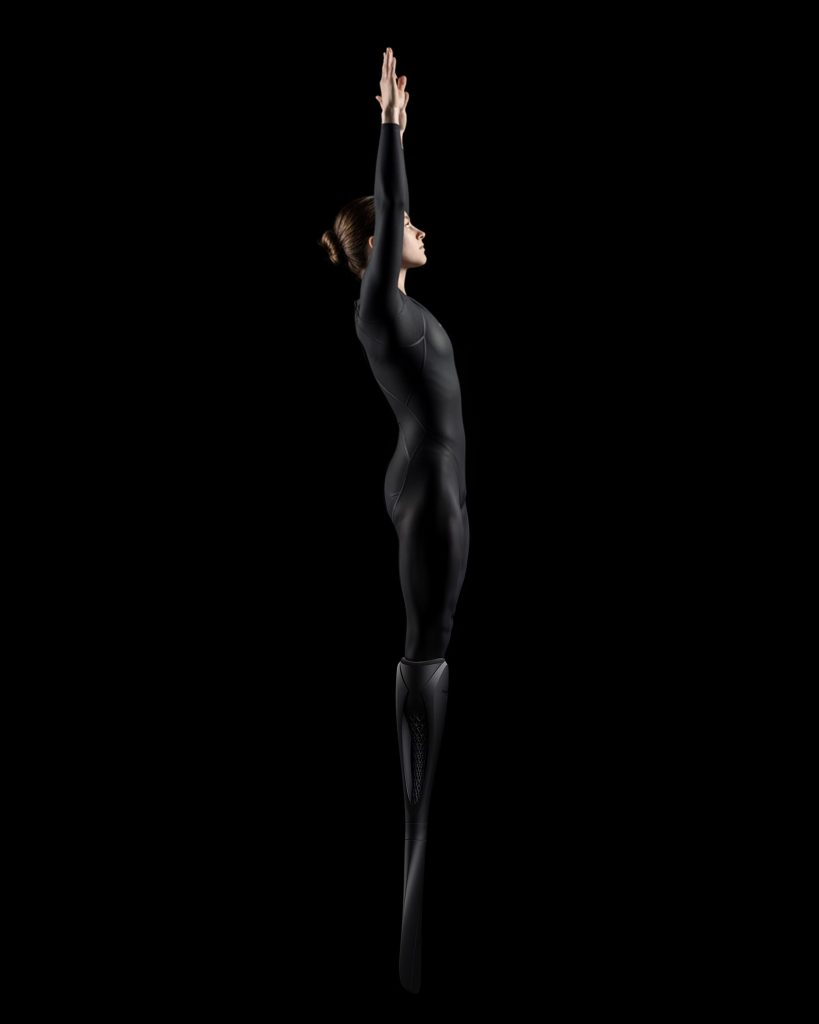
Nimble: a modular prosthetic fin by Essesi Design, using 3D-printed lattice & carbon fiber to aid amputee swimming.
Italian studio Essesi Design Studio has developed Nimble, a conceptual modular prosthetic fin designed to help amputees swim more effectively. The attachable device replaces a missing foot and lower leg, combining a lightweight carbon-fiber shell with a 3D printed flexible rubber lattice that generates thrust while reducing stress on the residual limb.
“The Nimble prosthetic fin redefines mobility for below-the-knee amputees. At its core is an innovative, 3D printed flexible lattice structure. This centerpiece is engineered to reduce stress on the user’s limb while simultaneously generating powerful thrust with each kick, all within an incredibly lightweight carbon fiber construction,” said the studio.
Rubber Lattice Delivers Thrust and Comfort for Amputee Swimmers
Essesi Design Studio constructs the prosthetic fin’s outer shell from carbon fiber, providing both strength and lightness. Inside, a rubber lattice forms the flexible core, while a connecting plastic component links the shell and lattice to the user’s limb. Thanks to the rubber, the internal geometry rebounds to its original shape during swimming or vigorous movements.
The modular fin consists of five parts, beginning with the main body that houses the torch-shaped lattice. Rotatable locks at the top and bottom secure the lattice, with the upper section designed for prosthetic attachment. The fin attaches at the bottom via a twist-lock mechanism.
When the swimmer kicks downward, the lattice compresses and stores energy, then rebounds at the end of the kick. This motion generates thrust while distributing forces across the lattice, rather than concentrating stress at the attachment point, helping amputee swimmers move efficiently with less effort.
Expanding 3D Printed Prosthetic and Orthotic Care
Beyond experimental designs like Nimble, 3D printing is increasingly being applied in healthcare to expand access to personalized prosthetics and orthotic devices worldwide.
In July, French non-profit My Human Kit partnered with Sculpteo, a France-based digital manufacturing company and BASF subsidiary, to develop the Bionicohand, an open-source bionic prosthetic. Conceived by co-founder and forearm amputee Nicolas Huchet, the project aims to make prosthetics more personalized, accessible, and sustainable.
Elsewhere, medical equipment manufacturer PROTEOR partnered with Unbroken Ukraine, One World Strong, and TrainAI to deliver 3D printed prosthetics to civilians and veterans affected by the war in Ukraine. Through this collaboration, rehabilitation centers can produce definitive lower-limb sockets on-site using PROTEOR’s ISO-10328-certified CPX-KyronMAX material, with fabrication times between two and six hours. The initiative aims to enhance clinical independence, and expand access to high-quality prosthetic care.