
Home  >  Materials

November 3, 2026      Materials      By 3DPTimes Editors | Report prepared November 3, 2026. Primary source: RMIT University, October 20, 2026.      5

The Waste to Form research project combines spent coffee grounds with architectural design. Its full-scale demonstrator explores circular materials, while building performance and end-of-life claims still need quantified validation.

Waste to Form architectural installation at RMIT. Image: RMIT University.
From café waste to architectural form

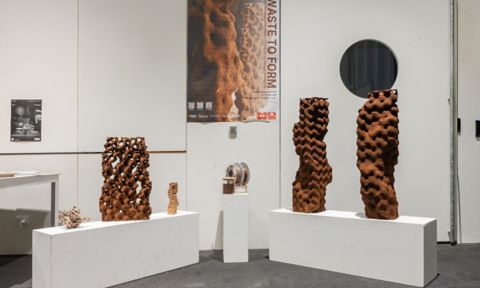
Researchers at RMIT University in Melbourne have developed a coffee-waste-based 3D-printing filament and used it in a full-scale architectural demonstrator. The Waste to Form project connects materials research with computational design, exploring how a familiar waste stream could become a resource for fabrication.

RMIT reported the work on October 20, 2026. The installation had already been presented during Melbourne Design Week in May; it is a research demonstration, rather than a newly certified construction product.

Printed architectural forms from the Waste to Form project on display at RMIT. Image: RMIT University.

A collaboration across scales and material performance

The project brings together Distinguished Professor Baohua Jia from RMIT’s School of Science and Dr Nic Bao from its School of Architecture and Urban Design. The materials team develops and characterizes the feedstock, while Bao’s FormX Research Lab investigates how material behavior can inform larger architectural forms.

RMIT’s design-week program placed Waste to Form at the Design Hub and Building 3 from May 22–24. It identified collaboration across the university’s architecture, science and engineering schools, with Hohai University and Beijing University of Civil Engineering and Architecture.

According to RMIT, adding coffee grounds improved material strength and introduced a brown color and coffee scent. Researcher Kang Liu also identified sound absorption and insulation as potential functions. The university announcement does not provide numerical acoustic or thermal results, so these should not be read as established product specifications.

The team is also using coffee-based printing in high-school outreach and seeking partners across materials, design and manufacturing.

3DPTimes view: measure the complete material system

For designers, the opportunity is to consider feedstock, geometry and sensory qualities together. A convincing next step would be a reproducible comparison with conventional materials: strength, moisture resistance, durability, processing energy and cost.

Biodegradability also needs an explicit end-of-life scenario. A material that breaks down under specified treatment conditions is different from one that decomposes in any environment. Future assessments should establish those conditions and test the finished composite, rather than infer its behavior from the presence of coffee waste.

Sources

RMIT University, “Turning coffee waste into 3D-printed architectural forms,” October 20, 2026.
https://www.rmit.edu.au/news/all-news/2026/oct/coffee-waste-architecture

RMIT University, “Designing regenerative futures: RMIT community leads the conversation at Melbourne Design Week 2026,” April 2026; exhibition dates May 22–24, 2026.
https://www.rmit.edu.au/news/all-news/2026/apr/designing-regen-futures-mdw

Reporting and editorial analysis: 3DPTimes. Sources reviewed November 3, 2026.


©2026 3dptimes.com All Rights Reserved