
Home  >  News

October 31, 2026      News      665

When technology meets travel, what new possibilities might emerge?
From 3D-printed handbags to three-dimensional garment details, additive manufacturing is entering more areas of fashion design.

On November 1, THOTHER will appear at the Los Angeles–Silicon Valley AI Film Festival for an experiment bringing together digital design, 3D printing, and fashion presentation.
As 3D printing moves from the desktop into consumer products, where are the boundaries of its applications?

Shoes, lighting, and home goods are already familiar application areas in the industry. Fashion design is another field worth watching.
Unlike conventional garment manufacturing, 3D printing can turn complex curves, three-dimensional structures, and distinctive textures in digital models into physical components, giving designers new ways to shape their work. It does not have to replace traditional craft; it can also be combined with fabric, hand-finishing, and assembly to create new forms of expression.

On November 1, Los Angeles fashion brand and creative platform THOTHER will appear at the 2026 Los Angeles–Silicon Valley AI Film Festival (SVAIFF) Awards Ceremony at Saban Theatre in Beverly Hills. Through a tech-fashion show, an on-site product booth, and a brand short film, THOTHER will present work that combines 3D printing and fashion design.
Chinese actors Huang Xiaoming and Xiao Yang recorded congratulatory videos for this year’s film festival (video screenshots).
What makes the event worth watching is not only the runway looks, but also how digital design moves from the screen into pieces people can wear.
3D Printing Is More Than Decoration
From Digital Models to Wearable Pieces
According to the event schedule, THOTHER’s tech-fashion show will run from 4:15 to 4:25 p.m. local time in Los Angeles on November 1.
Models from KSL Modeling Academy will walk in looks that combine traditional fabrics with 3D-printed details. The designs use white fabric with three-dimensional heart embellishments and sculptural silver spike elements, exploring how different materials, forms, and structures can work together.
The on-site display will include 3D-printed handbags, dimensional garment details, necklaces, hairpins, bracelets, and runway props. The brand’s booth will also present clothing, accessories, handbags, and footwear.
The process begins with digital modeling, followed by layer-by-layer printing. The printed parts are then hand-finished and assembled before being incorporated into the complete look.
This is also a practical pathway for additive manufacturing in fashion: digital design accommodates complex geometries, 3D printing turns models into physical components, and conventional finishing and assembly prepare them for presentation and use.
It is important to clarify that 3D printing does not mean every garment has to be made from printable material. For this kind of cross-disciplinary design, combining printed components with conventional fabrics is itself a more flexible way to bring an idea to life.
From Industrial Manufacturing to Fashion Design
Where Does 3D Printing Add Value?
From an additive manufacturing perspective, THOTHER’s work offers at least three areas worth discussing.
Creating Complex Forms
Conventional manufacturing may require multiple steps or dedicated molds to produce complex curves, distinctive textures, and three-dimensional structures. 3D printing can build the corresponding geometry directly from a digital model, giving designers another way to realize their ideas.
This does not mean 3D printing is always cheaper or faster. It means designers have more options for certain structures and forms.
Connecting Digital Design with Physical Pieces
A digital model can be more than a visual reference; it can also form the basis for manufacturing. By iterating on the model, producing prototypes, and refining designs after real-world try-ons, designers can explore how a finished piece will look and perform.
For fashion accessories and experimental wearable pieces, this digital workflow can help explore forms that are difficult to achieve with conventional craft.
Potential for Small-Batch and Personalized Creation
THOTHER says its 3D-printed pieces are made primarily from bio-based PLA at its Los Angeles studio, with made-to-order production and limited collections as its main model.
For design products defined by distinctive forms, made-to-order production and small-batch manufacturing offer a business path worth exploring. Actual costs still depend on materials, print time, post-processing, assembly, and product-quality requirements; 3D printing should not simply be equated with low-cost manufacturing.
For the 3D printing industry, the question worth watching is whether original design and manufacturing capabilities can bring printing equipment and materials further into consumer-product development, and support sustainable products and business models.
Why Would a Fashion Brand Appear
at an AI Film Festival?

Gina Jiang Founder & Designer of THOTHER®
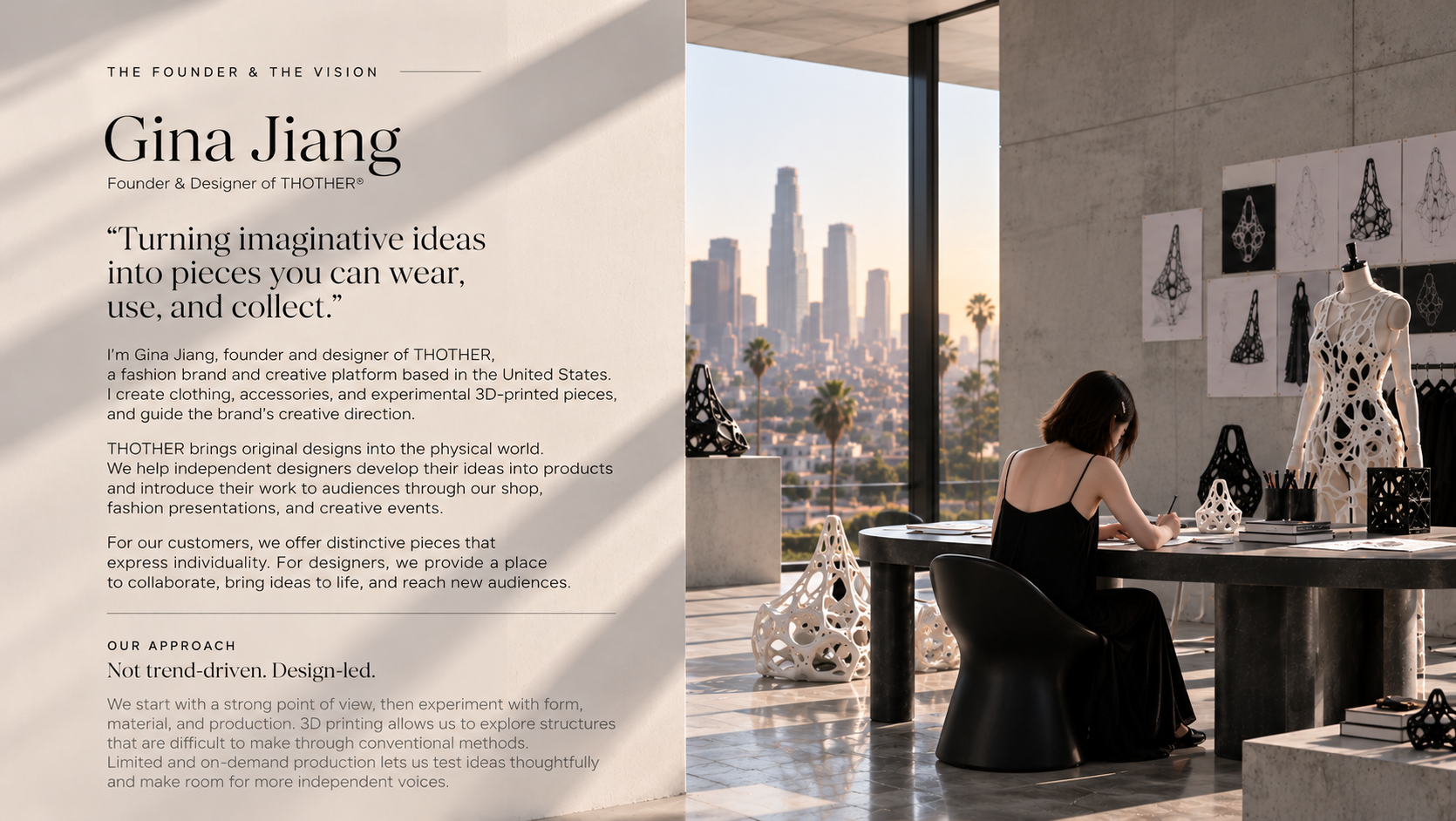
THOTHER founder and chief designer Gina Jiang says AI filmmaking and 3D-printed fashion have something in common: both explore how imagination can be turned into work that people can see and experience.
AI can help creators explore image-making and visual expression, while digital design and 3D printing can turn some ideas into physical objects that can be touched, worn, and used.
That is the cross-disciplinary significance of this event.

Ji Lin (Jason) Co-Curator Brand Strategy and Management Specialist / Curator CEO, Korea Division, Silicon Valley AI Film Festival Chief Planner, Silicon Valley AI Film Festival AI Idol Competition North America Secretary-General, Korean AI Management Association

Xu Fanglei (XU FANGLEI) Co-Curator Industrial Designer · Additive Manufacturing Applications Research
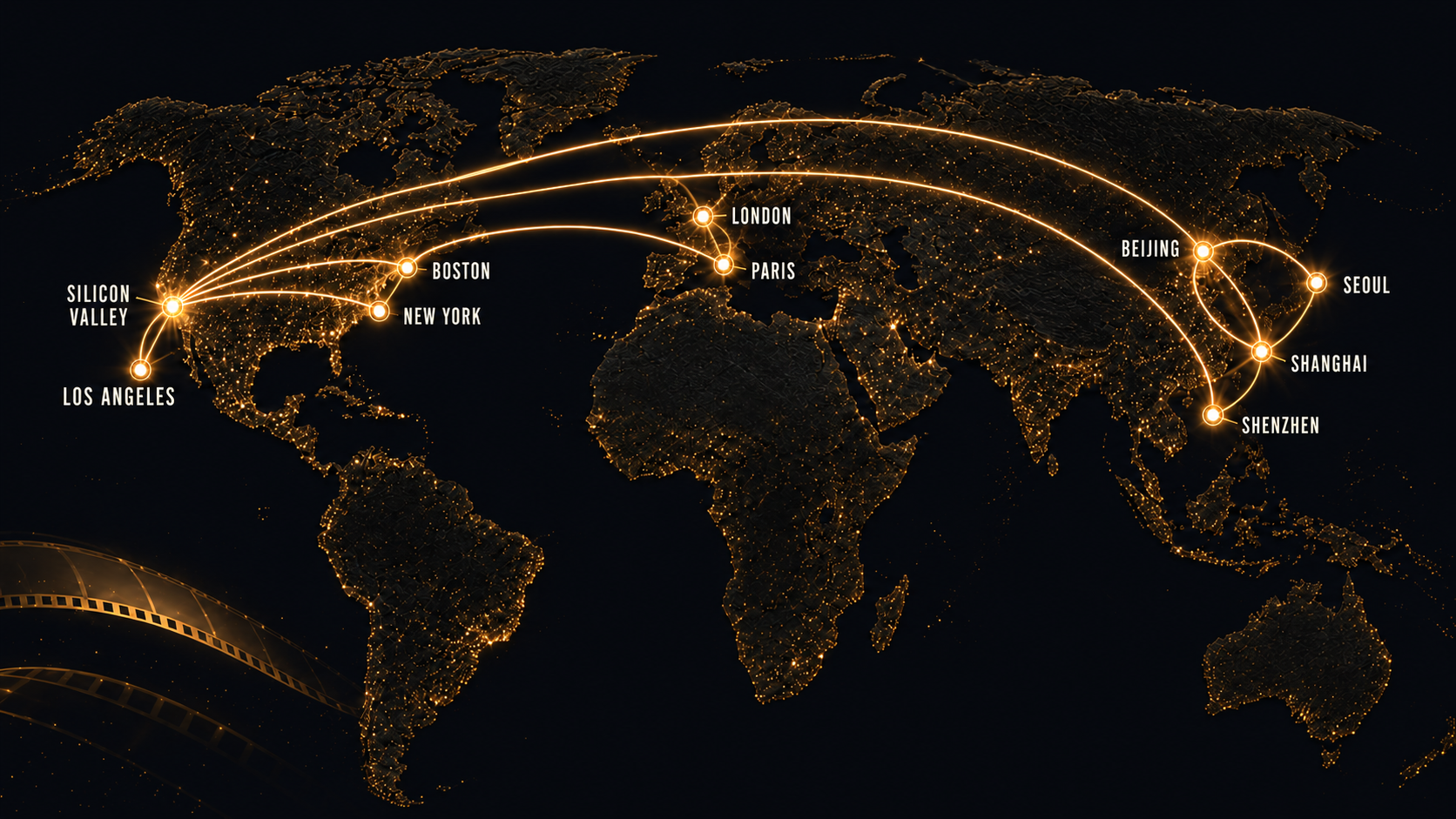
The 2026 Los Angeles–Silicon Valley AI Film Festival will be held at Saban Theatre. The program includes a red carpet, film screenings, keynote talks, industry roundtables, fashion presentations, and an awards ceremony, bringing together creators from film, technology, and design.
THOTHER hopes to explore collaborations in film and television costumes, stage styling, IP partnerships, and prop production through the event.
For the additive manufacturing industry, this kind of collaboration offers a direction to watch: 3D printing need not exist only as a standalone manufacturing technology. It can also serve as a tool for film storytelling, brand expression, and creative product development. Moving from a fashion show to a mature commercial application still requires attention to material performance, wearing comfort, durability, production efficiency, and cost. A showcase can demonstrate design possibilities; these practical considerations will determine whether an application can move further toward the market.
THOTHER Is Looking for
More Designers and Creators
Alongside its own product lines, THOTHER has launched a designer collaboration program called “Interstellar Designers.” It is open to fashion and accessory designers, 3D and digital artists, product and industrial designers, and creators exploring new materials.

Potential collaborations include prototype development, accessories and wearable pieces, limited collections, and showcasing work through brand content, fashion events, and in-person experiences.
The value of this collaborative model is that it gives designers room to explore from digital models to physical pieces, while creating more opportunities for 3D printing to connect with consumer markets.
For creators with original designs, digital modeling, or additive manufacturing capabilities, cross-disciplinary collaboration may help their work reach new audiences more effectively than a discussion focused only on technical specifications.
In Beverly Hills,
See You There
On November 1, THOTHER will present a tech-fashion show and an on-site product display at the Los Angeles–Silicon Valley AI Film Festival Awards Ceremony.
If you are following 3D printing in fashion, accessories, consumer products, and the creative industries, this event is worth watching.
We look forward to seeing how digital design and additive manufacturing come together in products, on the runway, and in other creative settings—and what new possibilities the technology may open for designers.

.........

If you are in Los Angeles or Southern California, you are welcome to follow the event and attend in person. Rather than seeing 3D printing only on a screen, come see how printed components work with fabric, styling, and the overall design.

2026 Los Angeles–Silicon Valley AI Film Festival (SVAIFF) Awards Ceremony
November 1, 2026
3:30—7:30 PM
THOTHER Technology Fashion Show: 4:15 PM
Saban Theatre · 8440 Wilshire Boulevard, Beverly Hills, CA 90211
Official website: thother.io
Instagram: @th0therofficial

All times listed above are in Los Angeles local time.

THOTHER is a Los Angeles-based fashion brand and creative platform that brings together original design, 3D printing, and collaborations with independent creators to explore new possibilities across fashion, art, and physical products. Its 3D-printed work is made primarily with bio-based PLA, alongside projects in product development, IP collaborations, and 3D design education.


©2026 3dptimes.com All Rights Reserved