Virginia Tech Develops 3D Printable Ceramic-Metal Composite with Shape-Memory Properties
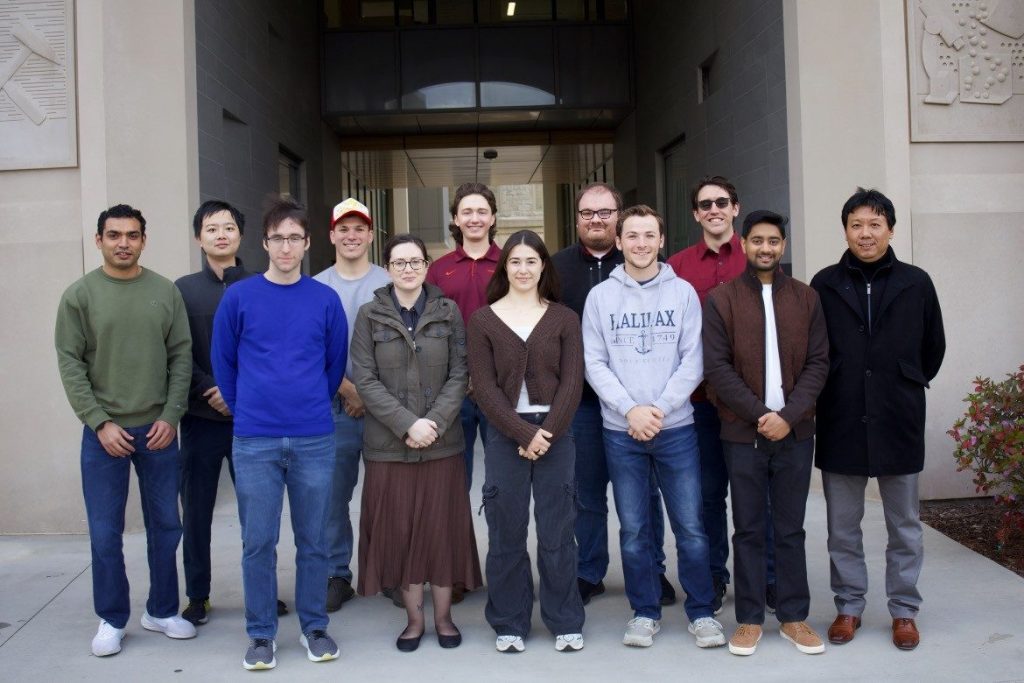
Virginia Tech researchers have created a method to produce bulk, defect-free ceramics embedded in metal, combining the strength of metal with the stress-responsive properties of shape-memory ceramics. Led by associate professor Hang Yu, along with Ph.D. student Donnie Erb ’15, M.S. ’18, and postdoctoral researcher Nikhil Gotawala, the approach could enable applications in aerospace, defense, infrastructure, and high-performance sporting equipment, addressing challenges in scaling traditionally brittle ceramic materials.
A Novel Manufacturing Technique
The team employed additive friction stir deposition, an advanced additive manufacturing process, to integrate functional ceramic particles into a metal matrix. Unlike conventional ceramics, which are brittle and prone to failure, this composite can undergo stress-induced phase transformations, allowing it to absorb energy while maintaining structural integrity.
“This composite can afford tension, bending, compression, and absorb energy through stress-induced martensitic transformation,” said Yu. “In that sense, it’s multifunctional. That allows us to move toward making big things with the potential for real applications.”
Overcoming Challenges in Ceramics
Shape-memory ceramics have long been valued for their ability to change structure under stress or heat and return to their original form. Metals like nickel-titanium alloys display similar behavior, but scaling ceramics for structural use has historically been difficult.
“When I was a postdoc, my advisor’s group published a Science paper showing that if you make this material at microscale, the brittleness of ceramics is not a major problem, and you can see the shape memory effect,” Yu said. “But no one could figure out how to scale up a shape-memory ceramic so it could have structural applications. It always broke apart.”
The development was achieved by embedding tiny ceramic particles into metal, “like putting chocolate chips into cookie dough,” Yu explained. The mixture is processed in the additive friction stir deposition machine, which spins materials together without melting, producing a uniform, 3D printable composite that retains shape-memory functionality.
Applications and Future Potential
The composite enables practical industrial applications, such as vibration damping in defense systems, aerospace structures, infrastructure components, and sporting goods.
“With this composite, you’re adding functionality to a metal that already works for a certain application,” Erb said. “It’s a ‘Field of Dreams’ situation: if we make it, someone will find some interesting applications for it. People have shown this material works in micrometer size. We’re saying, ‘Now you can have however much of it you want.’ We’ve realized a different scale for it.”
Ceramic 3D Printing Pushes Efficiency
Virginia Tech’s effort illustrates the growing potential of ceramics in additive manufacturing, but it is part of a larger trend across research and industry.
Last year, French 3D printing company 3DCeram was chosen as an official supplier for space propulsion manufacturer ThrustMe to produce ceramic components for electric thrusters. Through this partnership, ThrustMe applied ceramic additive manufacturing to create miniaturized, highly complex parts capable of operating in the extreme thermal, chemical, and electrical conditions of space.
Elsewhere in research, ceramic 3D printed solid oxide cells (SOCs) developed by the Technical University of Denmark (DTU) achieved over 1 W per gram, combining low weight with high power output. The fully ceramic, monolithic design was 3D printed with a gyroid structure that maximized surface area and mechanical stability while eliminating metal parts and seals.
This reduced manufacturing to five steps and enabled both fuel cell and electrolysis operation, producing hydrogen at nearly ten times the rate of conventional SOCs. The lightweight design demonstrated strong potential for use in aerospace and space systems.