Home  >  Materials

September 21, 2025      Materials      DOE      55

Real-time X-ray imaging reveals dislocation formation during metal 3D printing. This insight enables microstructural control for stronger additive-manufactured alloys.

U.S. Department of Energy (DOE) researchers from Argonne National Laboratory, Oak Ridge National Laboratory, and several universities have achieved a significant scientific breakthrough by observing real-time microstructure evolution in metal during 3D printing. This advancement was made possible through the use of the Advanced Photon Source (APS) at Argonne National Laboratory, a user facility operated by the DOE Office of Science.
The multiphysics simulation displays the positions of three lasers, along with the morphology and temperature distribution of a single-track 316L stainless steel. The inset shows a representative in situ X-ray image of the printing process. The purple box marks the region that requires characterization through focused beam diffraction.

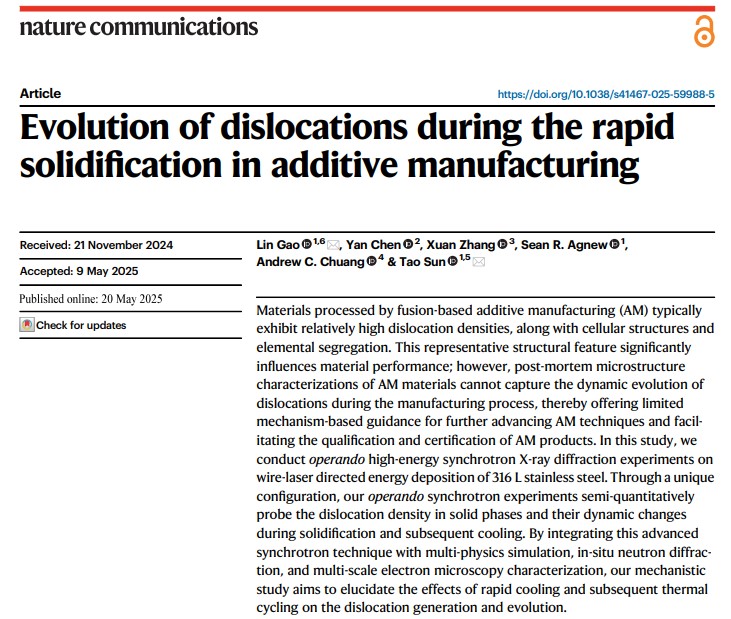
These findings were published in a paper titled "Evolution of Dislocations During the Rapid Solidification in Additive Manufacturing" in the journal Nature Communications. Previously, scientists could only analyze the microstructure of 3D-printed components after the printing process was completed.

The research paper can be accessed at: https://www.nature.com/articles/s41467-025-59988-5

Sun, the principal investigator of the project and a professor at Northwestern University who also holds an adjunct professorship at Argonne National Laboratory, explained: "Metals are composed of atoms arranged in an ordered crystal structure. However, under rapid heating and cooling conditions, some atoms lose their ordered arrangement. These defects—known as dislocations—can either strengthen or weaken the final component."

Using the 1-ID-E beamline at the Advanced Photon Source (APS), the research team conducted 3D printing experiments on the commonly used structural alloy, 316L stainless steel. They employed real-time X-ray diffraction to track the printing process, directly measuring how and when dislocations form and propagate.

In-situ synchrotron X-ray diffraction of SS316L during wire-laser DED process
Andrew Chuang, a physicist at the Advanced Photon Source (APS), stated: "Our analysis demonstrates that the APS is highly powerful in studying defects that were previously only detectable through post-process analysis. This is the first time this real-time technique has been applied to laser-based methods to investigate the evolution of dislocations in wire."

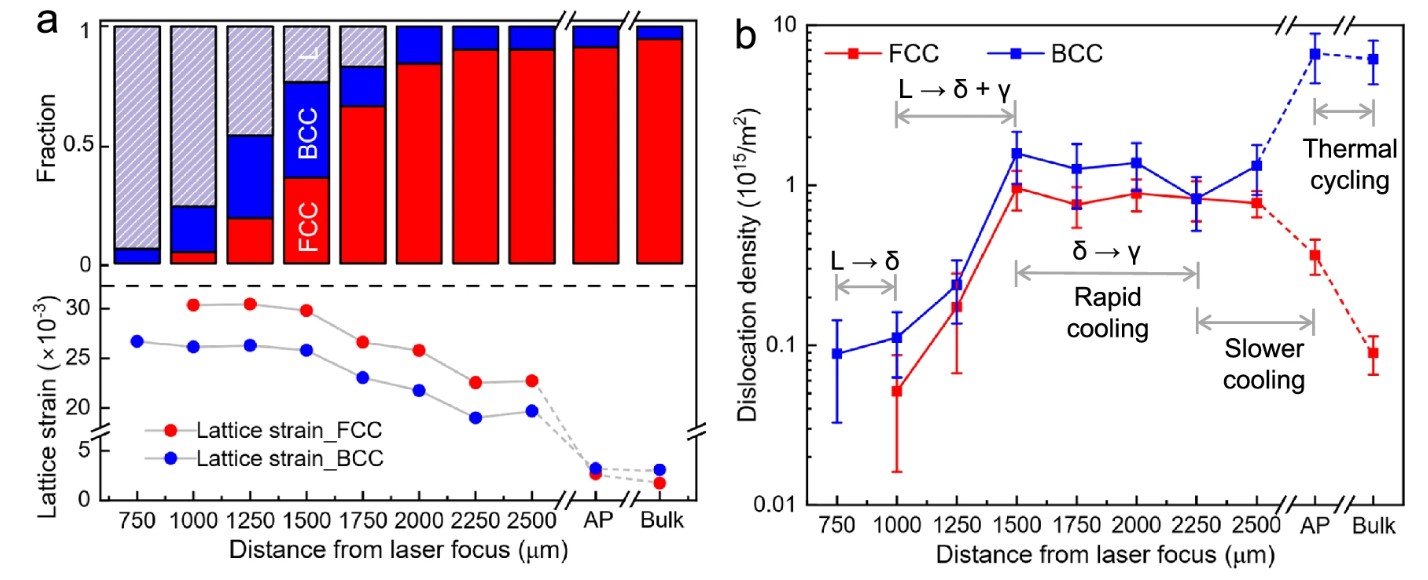
The data reveal that dislocations form early, just as the metal transitions from liquid to solid. It was previously believed that dislocations formed later due to the accumulation of stress during cooling and solidification. A key factor is a specific reaction where two solid phases simultaneously form from the liquid, resulting in a high density of dislocations.

The Evolution of Microstructure During the Wire-Laser DED Process of SS316L: From Solidification to Bulk Printing
This deeper understanding can help engineers enhance the strength and reliability of 3D-printed components. By adjusting printing parameters, developers can precisely control the formation of dislocations at the microscopic level. In this way, they can fully leverage the beneficial properties of dislocations while minimizing their detrimental effects.

These findings may also drive the development of novel alloys. Modifying the chemical composition of stainless steel—for instance, adjusting the ratios of chromium or nickel, or adding elements such as aluminum—can influence how dislocations form and how stresses are distributed.

As stated by Lin Gao, a postdoctoral researcher in the Nuclear Science and Engineering Division at Argonne National Laboratory: "This 3D printing technology enables the fabrication of reliable, ultra-strong, and customized metal parts capable of withstanding extreme conditions. It could prove crucial for producing advanced metal components required for next-generation nuclear reactors currently under design at Argonne and other research institutions."


©2025 3dptimes.com All Rights Reserved