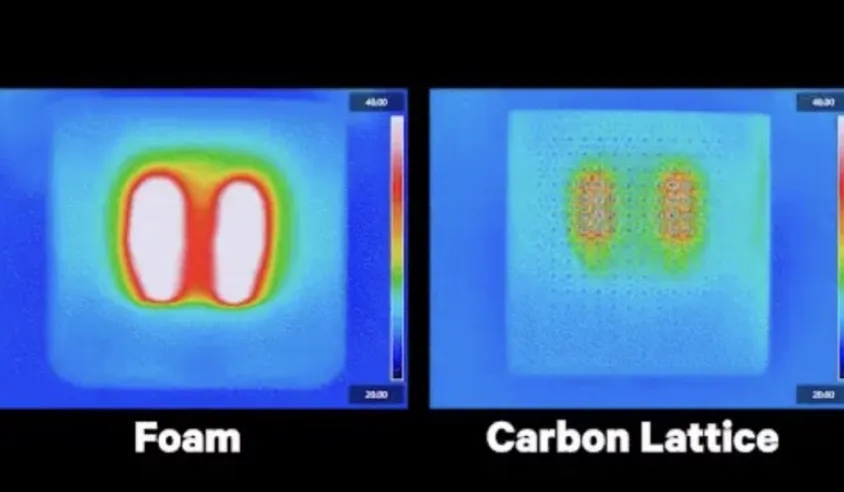
3D printed wheelchair cushions offer better ventilation and heat management than foam, confirmed by thermal imaging tests.
Carbon’s wheelchair cushions, which replace traditional foam with 3D printed lattices, have been increasingly embraced by users who appreciate the design’s improvements in terms of comfort, support, customizability, and, in particular, ventilation. In a bid to showcase just how much of a ventilation and heat management difference its printed lattice cushions make, Carbon conducted an informal experiment that used a hollow 3D printed butt and a thermal camera to compare a 3D printed cushion and a traditional foam cushion.
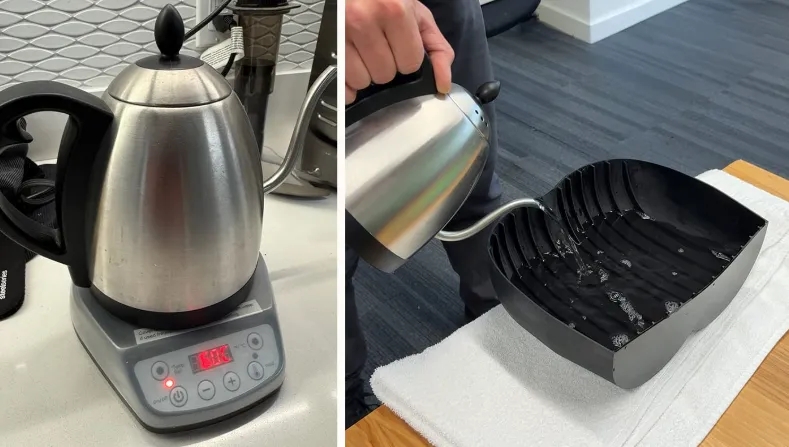
The experiment, carried out by a team of curious Carbon employees, was simple: first they 3D printed a water-tight “butt-shaped container” using UMA 90, a rigid one-part resin, and Carbon’s DLS technology. According to the team, the geometry of the model was aligned with ISO 16840, a standard specifically related to the physical and mechanical characteristics of seat cushions, and also integrated a portion of thighs to better mimic a seated posture.
Once printed, the hollow rear was filled with 60°C water and placed on the 3D printed lattice wheelchair cushion for a full minute. Throughout, an infrared camera was positioned to record the temperature profile of the printed cushion, capturing data before, during, and after the hot butt was placed on it. This exact process was then repeated for the traditional foam cushion.
According to the team, it was almost immediately clear that the heat dissipation of the 3D printed lattice was superior, with an obviously smaller heat signature and lower peak temperatures. This was likely no big surprise to the team, however, as the 3D printed lattice cushion is intentionally designed with an open cellular structure that allows for air flow even when sat on. This design prevents heat from becoming trapped and building up, which—for a person in a wheelchair—can lead to discomfort and, in more severe cases, even sweat-induced pressure sores.
“Heat dissipation isn’t the only factor in comfort, but for people sitting for long periods, it could be a helpful lens to consider,” the company writes on its blog. “This demo helped us think differently about material performance—plus, it gave us an excuse to 3D print a butt, and how often do you get to do that?”
Carbon’s 3D printed wheelchair seats are based on multi-zonal lattice structures that can be adjusted and tailored for specific users as well as for comfort and performance. The company offers a selection of elastomer materials for this application, including EPU 46 and EPU PRO, which deliver on energy return, and EPU 43, known for its energy-damping properties. Wheelchair cushions are just one use case for the company’s 3D printed lattices: it also prints bike saddles, helmets and other parts that benefit from greater ventilation and typically rely on foam.