Home  >  Materials

September 19, 2025      Materials      139

Northwestern Polytechnical University, in collaboration with multiple institutions, has developed a non-contact ultrasound method to enhance laser additive manufacturing. The research was published in Nature Communications.

3DPTimes: Breaking News and Trends in 3D Printing
Research Link: https://www.nature.com/articles/s41467-025-62803-w

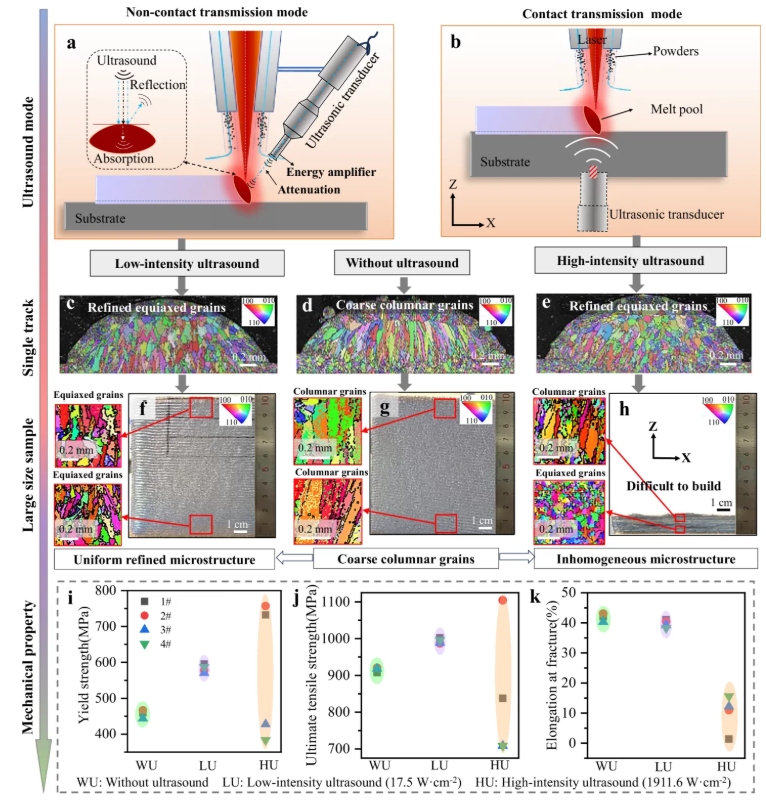
The study demonstrates that transmitting ultrasound below 20 W·cm⁻² through a gas medium can refine grain structures and enhance mechanical properties without causing cavitation. In tests conducted on Inconel 718, the yield strength increased from 456 MPa to 582 MPa (+27.6%), and the ultimate tensile strength rose from 915 MPa to 994 MPa (+8.6%), while ductility remained nearly unchanged at approximately 40%. Similar improvements were observed in stainless steel 316L, indicating the broad applicability of this method.

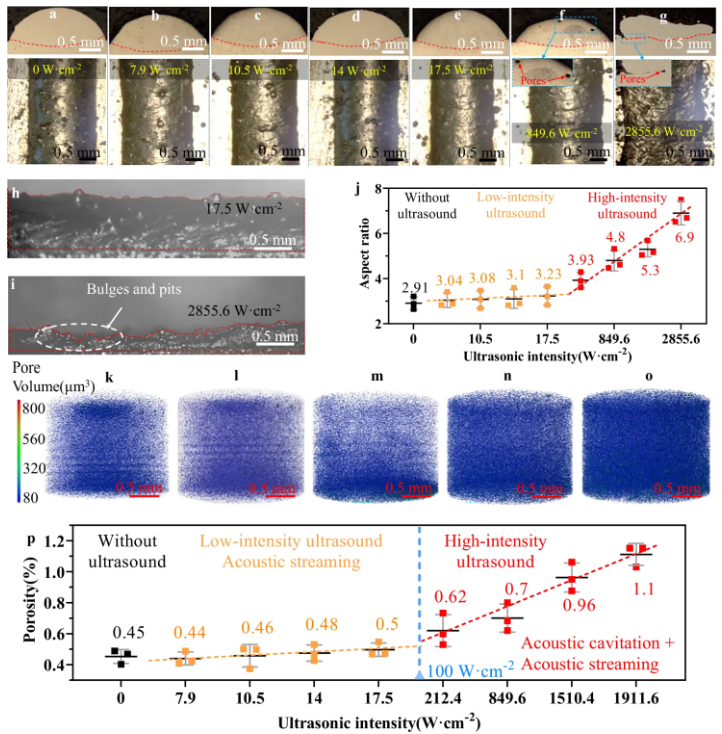
Laser additive manufacturing typically results in columnar grain structures due to high thermal gradients within the melt pool, which often limits mechanical performance. Conventional ultrasonic-assisted processing employs direct contact between the transducer and the substrate, emitting ultrasound at intensities exceeding 200 W·cm⁻². While this high-intensity approach can refine grains, it introduces instabilities. Computed tomography scans revealed that porosity increased significantly from 212.4 W·cm⁻² to 1911.6 W·cm⁻², accompanied by the formation of bulges and pits, which restricted build heights to under 15 mm.

In contrast, the non-contact method delivers ultrasound under 20 W·cm⁻² via a carrier gas, effectively avoiding cavitation. Samples with heights up to 100 mm achieved near-full density and maintained consistent grain refinement throughout the entire deposition process.

△ Schematic diagram of non-contact low-intensity ultrasonic transmission. In this mode, the ultrasonic transducer with an energy amplifier is fixedly connected to the powder feeder. Image from Nature Communications.
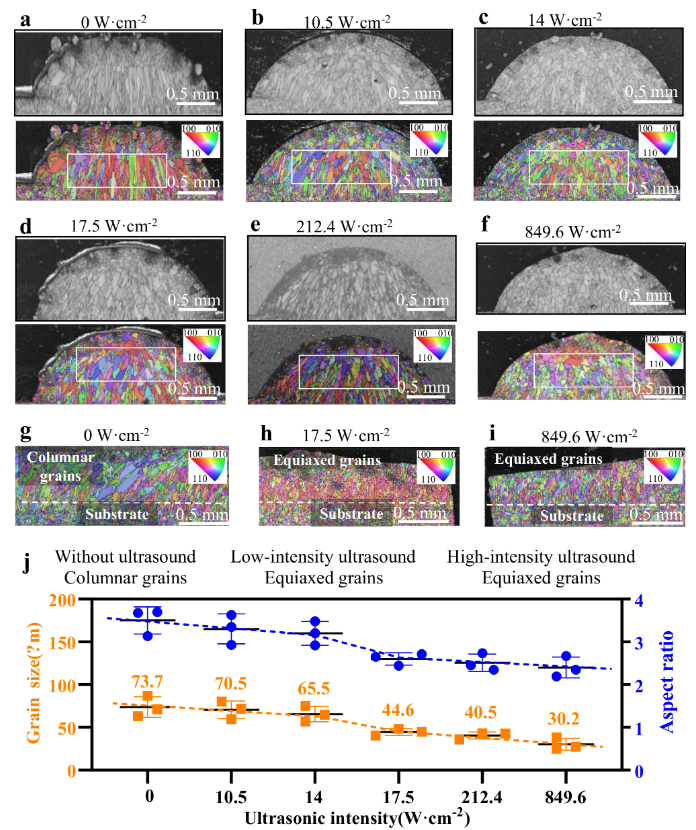
The research team from Northwestern Polytechnical University mounted the transducer onto the powder nozzle, maintaining a fixed distance from the melt pool during the deposition of powder layers. This configuration ensured stable transmission of ultrasound across varying build heights, resulting in a uniform equiaxed grain structure. Grain size analysis revealed that the average grain size decreased from 73.7 μm without ultrasound to 44.6 μm with non-contact ultrasound at 17.5 W·cm⁻². Although contact ultrasound at 849.6 W·cm⁻² achieved a finer grain size of 30.2 μm, it led to a sharp increase in porosity and surface defects.

The transition point of grain structure also differed: equiaxed grains emerged above 1.0 mm in non-contact samples, whereas in high-intensity builds, they appeared above 0.6 mm. The effectiveness of contact transmission diminished beyond 10 mm, with grains reverting to a columnar structure, while the nozzle-mounted method maintained refinement throughout the entire 100 mm block.

In-situ monitoring and multiphysics simulations elucidated the underlying mechanism. Low-intensity ultrasound interacts with Marangoni-driven flow, inducing high-frequency oscillatory motion within the melt pool. This motion subjects dendrite arms to cyclic stresses exceeding the material’s yield strength of 37.3 MPa, leading to fatigue fracture and fragmentation. Calculations showed that dendrite stress increased from 30.9 MPa without ultrasound to 71.3 MPa under non-contact excitation.

Unlike cavitation, which generates intense bubble collapse and shock waves, acoustic streaming maintains a stable melt pool surface. Porosity saw only a mild increase under low-intensity conditions—rising from 7.9 W·cm⁻² to 17.5 W·cm⁻²—confirming that grain refinement was achieved without introducing significant defects.

△ Effect of ultrasound on fusion defects in Inconel 718. Image from Nature Communications.
Contrasting Mechanisms and Reproducibility in Ultrasonic Grain Refinement
Early studies in welding, cladding, and casting concluded that cavitation was the primary driver of grain refinement, while the role of acoustic streaming was considered negligible. Recent synchrotron X-ray imaging studies have visualized acoustic streaming in laser additive manufacturing, yet still attributed refinement largely to cavitation, as the ultrasound intensities applied in those experiments exceeded the cavitation threshold.

This study demonstrates that equiaxed grain refinement can occur even in the absence of cavitation, proving that acoustic streaming alone is sufficient to achieve grain refinement. This finding resolves long-standing uncertainties regarding the contribution of acoustic streaming and addresses the scalability challenges associated with ultrasonic-assisted additive manufacturing.

Divergence in Mechanical Reproducibility
Mechanical testing highlighted significant differences in reproducibility. Samples processed with non-contact ultrasound exhibited consistent yield strength, clustering around 582 MPa, and ultimate tensile strength near 994 MPa. In contrast, components formed with contact ultrasound showed highly variable mechanical properties: yield strength ranged from 427 MPa to 757 MPa and tensile strength from 890 MPa to 1070 MPa, due to porosity and microstructural heterogeneity.

The authors report that the non-contact method achieved reproducible properties in both tested alloys, underscoring its reliability compared to the high variability associated with high-intensity ultrasonic processing.

△ Effect of ultrasound on the single-track grain structure of Inconel 718. Image from Nature Communications.
This study redefines the established assumptions of ultrasonic-assisted metallurgy by demonstrating that grain refinement can be achieved without cavitation. Non-contact ultrasound at intensities below 20 W·cm⁻² enables refined grain structures, reproducible mechanical strength, and defect-free surfaces in alloys widely used in aerospace and energy applications. The researchers note that this method is also suitable for laser cladding and welding processes where melt pool stability is critical. The findings establish acoustic streaming as a viable mechanism for microstructural control and point toward a reproducible strategy for manufacturing large, complex metal components.


©2025 3dptimes.com All Rights Reserved