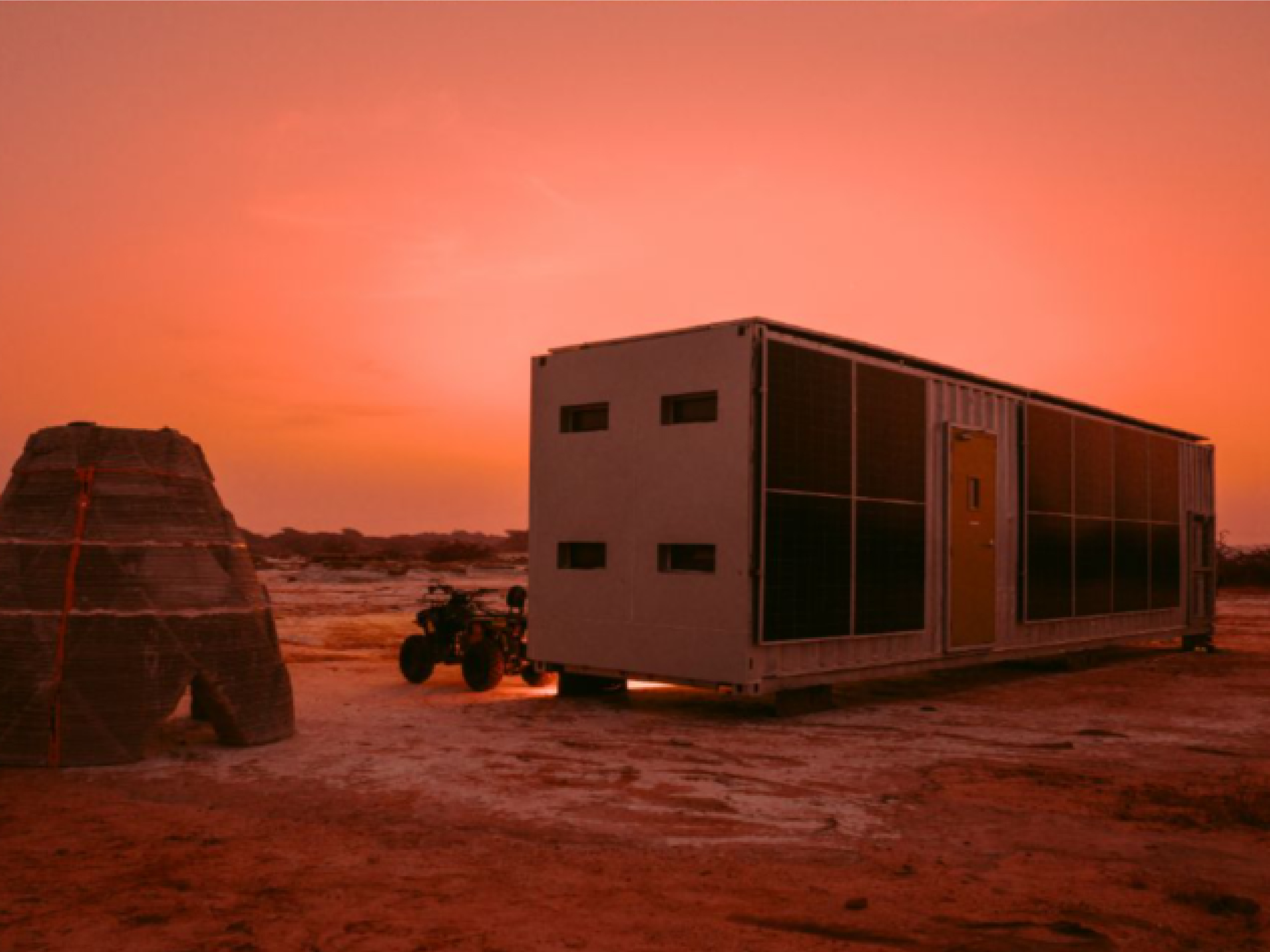
An Indian company has used basalt and limestone to simulate Martian soil, creating a radiation shielding layer via chemical bonding 3D printing, with energy consumption far lower than laser melting solutions.
AAKA Space Studio, an Indian space research company, has recently 3D printed a radiation shielding layer specifically designed for future Mars habitats. The demonstration took place during a simulated space mission in Gujarat, using locally sourced basalt and limestone from India—whose chemical composition closely resembles that of Martian soil.
AAKA mixed olivine-rich basalt and marlitic limestone with a lime-based binder, then fed the mixture into a concrete 3D printing system to build an integrated structure layer by layer. Tests show that the structure effectively attenuates cosmic radiation while maintaining good thermal stability under temperature variations. Both properties are critical for Mars, which lacks any magnetic field and atmospheric protection.
More importantly, Martian soil itself contains similar basalt and carbonate components, meaning that future missions could directly use local Martian soil for printing without transporting construction materials from Earth—this is the concept of “in-situ resource utilization.”
In terms of energy consumption, AAKA’s solution offers clear advantages. In comparison, the “Olympus” system developed by ICON in collaboration with NASA requires high-power lasers to melt the soil, resulting in extremely high energy use. In contrast, AAKA’s lime-based binder hardens through chemical bonding, requiring very little energy to produce an equally radiation-resistant monolithic structure, making it better suited for the limited energy conditions of early Mars missions.
In terms of energy consumption, AAKA’s solution offers clear advantages. In comparison, the “Olympus” system developed by ICON in collaboration with NASA requires high-power lasers to melt the soil, resulting in extremely high energy use. In contrast, AAKA’s lime-based binder hardens through chemical bonding, requiring very little energy to produce an equally radiation-resistant monolithic structure, making it better suited for the limited energy conditions of early Mars missions.
This demonstration also verified for the first time that locally sourced Indian raw materials can be used for Mars construction, reducing the country’s cost and import dependence for in-situ resource utilization research.