New DIW & laser method 3D prints self-supporting thermoset parts, skipping supports. Durability testing pending.
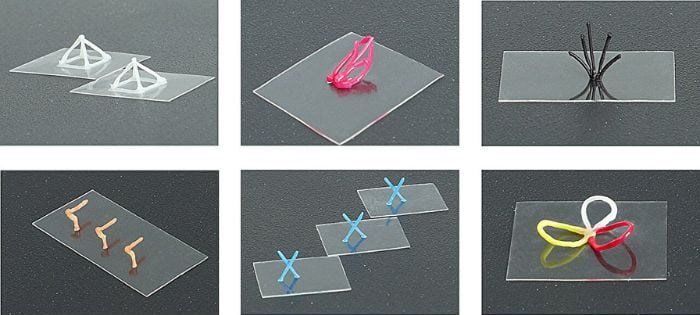
What if resin-based printing processes could eliminate the need for support structures, thereby simplifying the manufacturing workflow? This is the question explored by researchers from Xiamen University and the University of California, Berkeley. Together, they have developed a new approach for fabricating parts from thermosetting materials without requiring additional support structures. To achieve this, they utilized a Direct Ink Writing (DIW) technique combined with a laser curing system. Several parts were printed to demonstrate the capabilities of this method, clearly showing they can stand freely on their own. The remaining question is their long-term durability.
While many users are drawn to the precision of resin 3D printing, it still faces challenges such as lengthy post-processing times, which can extend the entire manufacturing workflow. Steps include removing supports, washing the part, and post-curing if necessary. Although some manufacturers are working to minimize these constraints, it is not yet a widespread practice in the market, and further progress is needed. Additionally, designing these supports is not always straightforward, as the material properties often make it difficult to maintain the structure before curing. This is where the new research comes in.
Dezhi Wu is a co-lead author of the paper behind this research. She explains: "Thermosetting materials (such as silicones) are widely used in engineering and infrastructure applications. However, their 3D printing processes suffer from prolonged curing times and complicate the support structures required for fabricating freestanding architectures, as they sag and collapse before solidification. Our lab's laser manufacturing tools are used to directly print thermosetting ink materials to cure the ink instantly."
The researchers therefore rely on a steerable laser that solidifies the material directly as it is extruded from the syringe. This approach accelerates the printing process since the resin is cured immediately—unlike techniques that involve dipping a build platform into a vat or projecting droplets onto a platform. Moreover, the technique eliminates the need for support structures; the researchers are able to print "in mid-air."
Another advantage highlighted by the researchers is that this process allows for programming the mechanical and electrical properties of the materials. Dezhi Wu states: "The properties of the 3D-printed structures are programmable. For example, local mechanical stiffness and electrical conductivity can be tuned using printing parameters, so that different zones can be made softer or stiffer, and their conductivity can be high or low."
The team 3D printed several structures to demonstrate the potential of their technique. These include soft sensors, stretchable electronic components, and magnetic soft robots.
Dezhi Wu concludes: "We now plan to establish a robust 3D printing platform for constructing soft, multifunctional devices. We will also expand the library of printable inks and investigate optimal printing parameters for industrial applications, such as flexible electronics, organic chips, etc." While awaiting these developments, you can find the full study HERE.