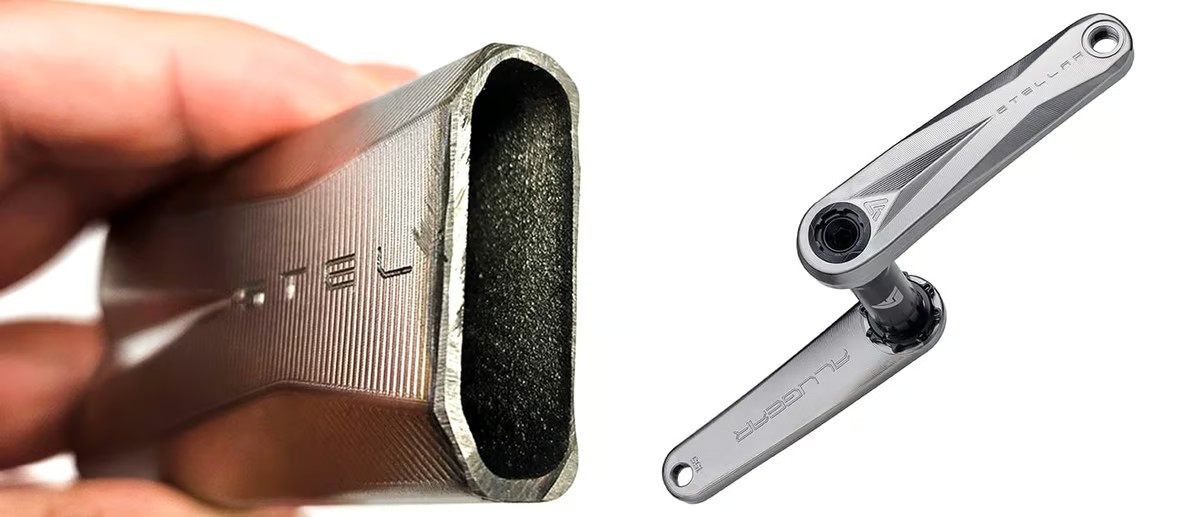
Coming in at just 345g, the weight of a full 12-oz can of soda, the 3D printed and CNC machined crankset from Alugear is bound for production.
Acollaboration between Polish cycling component maker Alugear and Materialise, the Belgian 3D printing, software, and development company, has yielded what both companies describe as a groundbreaking breakthrough in bicycle drivetrain technology: a 3D-printed, CNC-machined titanium crankset that is over 50% lighter than traditional counterparts and engineered for series production.
The effort marks an ambitious step for Alugear, a company long aware of additive manufacturing’s potential but uncertain how to harness the technology at industrial scale. “When we saw the potential to create a lighter, stronger crankset capable of working in a variety of disciplines, we knew it was the perfect component to begin our 3D printing journey,” saays Dawid Dyngosz, co-founder of Alugear. “We knew 3D printing would provide the performance benefits we were looking for, and Materialise was the right partner to take us from concept to production. It was their 3D printing expertise that led us to pursue this project.”
A Company’s New Approach to Design and Production
The crankset project was rooted in a deep collaboration between Alugear and Materialise, combining strategic design, simulation tools, and rigorous manufacturing processes. Early stages centered on validating the concept through First Article Inspection (FAI) and an audit of Materialise’s Metal Competence Center in Bremen, a facility equipped for both additive manufacturing and series production of metal parts.
Materialise Innovation Manager Simone Cannella framed the partnership as more than just part fabrication. “We don’t just print parts,” she says. “We industrialize both the product and the production process to ensure the business case is feasible for all involved. It helps customers create better products and demonstrates that 3D printing is the ideal technology for the job.”
Central to the process was choosing titanium for its exceptional strength-to-weight ratio, and designing the crankset with thin walls and a hollow structure to shave unnecessary mass while still meeting the demanding ISO 4210 high-load fatigue resistance test of 100,000 cycles.
Simulation: A Critical Tool
Simulation played a pivotal role in refining the crankset’s design and production readiness. Cannella stresses the complexity of this phase: “We had to find the sweet spot between mechanical properties, part performance, the proper design for post-processing, the cost of the project, the build orientation, and our printing parameters.”
Using Materialise Magics’ simulation module, the teams ran complex simulations calibrated to specific printing parameters to predict part behavior and deviations. This allowed them to adjust throughout iterative cycles, ensuring each prototype met performance and machining tolerances before production.
The outcome of this collaboration is the Stellar Ti crankset — a single-piece hollow titanium component boasting impressive performance and manufacturability. Weighing as little as 345 grams while withstanding ISO-level fatigue tests, it represents what Alugear calls “an industry-first” in mass-producible, 3D-printed and fully CNC-machined titanium cranksets.”
Dyngosz says the repeatability of the process as a key differentiator. “What truly makes this part groundbreaking in the industry is its repeatability. Alugear was the first to introduce a 3D-printed, fully CNC-machined titanium crankset that can be reliably mass-produced at an industrial level and cost-effectively.”
The design also eliminates the need for welding, reducing potential failure points and streamlining automation. With production now capable of producing multiple lengths simultaneously, the process supports series manufacturing and positions the technology for broader adoption.
With the Stellar Ti crankset now a reality, Alugear and Materialise are already considering expanding 3D printing’s role across other components in Alugear’s portfolio. “The most exciting part is that our crankset is not just a prototype — we can make these consistently, at scale, and at a cost that makes sense for the market,” Dyngosz says. “And now that we’ve proven it works for us, we see huge potential to expand 3D printing across our portfolio.”
The project underscores how additive manufacturing, simulation, and traditional machining can be integrated to push the boundaries of performance and production, setting a new benchmark for high-end cycling components.