Home  >  News

July 6, 2026      News      9704

Engineered human tissues without a biomimetic vascular network struggle to remain viable within the therapeutic window.

While extrusion‑based, embedded, and light‑based bioprinting have made considerable strides, recreating hierarchical branched vascular structures remains a notoriously difficult challenge.
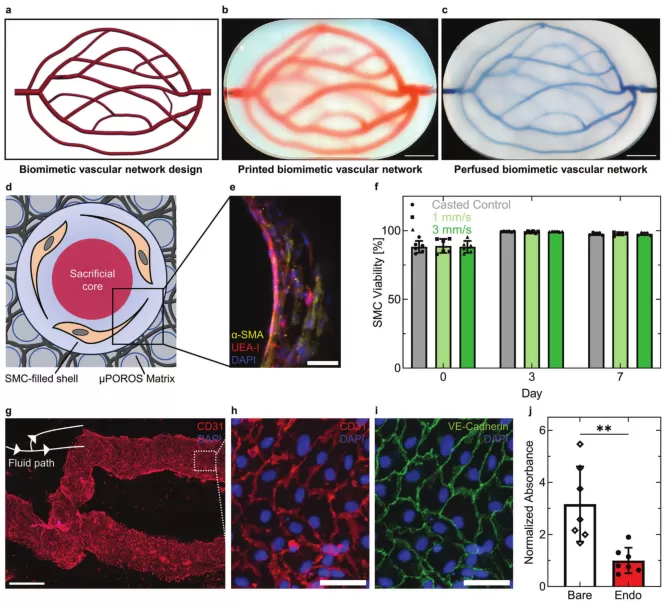
A team at Harvard University recently introduced a coaxial sacrificial writing approach (co‑SWIFT) that directly constructs multi‑layer branched vascular networks inside granular hydrogels and dense cellular matrices. The core of this method lies in a custom coaxial nozzle—the inner channel delivers a sacrificial gelatin core, while the outer channel carries a shell ink laden with smooth muscle cells. Both are simultaneously printed into a microparticle‑based collagen matrix. After printing, the construct is warmed to 37 °C: the gelatin core melts to create interconnected lumens, the shell ink gels into vascular walls, and subsequent endothelial cell seeding yields functional vessels surrounded by smooth muscle and lined with endothelium, which also exhibit good barrier function.
Cardiac tissues fabricated with this technique, after perfusion culture, beat synchronously and respond clearly to cardiovascular drugs, confirming both structural and functional maturation. This breakthrough opens new avenues for drug screening, disease modeling, and the production of vascularized organs for regenerative therapies, bringing scalable biofabrication of complex tissues one step closer to reality.


©2025 3dptimes.com All Rights Reserved