About Farsoon HighTech
Hunan Farsoon High-Tech Co., Ltd. was established in October 2009 in Changsha, Hunan Province by Dr. Xu Xiaoshu, a renowned 3D printing scientist. Adhering to the philosophy of "Independent Innovation and Open Sharing," the company persistently pursues high-quality independent innovation targeted at industrial applications, continuously advancing in the breadth and depth of science and technology, and steadily promoting innovation, entrepreneurship, and creation. It has become a leading enterprise in China's additive manufacturing industry. On April 17, 2023, Farsoon HighTech conducted its initial public offering of A-shares on the Shanghai Stock Exchange's Sci-Tech innovation board (STAR Market), with the stock abbreviation: Farsoon HighTech, Stock Code: 688433.
The company possesses the National Engineering Research Center for Additive Manufacturing of Complex Polymer Structures, approved by the National Development and Reform Commission. Its "Industrial-grade 3D Printing System" was included in the Ministry of Industry and Information Technology's (MIIT) first batch of smart manufacturing pilot demonstration projects. It is a national-level "Little Giant" enterprise specializing in specific sectors and a member unit of the National Technical Committee for Additive Manufacturing Standardization. The company has established wholly-owned subsidiaries in North America and Europe. Its self-developed additive manufacturing equipment and materials are sold to over 30 countries and regions worldwide, finding extensive application in fields such as aerospace, molds, automotive, medical, consumer goods, 3C electronics, and cutting-edge education and research. It is a global additive manufacturing enterprise integrating equipment R&D and manufacturing, material R&D and production, control systems, software, and technical service support.
As of August 2025, Farsoon HighTech has sold nearly 1,300 units to global clients.
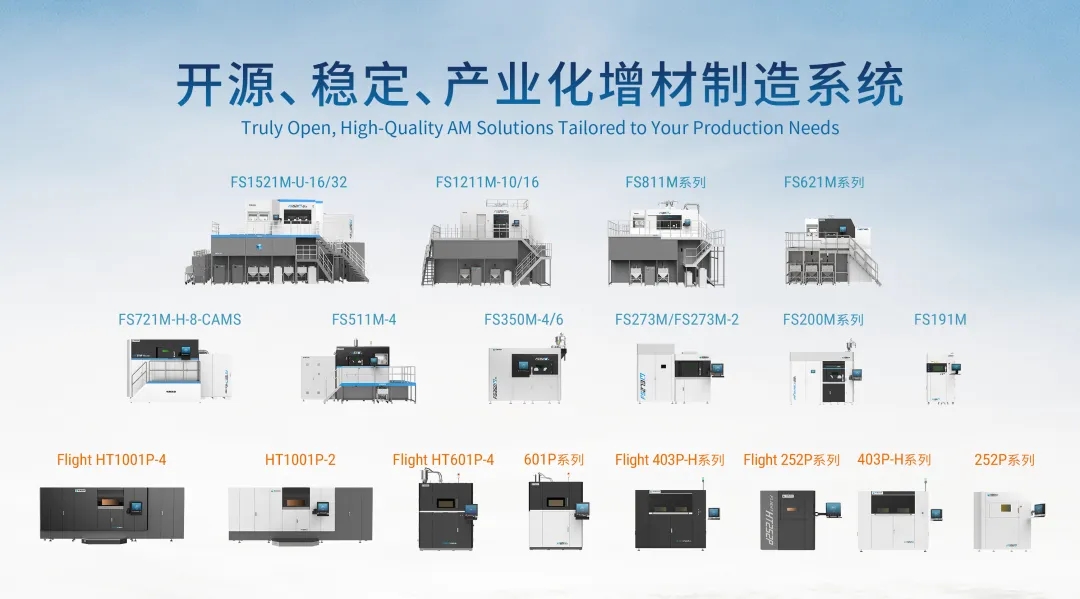
The company insists on facing the frontiers of world science and technology, continuously tackling key technologies in additive manufacturing and developing high-level equipment. It has broken through the "bottleneck" problem of system software in the additive manufacturing field, independently developing a full suite of industrial-grade additive manufacturing equipment software systems and mastering the source code for the entire software suite, supporting the autonomous controllability and continuous innovation of the overall additive manufacturing equipment. The company has undertaken major/key projects at various levels, including projects under the National Key R&D Program, MIIT's Industrial Transformation and Upgrading Key Projects, Industrial Strong Foundation Projects, Hunan Province's "Five 100" Major Product Innovation Projects, and Hunan Province's Major Science and Technology Projects. It has achieved numerous breakthroughs in core technologies such as the self-developed galvanometer control card (Farsoon Smart Controller), beam shaping (Farsoon Beam Shaping Technology), reduced support (Farsoon Support Reduction System), melt pool monitoring, high-precision printing, Cold Metal Fusion technology, SLS smooth post-processing technology, as well as in additive manufacturing production line construction, intelligence, and automation. As of August 2025, the company cumulatively holds 550 valid intellectual property rights, including 181 invention patents, 198 utility model patents, and 70 design patents; has registered 55 software copyrights; and has obtained 50 trademarks (domestic and international). It has led or participated in formulating 14 national standards and 6 industry standards for additive manufacturing technology. The company offers an open, customizable range of over 20 self-developed industrial-grade additive manufacturing systems for metals and polymers, and nearly 40 materials. These include: the FS1521M, an ultra-large metal additive manufacturing equipment developed for specific aerospace needs, with a build size of Φ1510mm*1650mm, configurable with up to 32 lasers and a long-life circulating filtration system, effectively solving challenges in integrated manufacturing of aerospace parts, significantly shortening part processing cycles, and reducing production costs; the HT1001P (1000mm*500mm*450mm), a polymer additive manufacturing equipment developed for efficient large-size integrated forming or batch production of small parts, featuring continuous production capability, dual lasers, and a build size exceeding 1000mm – this equipment is the main Chinese-brand powder bed additive manufacturing equipment deployed at the German BMW 3D printing factory; the Flight technology series of polymer fiber laser sintering systems, whose printing efficiency and accuracy rival international brands; and the UT252, one of the few global systems capable of printing PEEK materials. Farsoon has pioneered the establishment of a complete, independently innovative industrial-grade additive manufacturing technology system integrating equipment, software, materials, processes, and application technologies globally.
The company persists in enhancing the performance and technical capabilities of its self-developed, high-performance additive manufacturing equipment, helping to reverse the "bottleneck" predicament in high-end manufacturing. Its series of self-developed equipment are widely used in industries and units such as aerospace, medical, automotive, molds, and education/research, participating in and supporting the development of several national key model projects. Significant breakthroughs have been made in solving problems related to "integrated design of structure and function," "low-cost, short-cycle development," and "rapid integrated manufacturing of new products," providing important support for accelerating major mission construction in fields like aerospace and collectively tackling "bottleneck" problems.
The company insists on facing the main battlefield of the economy and the people's life and health, empowering national economic and social development. Guided by market and industrialization needs, it fully integrates resources across the industrial chain, continuously promoting technology transfer and multi-industry integrated application. It collaborates with leading automotive OEMs and parts manufacturers like FAW-Volkswagen on research and practice involving 3D printing-based parts optimization design, R&D verification, and small-batch manufacturing, empowering the leapfrog development of the automotive industry.
In the healthcare sector, it collaborates with Xiangya Hospital, Shanghai Ninth People's Hospital, Peking University School of Stomatology, West China School of Stomatology, A-Zenith, and Peri-dental on research and application of 3D printing digital assisted medicine, 3D printed personalized implants, and 3D printed dental frameworks. Its porous interbody fusion cage became the first laser 3D printed medical implant in China to obtain the NMPA Class III medical device registration. It cooperates with institutions like the Chinese Academy of Sciences, Shanghai Jiao Tong University, Sichuan University, Central South University, Harbin Institute of Technology, Huazhong University of Science and Technology, Jinan University, and South China University of Technology in scientific research and education, providing open-source additive manufacturing equipment systems and technical support for innovative research on new materials, designs, processes, and structures, and jointly building an additive manufacturing innovation ecosystem.
The company actively implements the "Going Global" strategy. It has established R&D centers and wholly-owned subsidiaries in North America and Europe, introducing high-end overseas technical and management talent. It engages in technical and industrial cooperation with renowned enterprises such as German Daimler (a globally renowned bus manufacturer), German BASF (a Fortune Global 500 chemical giant), Swiss Oerlikon (a world-renowned materials company), American Autodesk (a global leading software company), British AMT Company, and German Leibinger. It also conducts industry-academia-research collaboration with overseas renowned institutions like the University of Texas at Austin (the birthplace of Selective Laser Sintering additive manufacturing technology), University of Southern California, University of Louisville, and Korea Institute of Industrial Technology. On one hand, this fully promotes the global industrialization implementation and promotion of the company's independent innovation achievements, forming a highly internationally competitive Chinese independent additive manufacturing brand and demonstrating the strength of Chinese "Intelligent" manufacturing. On the other hand, through "Going Global," it effectively integrates with global innovation and industrial resources, promotes the digital transformation and upgrading of traditional manufacturing, stimulates rapid growth in industrial scale, and contributes significantly to the national economy and social development.