October 24, 2025      Applications      340

Open Source Ecology's founder develops open-source industrial machines to enable sustainable, self-reliant living after experiencing proprietary equipment limitations.

Source: MIT Technology Review

As the founder of Open Source Ecology (OSE), 53-year-old Marcin Jakubowski is dedicated to developing open-source industrial machines and tools for sustainable living.

Born in Słupca, Poland, Marcin immigrated to the United States as a child. There, he experienced for the first time the so-called prosperity brought by technology, with supermarkets filled with a vast array of agricultural products. That vibrant scene of abundance convinced him: achieving sustainable, prosperous living was possible in America.

However, after earning his PhD, Marcin's entrepreneurial venture of buying a tractor and starting a farm failed. Large US agricultural machinery manufacturers almost monopolize the market and, to this day, prohibit farmers from repairing their own tractors. His purchased tractor required repeated repairs, consuming large sums of money and ultimately leading to bankruptcy.

Thus, a physics PhD transformed into an idealist who handcrafts agricultural machinery. Starting with fixing one tractor, he aims to prove that only when technology is returned to people's hands can true freedom and abundance be possible.

From Physics PhD to Idealist Handcrafting Farm Machinery

After earning a bachelor's degree from Princeton University and a PhD in Physics from the University of Wisconsin, Marcin chose a path different from his peers.

After graduating with his PhD in 2003, he bought a tractor and started a farm in Maysville, Missouri, hoping to put his "theory of abundance" into practice. "I decided to abandon life in an office tower, and also to forego high-level research work studying microscopic problems. I wanted to study the big picture," he said.

Yet, just a few months later, the tractor broke down, and he went bankrupt.

Every time the machine malfunctioned, he had to pay John Deere for repairs. John Deere is one of the world's largest agricultural machinery manufacturers and a major producer of construction and forestry equipment, with a market capitalization of $120 billion. It still prohibits farmers from repairing their own tractors; unauthorized repairs void all insurance and warranties (except in Colorado, which passed a "Right to Repair" law in 2023).

Large agricultural machinery manufacturers like John Deere almost monopolize the market, and most parts for commercial tractors are proprietary designs. Farmers pay $1.2 billion annually in repair costs and lose $3 billion due to machine downtime. The root of these losses lies in manufacturers' decades-long lobbying, since the 1990s, against "Right to Repair" legislation. Currently, hundreds of farmers across the US have filed collective lawsuits.

"The machines are controlling the farmers, not the farmers controlling the machines." This made Marcin gradually realize that the prerequisite for self-sufficiency is agricultural autonomy, and the prerequisite for agricultural autonomy is open technology. So, he decided to apply the principles of open-source software to the hardware field: as long as farmers could freely access the designs and materials to build machines, they could repair them themselves, or even adapt tools more suitable for their needs.

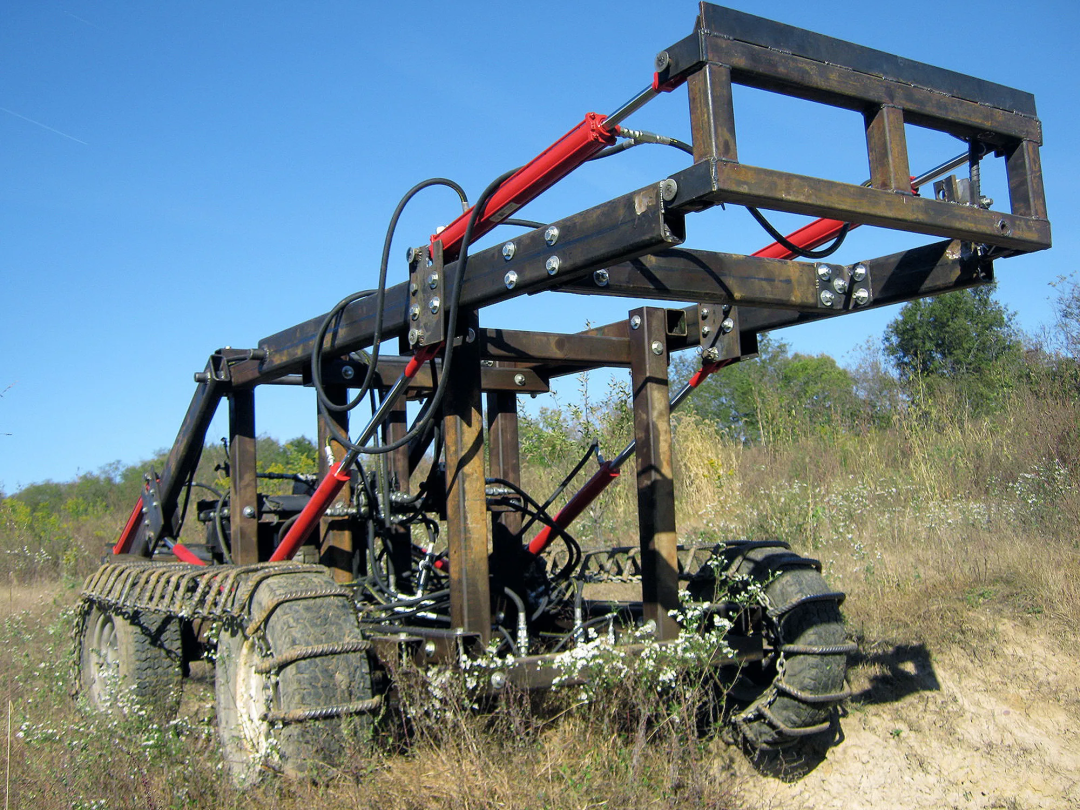
So, he built a tractor himself and published all the design blueprints on his website, Open Source Ecology (OSE). OSE is an open collaborative organization of engineers, manufacturers, and builders. Its goal is to create the "Global Village Construction Set (GVCS)" – a set of 50 machines, encompassing everything from tractors and ovens to circuit board manufacturers, which theoretically allows one to "rebuild civilization from scratch" and can be freely reconfigured according to individual needs.

Figure | Marcin, with his background in physics and mechanical engineering knowledge, built his own tractor (Source: MIT Technology Review)
This open-source tractor is modular and is one of the core components of the GVCS. The GVCS includes: a 3D printer; a self-powered hydraulic power unit called a Power Cube; a multi-purpose brick press, a sawmill, a CNC milling machine, a bioplastic extruder, and more. These machines are interoperable and can be combined. For example, the Power Cube can power the brick press, sawmill, vehicle, or wind turbine; the metal framework for a house structure can also be used to assemble a wind turbine.

Just like Linux's source code can be freely viewed, modified, and redistributed, all the construction blueprints, parts lists, assembly instructions, and testing plans for the GVCS are also publicly available online.

But unlike software, hardware cannot be infinitely replicated. It requires materials, manufacturing facilities, and detailed documentation. Today's globalized production chains are so complex that the parts for a single jacuzzi might come from seven countries and fourteen states. So how can we replicate these complex agricultural machines in our own backyards?

Marcin's answer: make technology appropriate.

"Appropriate technology" is a concept of technology designed for specific regions, affordable and sustainable. It originates from Gandhi's ideas of "self-reliance" and was popularized by economist Fritz Schumacher in Small Is Beautiful. The book states: "Any fool can make things bigger, more complex, and more violent. It takes a touch of genius—and a lot of courage—to move in the opposite direction."

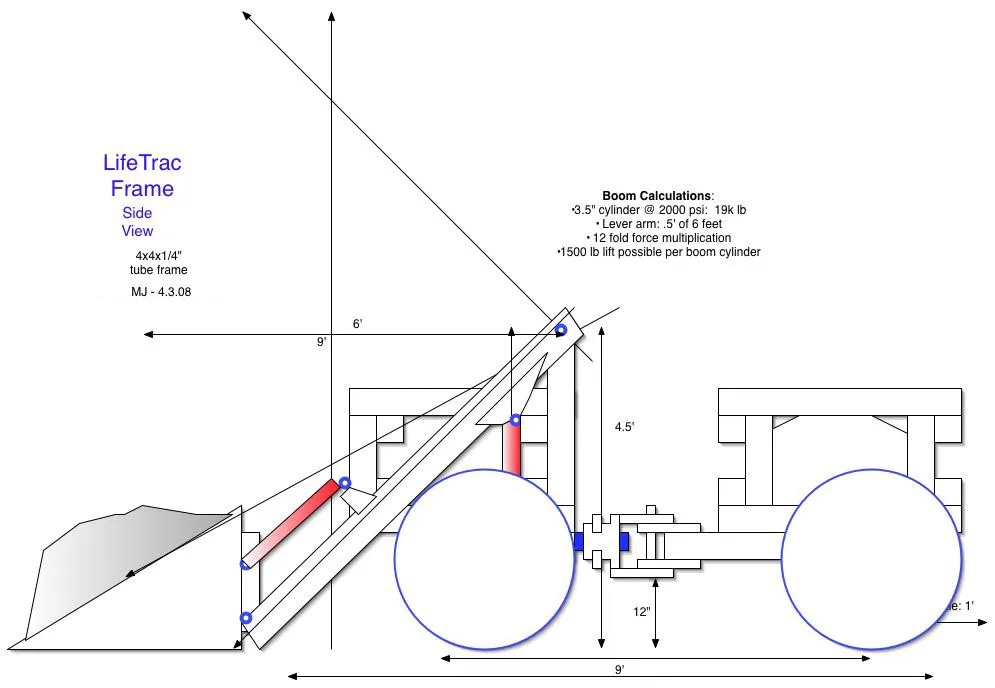
Marcin's machines are "appropriate" because they are built using recyclable materials and universal parts. This allows him to bypass complex global supply chains and replicate them using local resources.

Figure | Marcin's design schematics are all available online (Source: MIT Technology Review)

Building a House in Five Days

Although building your own tractor sounds daunting, the huge cost difference makes many people eager to try – a GVCS tractor costs about $12,000, while commercial tractors can cost $120,000, with repairs ranging from $500 to $20,000.

Shortly after the project launched in 2008, it attracted enthusiasts from Chile, Nicaragua, Guatemala, China, India, Italy, Turkey, and other countries. Over 110 machines have been replicated globally so far.

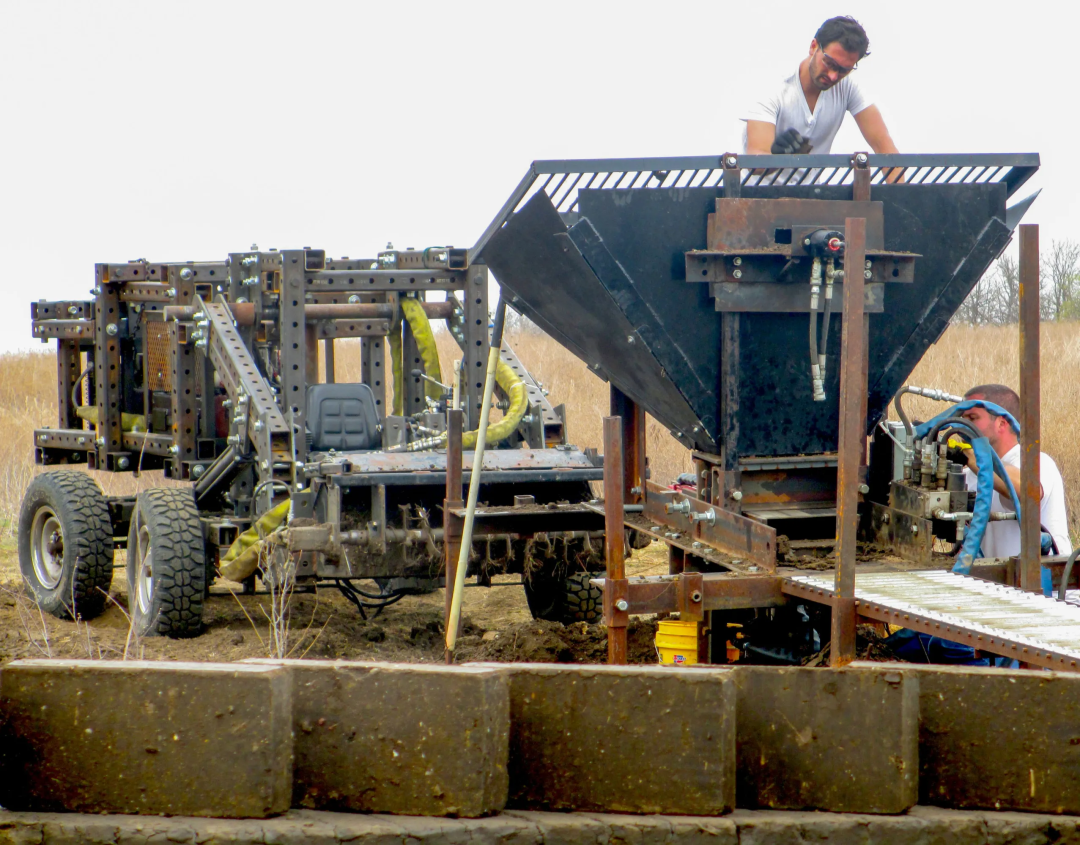
The most popular one is a brick press called the "Liberator" – it can compress local soil into energy-efficient bricks, saving money and energy. A resident in southern France used it to build his own home; in 2020, volunteers in a fishing village in northern Belize also used these bricks to build a small house.

A Texan named James Slate, with almost no engineering background, successfully built the "Liberator" by downloading the designs and even started a brick-selling company. Marcin recalled: "When he sent me photos, I thought it was a photoshopped image of my machine, but it turned out he really built it himself."

Figure | The "Liberator" can transform local soil into energy-efficient compressed earth blocks (Source: MIT Technology Review)
Today, most participants simply replicate Marcin's machines; few are truly able to improve the designs. They often need to go to his farm in Maysville to learn and practice hands-on.

To cultivate more people capable of building, Marcin announced the creation of the Future Builders Academy, which teaches skills for building affordable, self-sufficient homes.

These homes are called Seed Eco Homes. They use a modular "human-scale" design and are equipped with biogas digesters, geothermal cooling systems, solar power generation, and thermal storage units. The entire house is completely energy independent, can be built in just 5 days, and costs about $40,000.

So far, more than 8 demonstration homes have been built in the US, and Marcin himself lives in one of the earliest ones.

The Seed Eco Home is the culmination of the GVCS concept: it integrates multiple machine components into the housing construction system, realizing the vision of "building a home like assembling building blocks."

Marcin's ultimate goal is to achieve a "zero marginal cost society" – where the cost of producing each additional unit of a good or service approaches zero. Leveraging open-source design, decentralized manufacturing, and educational collaboration, he hopes to eliminate licensing fees and monopoly barriers, making technology truly fair and self-sufficient.

"Open-source hardware isn't just about letting farmers build tractors," he said. "It's a way to redefine the relationship between humans and technology."


©2025 3dptimes.com All Rights Reserved