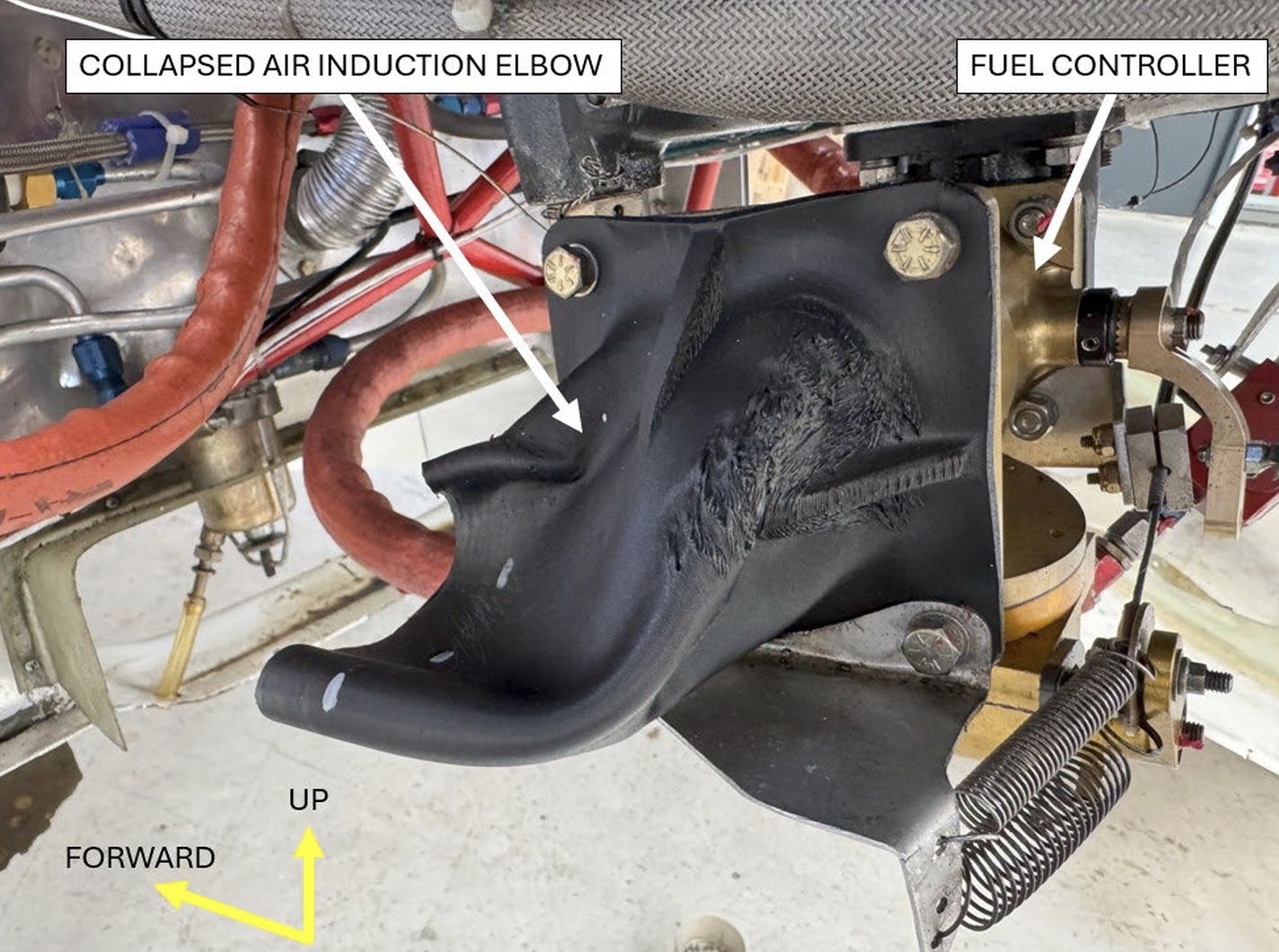
AAIB report states reason for engine failure was collapsed 3D printed air induction elbow
While 3D printing has become a popular tool for making low-cost replacement parts at home, like cupboard knobs, electronic mounts, and even 3D printer components, it is generally not advisable to use the technology to print safety-critical parts in an unvalidated setting. At least this was the lesson learned the hard way by a pilot in Staverton, England, whose light aircraft crash landed after a 3D printed part failed.
The incident occurred on March 18, 2025 and saw a Cozy Mk IV light aircraft crash into a landing aid system at Gloucestershire Airport. Fortunately, the plane’s pilot (and only occupant) made it out with only minor injuries when the crash occurred after the engine lost power on the final approach to runway. While the accident itself occurred months ago, a new report by the Air Accidents Investigation Branch (AAIB) reveals that the cause of the engine failure was a plastic 3D printed air induction elbow, which was attached to the engine. Over the course of the flight, the plastic had softened and collapsed, which limited the induction airflow to the engine and resulted in the failure.
According to the AAIB report, the owner of the aircraft had modified the plane’s fuel system and had installed a 3D printed induction elbow that was purchased at an airshow in the United States. The part was understood to be made from a carbon-fiber-reinforced ABS filament with a glass transition temperature of 105°C. The aircraft owner thought this would meet the requirements of the aircraft because other air induction elbows used in the aircraft plans are made from laminated bi-directional glass-fiber cloth with epoxy resin that has a glass transition temperature of 84°C.
“The aircraft owner stated that as the glass transition temperature listed for the CF-ABS material was higher than the epoxy resin, he was satisfied the component was fit for use in this application when it was installed,” the report states. “A review of the design of the laminated induction elbow in the Cozy Mk IV plans showed that it featured a section of thin-walled aluminium tube at the inlet end of the elbow, where the air filter is attached. The aluminium tube provides a degree of temperature-insensitive structural support for the inlet end of the elbow. The 3D printed induction elbow on G-BYLZ did not include a similar section of aluminium tube at the inlet end.”
Moreover, in further tests conducted on samples of the 3D printed part, the glass transition temperature was found to be no higher than 54°C. (The report does not say whether the build material was in fact what the aircraft owner thought it to be.) If at this point you’re wondering about regulatory infrastructure for DIY plane mods, there was a modification proposal submitted to the Light Aircraft Association (LAA), however it did not include the 3D printed air induction elbow. This meant that when the proposal was approved the LAA could not assess the printed part’s airworthiness.
Overall, the use of an untested and “inappropriate” material for the aircraft component as well as the oversight in the aircraft modification proposal led to engine failure in the aircraft, which—very luckily—did not end in lives lost. In light of this event, the Light Aircraft Association plans to publish a special alert regarding the use of 3D printed parts in aircraft modifications.
If anything, this plane crash incident shows how 3D printing should not be used to make safety-critical components that have not undergone tests or validation. In the larger aerospace industry, 3D printing technologies are increasingly being used to print engine components, aircraft interior parts, and critical parts. The difference is that all these parts have undergone rigorous qualification and quality control processes to ensure that they can withstand the temperatures and stresses of flight. The problem is thus not 3D printing in itself, but how the technology is used and what safeguards are in place.