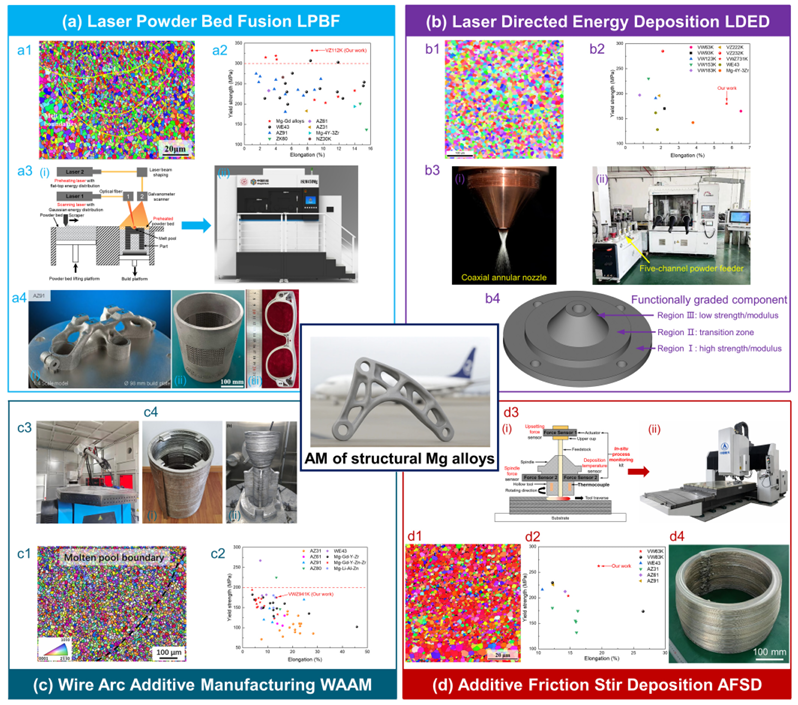
On July 24, 2026, Professor Peng Liming's team from Shanghai Jiao Tong University published a review in the Journal of Magnesium and Alloys, a top journal in the magnesium alloy field.
The paper systematically compares four technical routes for magnesium alloy additive manufacturing and, for the first time, discloses the parameters of four custom-built equipment systems developed by the team, along with raw material cost data.
Four Technical Routes, Each with Its Own Niche
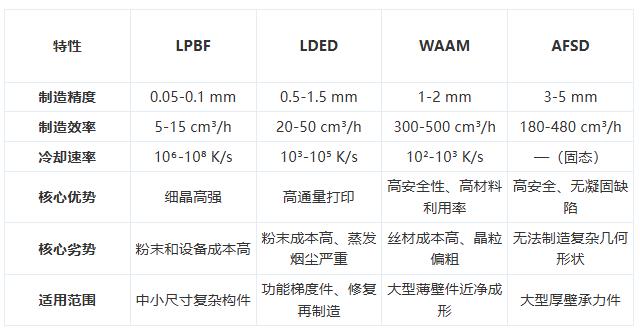
LPBF (Laser Powder Bed Fusion) is the king of precision manufacturing. It offers the highest cooling rate (10⁶–10⁸ K/s) and the finest accuracy (±0.05–0.1 mm), capable of producing ultrafine equiaxed grains of just 2–3 μm. The team's VZ112K alloy (Mg-11Gd-2Zn-0.4Zr) achieves a strong-plasticity synergy with a yield strength of 332 MPa and an elongation of 8.6%. Their custom-built four-beam LPBF system (420×420×450 mm³) employs a "preheating-melting" separation strategy—two flat-top large-spot lasers for preheating and two Gaussian small-spot lasers for melting—effectively mitigating thermal stress and cracking. It is suitable for small-to-medium-sized complex components.
LDED (Laser Directed Energy Deposition) is a coaxial powder-feeding process with a cooling rate of 10³–10⁵ K/s and accuracy of ±0.5–1.5 mm. Its standout advantage is high-throughput alloy development—a single batch can print about 100 different compositions, enabling functionally graded components. The team's VWZ731K alloy delivers a yield strength of 180 MPa and an elongation of 5.7%. Their custom-built system (800×800×300 mm³) is equipped with a five-channel powder feeder. It is suited for manufacturing and repairing large structural parts, as well as functionally graded components.
WAAM (Wire Arc Additive Manufacturing) uses wire feedstock and an arc heat source, with a cooling rate of 10²–10³ K/s and accuracy of ±1–2 mm. It produces very few pores and offers excellent plasticity. The team's VWZ941K alloy achieves an elongation of 13.6%. Their custom dual-wire WAAM system (1500×1500×1000 mm³) integrates two independently controlled CMT arc sources, allowing in-situ composition adjustment. It is ideal for near-net shaping of large thin-walled components.
AFSD (Additive Friction Stir Deposition) is the only solid-state process that does not involve melting, completely avoiding porosity and hot cracking issues. It has a deposition rate of 180–480 cm³/h and produces grains of 2–4 μm. The team's VW63K alloy achieves an elongation of 19.5%—the highest plasticity reported among all routes. Their custom system (2000×2000×500 mm³) integrates an online monitoring suite. It is suitable for large thick-walled load-bearing components.
The Core Trade-off: Precision and Efficiency Cannot Both Be Maximized — LPBF offers the highest precision but the lowest efficiency (5–15 cm³/h), while WAAM delivers the highest efficiency (300–500 cm³/h) but the coarsest precision.
Three Major Challenges and Solutions
Raw materials are expensive and scarce—this is the biggest bottleneck. Powder costs are approximately $118/kg for AZ91D, $221/kg for WE43, and $265/kg for Mg-Gd, while Mg-RE wire costs as much as $1,031–$1,179/kg. Solutions include building dedicated production lines, powder recycling, ultrasonic atomization as an alternative, and developing "direct wire casting" processes to reduce costs.
Evaporation and spatter severely impair performance. Countermeasures include in-situ synchrotron radiation observation, powder pre-sintering, and laser beam shaping.
Thermal stress and cracking worsen with increasing part size. Solutions include preheating the substrate to 300–400°C, using auxiliary heat sources, and introducing external physical fields.
Six Future Directions
Integrated optimization of deposition paths and topological structures; multi-beam collaborative additive manufacturing (using auxiliary lasers to actively "program" the thermal history of the melt pool); comprehensive performance optimization (current research focuses on room-temperature tensile properties while neglecting corrosion and fatigue); high-fidelity computational modeling; AI-driven alloy design (LDED high-throughput printing combined with machine learning to achieve "on-demand" material customization); and full-chain standardization.
The value of this review lies not in a superficial summary, but in providing first-hand data and clear judgments based on over a decade of deep research. Magnesium alloy additive manufacturing is moving out of the lab—at a time when demand is surging in low-altitude economy, humanoid robotics, and new energy equipment, the need for "dual lightweighting of materials and structures" has never been more urgent.
Paper Information:
Deng Qingchen (first author), Peng Liming (corresponding author), Journal of Magnesium and Alloys, July 24, 2026, DOI: 10.1016/j.jma.2026.102174