This tool does not rely on specialized hardware. It is open‑source, free, and has a very low entry barrier – well worth a try for every 3D printing enthusiast.
A new breakthrough has been made in color mixing 3D printing. A foreign blogger, 3D Revolution, has developed a free and open‑source tool called Primed3D, which allows FDM multi‑color printing to achieve photo‑level full‑color effects using only 3 to 5 filaments, through a dithering algorithm.
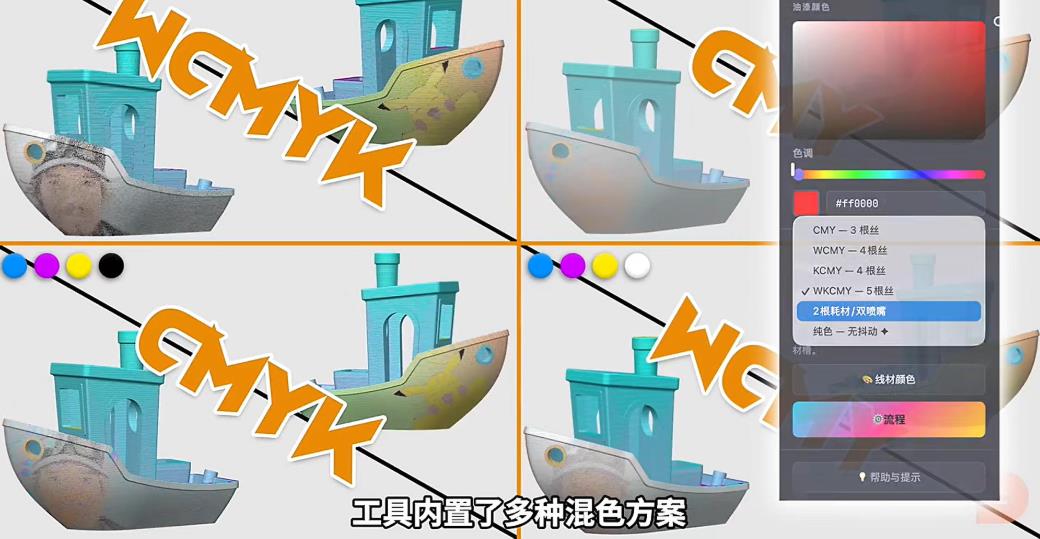
For a long time, FDM printing faced a high barrier when it came to reproducing true‑to‑life colors. The core logic of Primed3D is “dither printing” – converting colors or even real photos into dither line patterns, and using the human eye’s color mixing effect to simulate rich colors with a limited number of filaments.
The tool includes three coloring methods:
Manual fill: Use a brush or fill tool to apply color directly onto the model surface.
Two‑color gradient: Automatically generates a gradient effect between any two colors you choose.
Custom gradient direction: You can freely define the angle and direction of the color gradient – a first among similar tools.
The most impressive feature is the photo projection function: import a 3D model, select a photo, adjust its position, size, and angle, and with one click, the image is perfectly mapped onto the model surface. The official recommendation is to use the WKCMY five‑color mode (White, Black, Cyan, Magenta, Yellow), which delivers better detail and contrast.
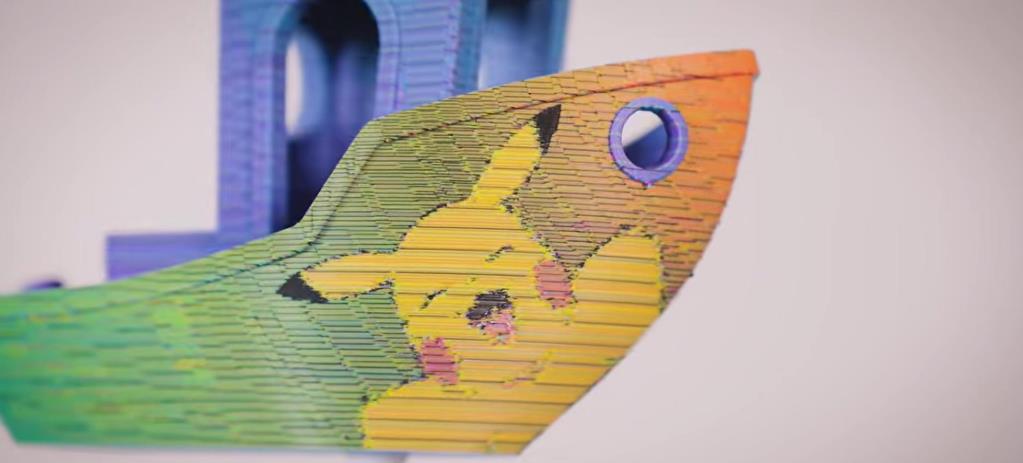
Actual printed results – such as a Pikachu pattern or a real‑life portrait – show high fidelity. Note that a layer height of 0.08 mm is required to ensure color accuracy. Printing this way is time‑consuming and works best with multi‑toolhead printers, but technically it is compatible with any multi‑color FDM printer that supports pause‑and‑filament‑change.
Two common issues:
Black streaks: This is a normal effect of the dithering algorithm when darkening shadow areas. Up close, you may see some grainy noise, but from a distance the result looks much better.
Overall darkness: The official suggestion is to increase the brightness of the image slightly before importing it – the final print will then be closer to the real colors.
In addition, Primed3D has added a solid color mode, which lets you export multi‑color models without dithering mixing. This is suitable for scenarios that demand higher color accuracy and no noise. The development team is currently refactoring and optimizing the algorithm, and future versions will include features like photo simplification to further reduce graininess.