September 22, 2026      9151

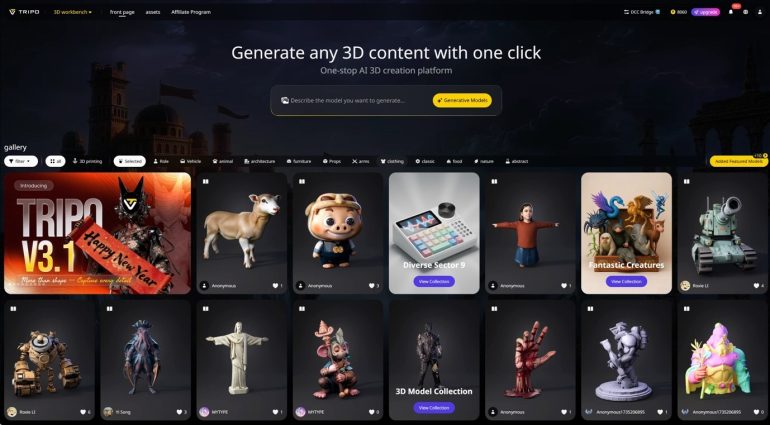
On September 10, 2026, Tripo AI announced that it had closed Series B and B+ funding, raising a total of about $447 million, led by MPCi.

Strategic and financial backers such as Perfect World, CDH Ventures, and CICC joined the round, while existing investors increased their positions. The funds will be used to advance 3D-native foundation models and data infrastructure, expand compute for training and inference, and support further product development and commercialization.
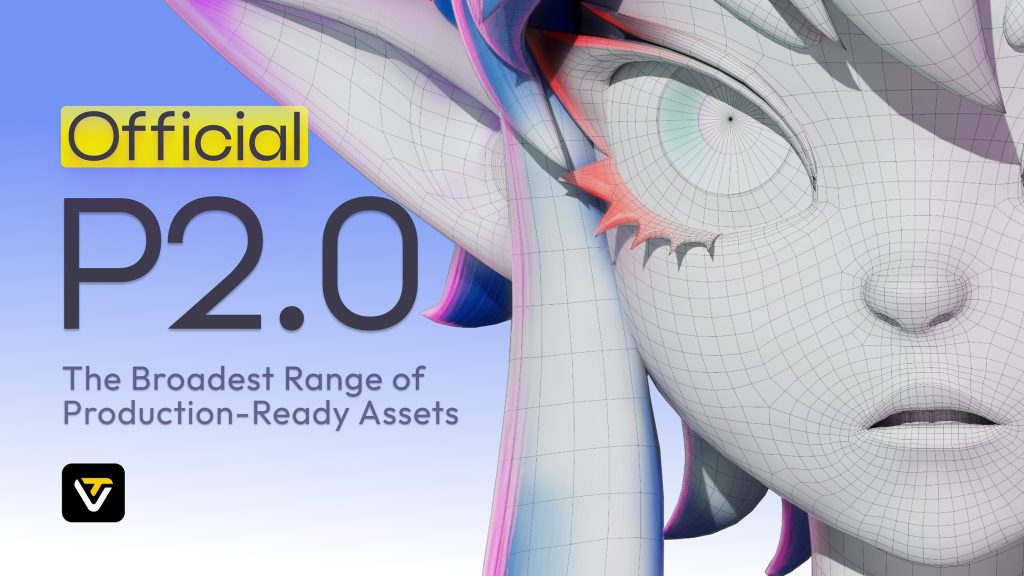
On the same day, Tripo released a preview of P2.0. An upgrade to Tripo P1.0, it is billed as the industry’s first 3D foundation model with native support for quad topology. Quad meshes are generally easier to edit, rig, and animate than triangle meshes. P1.0 capped out at 20,000 triangle faces; P2.0 raises triangle topology to 50,000 faces and introduces quad topology of up to 25,000 faces, making it better suited to hard-surface mechanical parts, detailed characters, and modular building components. It also supports multi-view reconstruction from up to four reference images—front, left, right, and back—delivering more reliable side and back views. Generation takes about 10 to 40 seconds, depending on face count.
Tripo is targeting P2.0 at game development and real-time production: characters and props can go straight into rigging and animation without a separate retopology step, while weapons, vehicles, and mechanical parts keep flat panels clean and detail concentrated where needed. Users can try the preview through Tripo Studio. Single-image generation is free twice per user, while multi-view input is reserved for subscribers. The full version will launch later.
The round also shows that AI 3D generation is heating up. Meshy closed a nearly $400 million Series B in July this year at a $1.5 billion valuation, while Alphabet acquired Common Sense Machines earlier this year. Both investors and big tech are racing to own the next generation of 3D content infrastructure. For 3D printing and modeling workflows, quad topology, multi-view input, and higher mesh budgets mean AI-generated assets are moving from “looks good” to “ready to use.”


©2025 3dptimes.com All Rights Reserved