On August 27, 2026, Chinese company SHINING 3D launched the EinScan Trak tracking scanning system.
Its core breakthrough is simple: you no longer need to cover a large object with reflective markers before scanning.
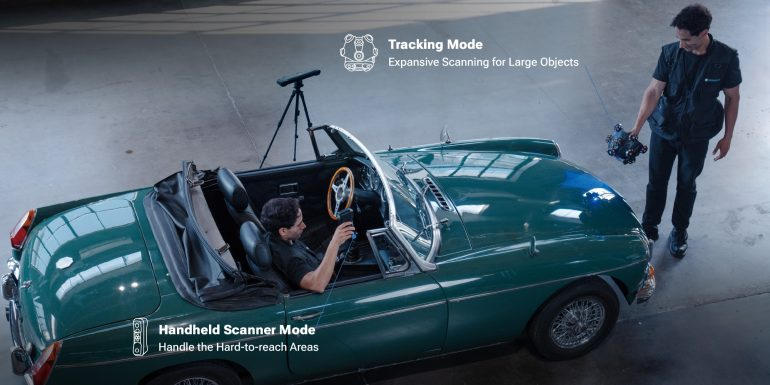
In the past, original paint on a classic Porsche or untouchable artifacts in museums made markers a dead end. The system sidesteps this by having the optical tracker follow the scanner itself, not the target object. The spherical scanning module has built‑in reflective marks on its shell; the tracker reads those to determine position, so the object’s surface stays completely clean.
What makes it even more practical is the detachable handheld scanner inside. Pop it out and you get a standalone wireless handheld device for wheel wells, deep cavities, or small parts. Data from both modes can be imported into the same project file – for example, scan the car body in tracking mode, then detach the handheld to capture the intake manifold, all without switching software or re‑registering datasets. This cross‑scale flexibility is where the real time savings lie.
The laser system offers three projection modes: 19 pairs of crossed lines for fast wide‑area coverage, 7 parallel lines that trade speed for sharper edges on tight‑tolerance mechanical parts, and a single line dedicated to deep holes and narrow channels. The scanner captures up to 2,630,000 points per second at a resolution as fine as 0.05 mm, and you can switch resolution settings locally within the same project to balance speed and detail where it matters. A 5‑megapixel texture camera captures color simultaneously – just as critical as geometry for cultural heritage digitization and AR/VR asset creation.
Wireless connectivity uses Wi‑Fi 6 over a dedicated local network, with an effective range of four meters from the tracker. Battery life runs 5.5 hours in tracking mode and 3.5 hours in handheld mode, with hot‑swappable batteries so you never need to power down. The carbon‑fiber body keeps it portable. And if four meters isn’t enough, the “Hybrid Leapfrog” function lets you reposition the tracker during scanning without interrupting the workflow. Outdoor use is supported up to 110,000 lux, and it handles challenging surfaces like glossy black, bare metal, and reflective finishes without any spraying.
On the software side, EXMeasure handles dimensional inspection – GD&T, flatness, parallelism, caliper simulation, and color‑mapped comparisons – while EXModel tackles reverse engineering with mesh cleaning, automatic surface generation, and CAD‑ready export (the latter requires a separate purchase). The system comes with a one‑year EXMeasure license. This setup is especially suited for automotive custom shops, heritage preservation teams, and on‑site reverse engineering – in short, anyone tired of surface prep and hauling different gear for different jobs will find it worth a closer look.