3D Printing "Hits the Road," Propelling Chinese Hypercar to Become World's Fastest!
On September 20, 2025, BYD's premium brand, Yangwang, officially launched its track-special edition – the Yangwang U9 Xtreme (U9X). This hypercar, limited to just 30 units globally, set a new record with a top speed of 496.22 km/h, claiming the title of the world's fastest production car.
Recently, the U9X gained further international recognition, scoring highest from the jury at the Euro Car Body Conference for its "Carbon Fiber Ultra-Safe Body Structure" and "Production-Level 3D Printed Integrated Body Technology." It was the only Chinese brand model to receive an award.
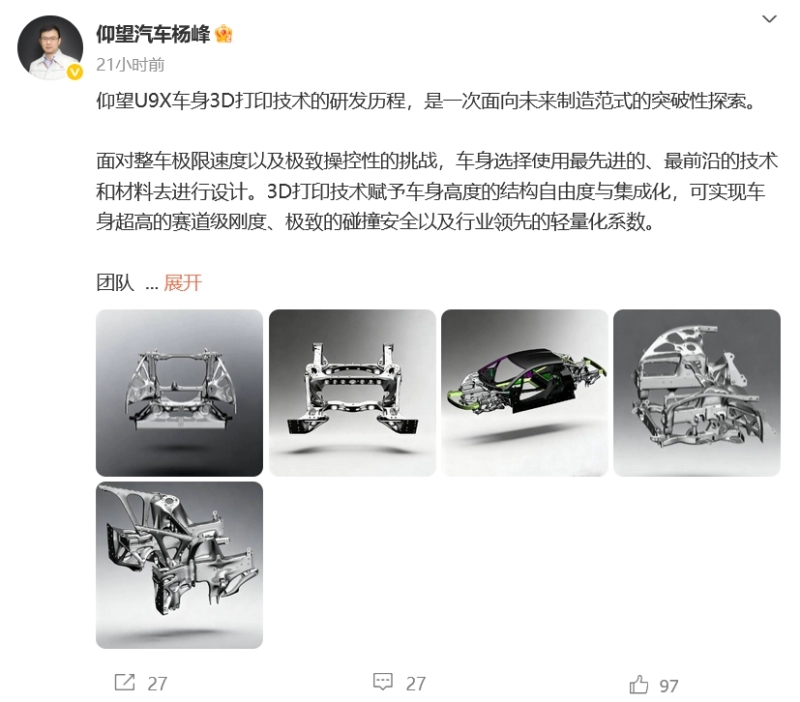
Regarding the application of 3D printing technology in the U9X, Yang Feng, President of the Yangwang Research Institute under BYD's Automotive Engineering Research Institute, praised it highly. On October 30, he published a detailed post on Weibo disclosing the technology's R&D background and core advantages.
Yang stated that the U9X's core structural components are manufactured via 3D printing. Based on aerospace-grade materials, a high-strength aluminum alloy structure was developed, achieving yield strength three times that of traditional materials. Furthermore, a pioneering "Multi-dimensional Surface Parametric Modeling Technology," combined with a Printing HyperCell structure, increased torsional stiffness by over 200% at an equivalent weight. Utilizing Laser Powder Bed Fusion (LPBF) technology, they achieved 0.03mm-level precision, with key component tolerances controlled within ±0.1mm.
This technology significantly improved the U9X's dynamic response during cornering at 400 km/h. This breakthrough not only validates the engineering feasibility of aerospace-grade manufacturing processes in the automotive field but also paves an innovative path for the subsequent adaptation of aerospace technologies to automotive standards.
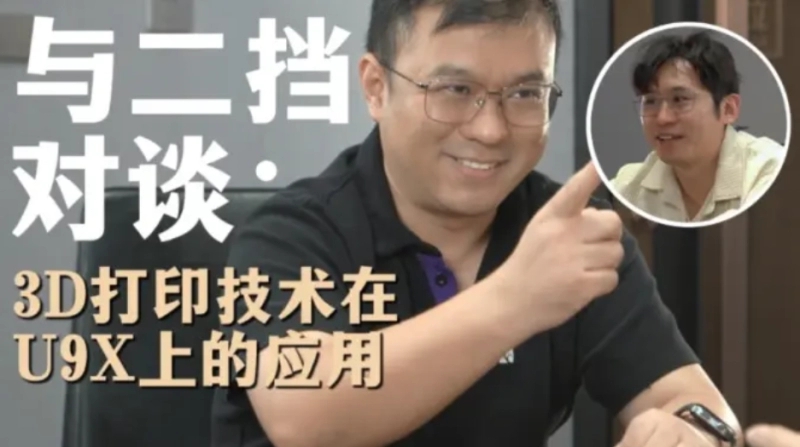
In fact, prior to this Weibo post, Yang Feng had given an in-depth interview to "Second Gear Start Reviews," explaining the U9X's engineering philosophy and technical breakthroughs, particularly how 3D printing achieved extreme vehicle lightweighting without compromising performance.
Uncompromising on Performance: Shifting from "Reducing Features" to "Emphasizing Design"
"I said from the very beginning that we cannot sacrifice performance," Yang recalled. During the initial project phase, the team proposed several lightweighting solutions, but most revolved around "cutting features" and "simplifying functions." He rejected these approaches without hesitation, insisting that "performance must not be decreased, only increased."
After repeatedly refining the design, they realized that traditional weight reduction methods had reached a bottleneck. Structural optimization of the entire vehicle body had nearly been pushed to its limit, making further breakthroughs via conventional paths difficult. It was then that they turned their focus to the manufacturing method itself: 3D printing.
"The most critical turning point was actually when we re-examined how the body structure was manufactured," Yang explained. Originally, the front and rear aluminum assemblies were made using traditional casting and extrusion processes. While lightweight, these involved complex connections and process limitations, particularly requiring regular shapes for structural cavities, making it difficult to balance strength and lightweighting.
"Later, we decided to replace them all and use 3D printing instead."
This decision completely opened up the design space. They used 3D printing to remodel the structures, mimicking bird bone anatomy by completely hollowing out non-load-bearing areas, significantly reducing wall thickness, and entirely eliminating redundant material from joints inherent in traditional structures, achieving true integrated formation.
Furthermore, they integrated the rear subframe with the bodywork. All mounting points for components like suspension arms were finalized during the 3D modeling stage and 3D printed in one go, truly integrating structural optimization with manufacturing.
Titanium Calipers, Door Hinges... 3D Printing Rolls Out Comprehensively
Beyond the body structure, the Yangwang team also extended 3D printing technology to several key components: the caliper housings were 3D printed from titanium alloy, maintaining strength while improving high-temperature heat dissipation. Door hinges were also replaced with 3D printed structures instead of traditional large castings, achieving significant weight reduction. Even some heat sinks and basic structural elements were redefined in form and performance through 3D printing.
"You might not believe it, but 3D printing optimization alone shed a full 100 kilograms from this car," Yang revealed. This was a disruptive improvement brought by 3D printing, coming after traditional lightweighting methods had exhausted their potential.
The Future of Manufacturing: Additive Manufacturing is Not an Option, But an Inevitability
Concluding the interview, Yang Feng stated: "3D printing is not just an update in manufacturing technology; it's a disruption of automotive design philosophy."
He disclosed that Yangwang has positioned Additive Manufacturing as a strategic technology for its mid-to-long-term plan. They also hope that the innovative practices from this model will lay the foundation for the entire future product series.
Today, Chinese hypercars are also stepping onto the world stage. The Yangwang U9X similarly chose 3D printing as its breakthrough point, not only setting speed records but also demonstrating the technical prowess of Chinese manufacturing.
It is foreseeable that the future exploration of smart manufacturing and lightweight design in China's automotive industry will increasingly rely on 3D printing.
And the Yangwang U9X provides us with a viable path forward.