University of Sheffield researchers investigate the use of stainless steel 17/4 ph
According to the University of Sheffield, magnetostrictive materials have a large response to external strain or applied field, which allows them to be used as sensors or actuators in structural health monitoring, the Internet of Things, and healthcare sectors. Additive manufacturing allows tunable performance and flexibility in designs, which creates a natural lead to further explore the printing process and design for magnetostrictive materials.
Using AM with magnetic materials is a relatively new area of research. This project investigated the use of stainless steel 17/4 ph, a soft magnetic material ideal for smart applications due to its low coercivity and high saturation magnetization. Using the Desktop Metal 3D printer, a range of parts were printed to achieve triangular honeycombs with varying feature sizes.
The Superconducting Quantum Interference Device (SQUID) Magnetometer was used to measure the hysteresis loop at each stage of the printing process; during injection moulding, as-printed, and the final sintered steel part. Both the coercivity and saturation magnetization were measured, and a 12.6% lower coercivity was noted alongside a remarkable 18% increase in saturation magnetization for the final sintered part. Also measured was the directional magnetization for track prints in the as-printed and sintered steel parts. The anisotropy was shown to be lower in the sintered steel than in the as-printed parts due to grain growth, lower porosity, and reduction of the polymer material.
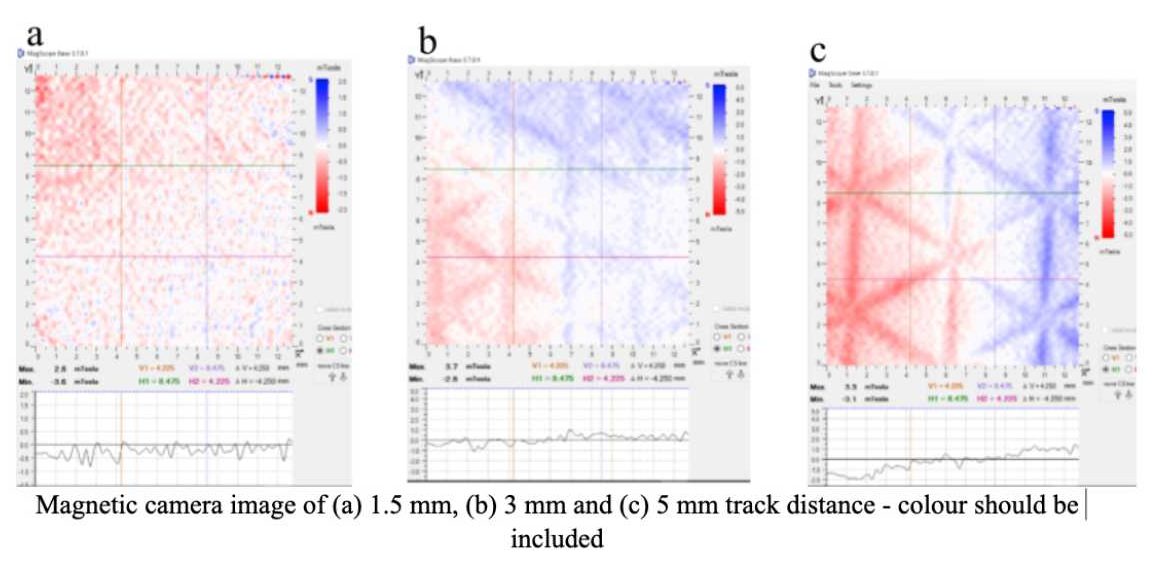
“The Honeycombs were printed with different track distances so that we could test how this influences the magnetostrictive and magnetic performance using a magnetic camera. The demagnetizing field revealed a split positive and negative out-of-plane field, more distinctive in the larger track gap, which may be due to the sintering process, where shrinkage is observed. It was found that the sintered steel had a 54% higher magnetostriction constant compared to that of the as-printed steel,” said Nisar Ahmed, Doctoral Researcher at the University of Sheffield.
The ready availability of stainless steel 17/4 ph, the intuitive user interface of the Desktop Metal 3D printer, and the use of pre-programmed designs mean that this mode of production is highly replicable and is well-suited for large or small industrial workplaces to adopt and utilize. Magnetostrictive materials are extremely useful in the development of smart devices; therefore, being able to manufacture them in an accurate manner would open up further applications where sensors or actuators are required. The discovery of positive and negative out-of-plane fields in the magnetic imaging of our test grid structure shows the future possibility to manipulate the magnetostrictive performance and directional magnetism of AM stainless steel 17/4 ph products.