Compact system sustainable designed for offices, labs and smart factories recognized with 2026 Robotics Honoree award
Korean company Ohsung System Co., Ltd. has been recognized as a 2026 Robotics Honoree at CES 2026 for its Gauss MT90, a compact 3D printer that uses metal paste and is built on Paste-based Metal Extrusion (PME) technology. The system is designed to provide a safer, lower-energy alternative to conventional metal additive manufacturing, which typically relies on laser sintering or high-heat welding.
Learn about MetalPrinting and its Gauss MT90, the award-winning 3D printer offering a compact and safer alternative for all users.The Gauss MT90 replaces metal powders and lasers with a paste-based approach that removes dust and eliminates explosion hazards, making it suitable for offices, laboratories, and educational settings as well as industrial production lines. A built-in high-efficiency particulate air (HEPA) filter captures emissions during printing, while an LED status system provides real-time updates for users.
Ease of operation is a core feature. The printer’s Quick Start mode automatically configures key settings for new users, and an automatic bed replacement system allows for continuous production and integration into automated workflows.
The Gauss MT90 incorporates an AI-enabled camera viscosity monitor, a precision dispensing algorithm, and an extrusion control system to ensure consistent material flow. These features support high-accuracy printing for components such as heat sinks and electronic parts. The machine supports several materials, including stainless steel, copper, titanium, and aluminum, and is intended for both prototyping and end-use production.
By replacing laser-based sintering with a low-heat, paste extrusion process, the system reduces power use and carbon emissions while maintaining print quality. Its low-noise design also supports quieter operation in shared environments.
Efficiency and versatility in production
Conventional metal 3D printing relies on selective laser melting or binder jetting methods, which use fine metal powders and high-power lasers to fuse materials. These processes pose safety risks from dust and explosion hazards and require substantial energy for melting or binding.
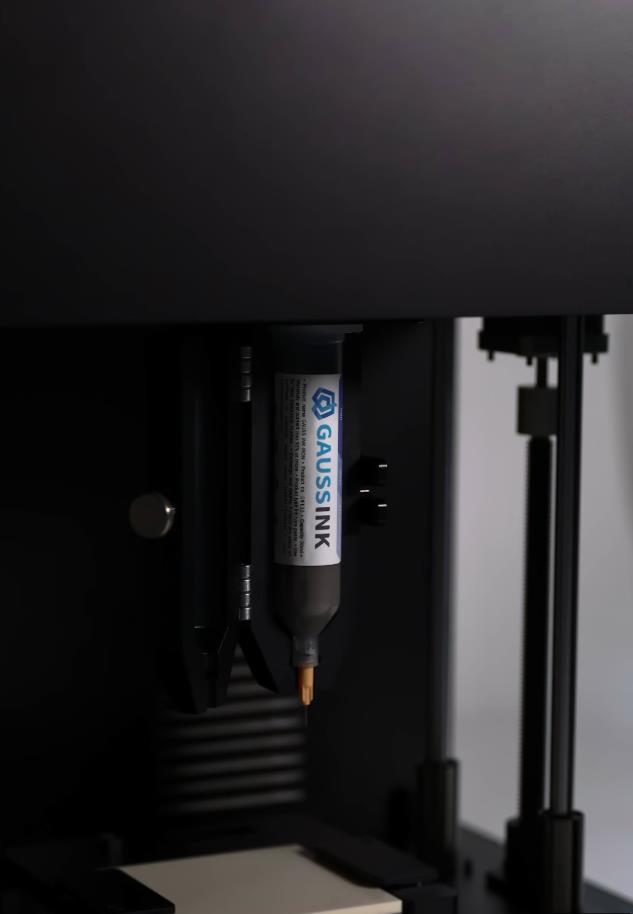
In contrast, Ohsung’s patented PME method, which has filed a Patent Cooperation Treaty (PCT) application, uses a paste-like metal ink that is squeezed out layer by layer based on a digital design. The printed part is then sintered in a furnace to form a dense metal object. This process eliminates the need for lasers or separate heating mechanisms during printing, significantly reducing energy use and operational hazards.
The PME process begins with the formulation of a paste-type metal ink, created by mixing metal powder with a binding medium. The ink is filled into a sealed cartridge and mounted onto the printer. Once printing is complete, the layered part is transferred directly to a sintering furnace without additional cleaning. The final product retains the mechanical properties of pure metal and can undergo standard post-processing if required.
The Gauss MT90’s PME technology minimizes material waste and simplifies handling compared to powder-based systems. The process supports customized production runs and short lead times, making it suitable for prototyping, small-batch manufacturing, and specialized component fabrication.