Under the drive of capillary action, when a liquid comes into contact with a super-lyophilic rough surface, it spontaneously wicks into the texture; this is known as capillary wicking, which is widely used and highly significant in applications such as microfluidics, self-cleaning surface design, and lab-on-a-chip technologies. However, due to a lack of fabrication techniques, the phenomenon of wicking at the mesoscopic scale roughness has been scarcely studied. Inspired by the South American sun pitcher plant (Heliamphora minor), a research team from the Chinese Academy of Sciences utilized 3D printing technology to fabricate simulated mesoscopic trichome arrays and investigated the high-throughput capillary wicking process. Unlike the climbing film of uniform thickness on micro-textured surfaces, the spaced filling of trichomes with millimeter lengths and sub-millimeter spacing forms a liquid film of non-uniform thickness. Differing from the viscous dissipation dominant on micro-textured surfaces, the article reveals an inertia-dominated transition region with mesoscopic wicking dynamics and constructs a scaling law where the height grows to the 2/3 power of time under various conditions. Finally, emulating the plant's nutrient supply method, the research team studied mass transport within the non-uniform thickness film and achieved open-system siphon flow within the film, with its flux saturation condition determined experimentally. This work explores capillary wicking in mesoscopic structures and holds potential application value in the design of low-cost, high-throughput open fluid systems.
Main Content
01 Nature's Fluid Master: The Sun Pitcher Plant (Heliamphora minor)
In the cloud forests of South America, an insectivorous plant named the Sun Pitcher Plant (Heliamphora minor) grows quietly. The inner wall of its pitcher-shaped leaves is covered with dense, millimeter-scale trichomes. These seemingly simple structures are actually masterpieces of fluid transport, refined by hundreds of millions of years of natural evolution.
Research has found that when rainwater or dew falls into the pitcher, the liquid spontaneously forms a lubricating layer on the trichome array. This not only helps the pitcher plant trap insects but also efficiently drains excess water, preventing rot from accumulated fluid inside the pitcher. This mesoscale structure (millimeter-length + sub-millimeter spacing) perfectly balances capillary action and fluid inertia, becoming a new key for scientists to solve the challenge of high-throughput fluid transport.
Science Cool Fact!
Traditional microfluidic devices rely on microstructures (micrometer scale) but are limited by low flow rates; whereas macroscopic pipes require external pumps for driving. The mesoscopic structure of the Sun Pitcher Plant precisely fills this gap!
Why is it Important?
Existing microfluidic technologies rely on complex pumps and valves, whereas the pitcher plant-inspired solution enables self-driven, high-flow, low-energy fluid manipulation through structural design alone!
03 Bionic Applications: From Lab to Industry
This research, published in Biomimetics, not only reveals the secrets of fluid dynamics in nature but also catalyzes a series of disruptive applications:
Chip Cooling: Say Goodbye to Fans and Pumps
Heat generation in electronic devices is a bottleneck limiting computing power improvement. Bionic trichome brush arrays can automatically transport coolant via capillary action, with flow rates far exceeding those of microchannels. Future phones or servers might feature built-in "electronic pitcher plants" for silent, efficient cooling.
Agricultural Irrigation: Zero-Energy Water Transport Systems
In arid regions, the open siphon structure can utilize day-night temperature differences to condense dew and automatically transport it to crop roots via the brush arrays, reducing energy consumption by up to 90%. The team has successfully tested this in simulated desert environments in the lab.
Mass Transport: Bionic "Plant Veins"
Through experiments dissolving nutrients (like sugar, salt), the team found that the non-uniform liquid film preferentially evaporates in the thin layer regions, causing solutes to crystallize directionally at the top. This mechanism could be applied to drug-delivery patches or microreactor design.
Conclusion and Outlook
This study successfully replicated the mesoscopic trichome structure of the Sun Pitcher Plant (Heliamphora minor) through bionic design and 3D printing technology. It revealed the inertia-dominated mechanism and non-uniform film dynamics in its capillary wicking process, and established a height-time scaling law (H ∝ t²/³), filling a theoretical gap in fluid transport at the mesoscopic scale. The mesoscopic capillary theory proposed in this work demonstrates that millimeter-scale structures can achieve high-throughput, self-driven fluid transport through inertial effects. Based on this, the developed open siphon system, requiring no external pump, achieves a flow rate three times that of traditional siphons, providing revolutionary solutions for fields such as microfluidics, chip cooling, and agricultural irrigation.
When scientists pose questions to nature, the answers are already written in billions of years of evolution. The mesoscopic structures in nature are "metamaterials" optimized over eons, and the mission of biomimetic science is to decode their physical essence with engineering wisdom, reshaping the boundaries of human technology. This research not only opens a new paradigm for capillary hydrodynamics but also heralds a new era of self-driven, low-energy, high-throughput fluid technology.


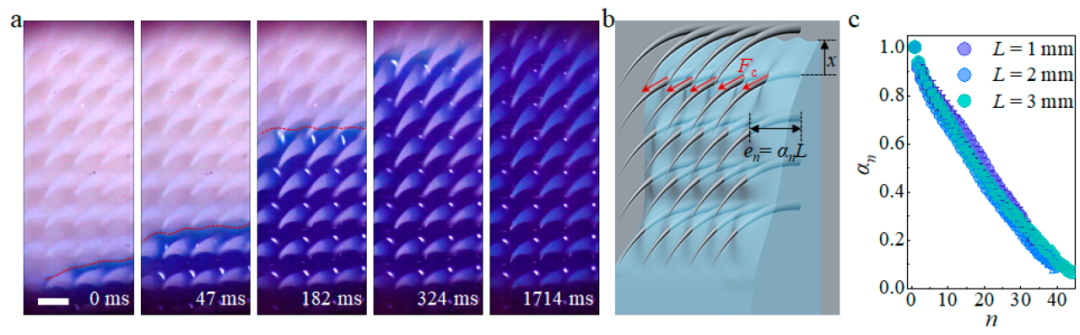 Microscopic view of capillary wicking on bionic trichome arrays and film thickness analysis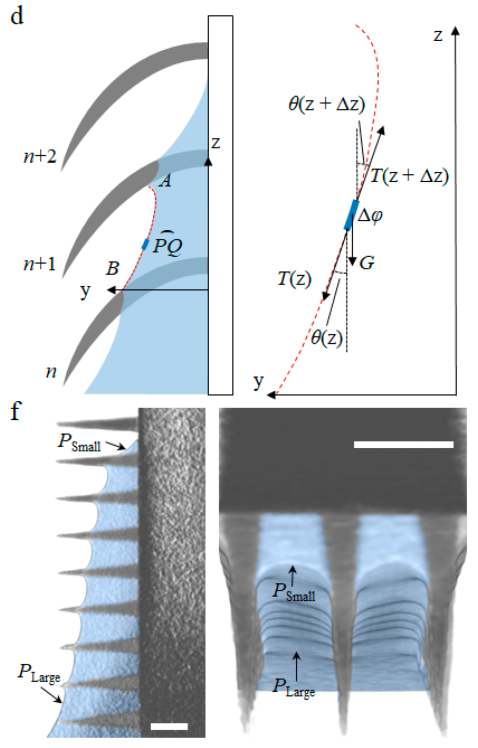
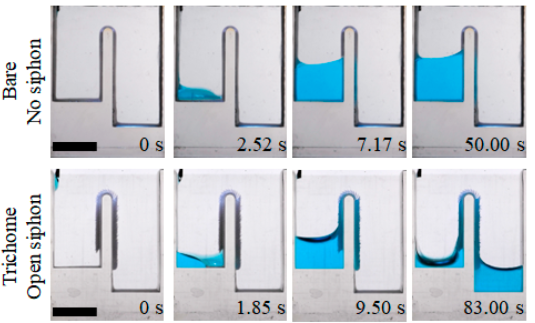 Comparison of capillary wicking effects in modified villi array devices