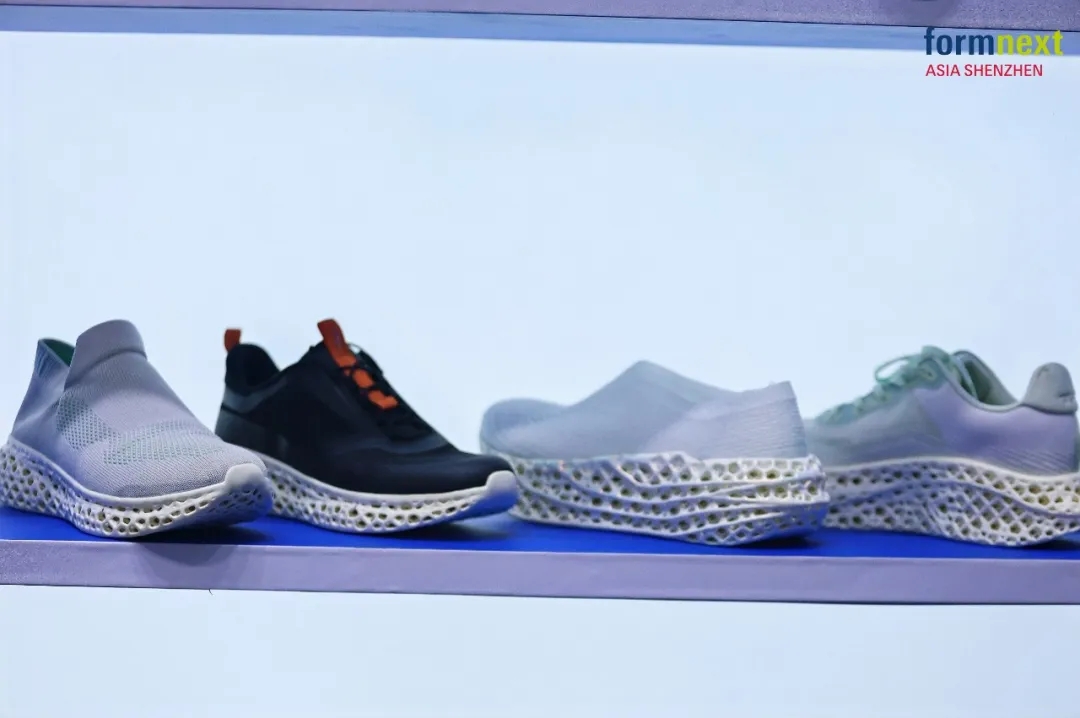
3D-printed shoes are not short on concepts; the hard part is mass production. Strength often comes with extra weight, while pure lattice structures can feel “soft but not bouncy,” and durability is another challenge.
On August 27, at the Shenzhen International Additive Manufacturing Exhibition forum in China, Deng Rongdong, Footwear Industry Development Director at TPM3D, shared the company’s SLS-plus-foaming approach.
TPM3D’s P360 Ultra won the Manufacturing Process Award at the first International Footwear Design Awards. It made its debut at TCT Asia in March. It takes up 11% less floor space, and its independent downward powder-dispensing design delivers more uniform powder spreading. Modular controls and semiconductor cooling reduce power consumption. A single PPS workstation can support four P360 Ultra machines, making mass-production costs more controllable.
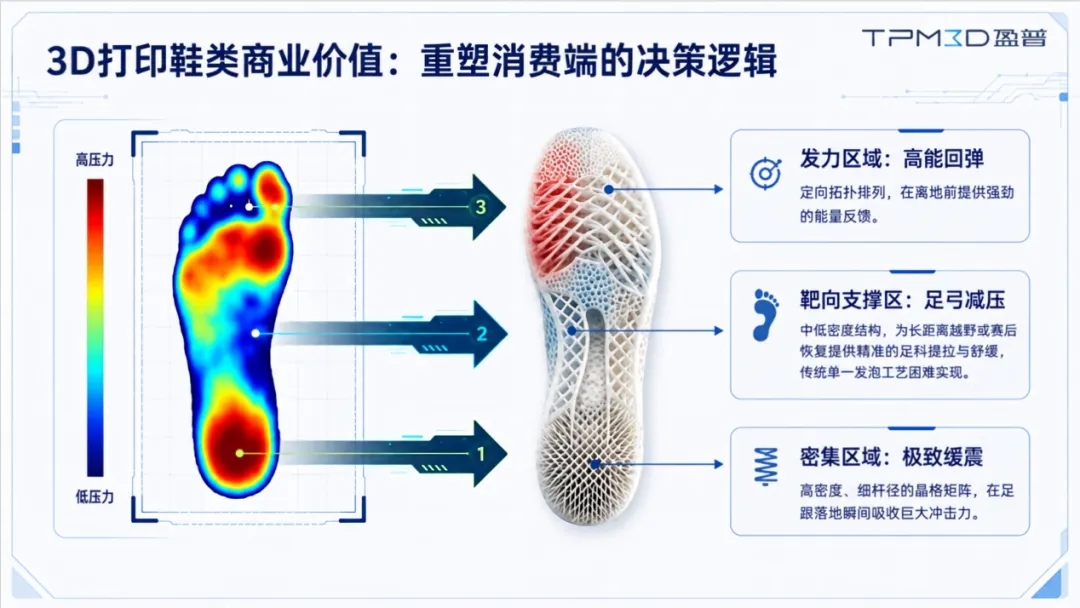
SLS powder-bed printing is self-supporting, so complex 3D lattices can be printed directly without support structures. Based on plantar pressure data, the sole can be divided into zones: a high-density lattice at the heel for cushioning, a medium-to-low-density structure at the arch for support and pressure relief, and a directional layout in the forefoot for high energy return. This is difficult with traditional injection molding or in-mold foaming. Midsoles, shoe lasts, outsole texture components, and torsion-control plates can also be formed in one piece.
After SLS forming, foaming reshapes the material’s microscopic properties while keeping the lattice structure intact. The foaming ratio can reach 2.5x, with solid density as low as 0.3 g/cm³ and apparent density as low as 0.1 g/cm³. Compression set is controlled at 22–26%, and energy return exceeds 70%. Third-party testing shows no collapse or fracture after 200,000 dynamic flex cycles.
On the production side, industrial SLS systems such as the P360 Ultra and P550DL support 3D nesting for batch printing of sole components. A single P550DL can form 190 soles at once. Closed-loop powder management and integrated post-processing improve batch consistency, supporting everything from prototyping to flexible small-batch manufacturing.
In the second half of the 3D-printed footwear game, the goal is not to print one good-looking shoe, but to reliably, efficiently, and sustainably produce thousands of wearable shoes. TPM3D’s solution offers an answer for industrialization.