BMF Precision and ZDOO 3D have launched the microArch® M150, a multi-material 4D printer enabling integrated molding of functional materials for high-precision, intelligent manufacturing.
With the global additive manufacturing industry accelerating its evolution towards intelligence and functionalization, manufacturing technology is inevitably transitioning from single-material molding to multi-material collaboration to achieve functional integration and component miniaturization.
Previously, Chongqing BMF Precision Technology Co., Ltd. and Shenzhen ZDOO 3D Technology Co., Ltd. formally entered into a strategic partnership, precisely addressing long-standing high-end manufacturing bottlenecks and customer pain points in the industry. Leveraging their respective core technological strengths, the two companies have jointly launched an innovative multi-material 4D printing achievement—the microArch® M150 photocurable multi-material 4D printer.
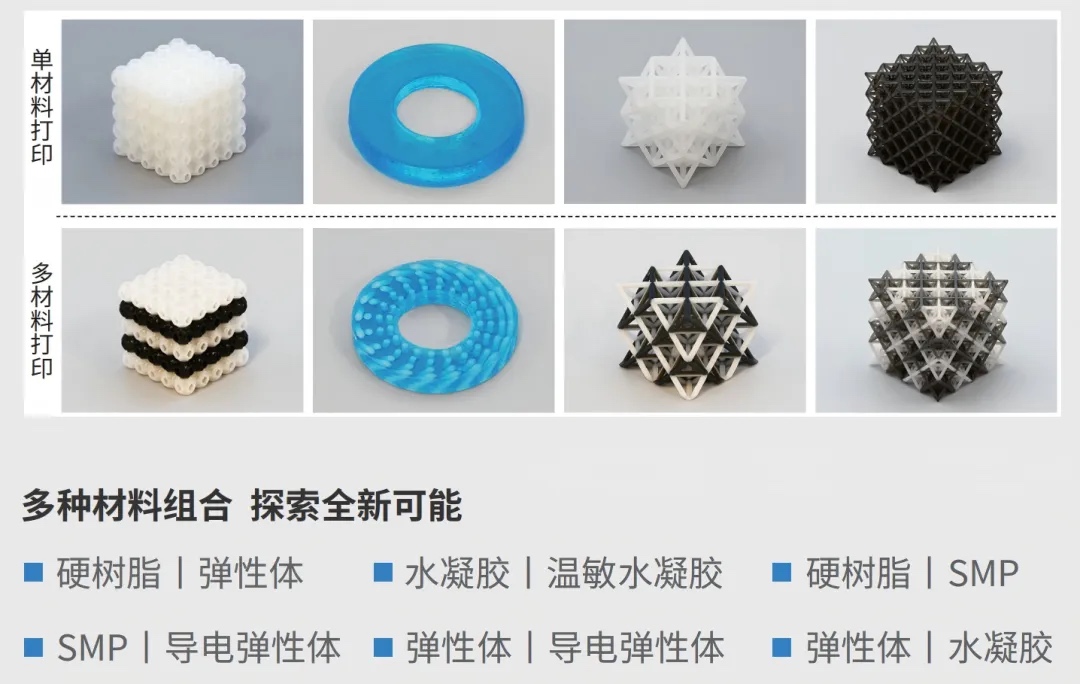
Addressing core challenges faced by traditional printing equipment, such as poor multi-material compatibility, insufficient molding precision, and difficulties in integrating diverse functions, the M150 (optical precision: 25μm) supports integrated molding of multifunctional materials including rigid resins, elastomers, hydrogels, shape-memory polymers, and conductive elastomers. Its 4D printing solution meets the demands of complex and precision-driven scenarios such as biomedical applications, soft robotics, and aerospace, successfully achieving a leap from single precision machining capabilities to integrated application capabilities of smart materials. This provides global customers with a full-chain solution transitioning from "high-precision manufacturing" to "functional intelligent manufacturing."
Technical Core: Centrifugal 4D Printing Technology
4D printing, as a groundbreaking extension of additive manufacturing technology, integrates smart materials with three-dimensional structures, endowing printed components with controllable deformation and functional response characteristics under external stimuli such as thermal, light, and chemical fields. The multi-material 4D printing solution jointly launched by BMF Precision and ZDOO 3D overcomes the limitations of single materials in terms of performance and functionality. It precisely combines materials with different properties in three-dimensional space, expanding the design possibilities into the fourth dimension and achieving functionality that is richer and more powerful than that possible with single materials.
The M150 is based on centrifugal photocurable multi-material 4D printing technology. It utilizes a 405nm UV LED light source projected onto the surface of functional materials to achieve precise curing and molding. The high-speed centrifugal action of the printing platform efficiently removes residual material, successfully overcoming the technical bottlenecks of dynamic multi-material switching and residual liquid removal. Through collaborative technical efforts, it effectively addresses two core challenges long present in the field of 4D printing: micro-structure precision control and smart material compatibility. This enables the equipment to possess intra-layer and inter-layer multi-material composite printing capabilities, ultimately achieving the integrated molding of products with high complexity, high precision, multi-functionality, and multi-material coupled structures.
Centrifugal Multi-Material Switching Technology
Adjustable centrifugal speed (up to 10,000 rpm).
Rapid dynamic material switching within 60 seconds.
Supports up to 2,500 material transitions in a single print.
Material switching efficiency and residual liquid removal capability lead the industry, effectively ensuring the continuity and stability of multi-material molding.
Supporting Multi-Material Slicing Software
Self-developed multi-material model slicing system.
Supports slicing of models with multiple materials distributed arbitrarily in space.
Slicing processing speed up to 500 layers/minute.
Significantly improves data processing efficiency for complex structural models and speeds up print preparation, providing intelligent support for efficient production.
Supports Various High-Performance 4D Printing Functional Materials
Compatible with a diverse range of 4D printing materials with viscosities ranging from 5 to 5,000 cps.
Includes rigid resins, elastomers, hydrogels, shape-memory polymers, conductive elastomers, and their combined structures for multi-material 4D printing.
Meets the functional material requirements of different application fields.
Integrated Molding of Multi-Material, Multi-Functional Coupled Structures
Achieves integrated molding of highly complex, high-precision, multi-functional, multi-material coupled structures.
Supports simultaneous printing with 3 materials.
Enables intra-layer and inter-layer multi-material switching.
The transition zone between different materials within a layer is <100 micrometers, ensuring precise connection and synergistic performance of functional gradient materials.
Application Prospects: Bridging the Gap from Laboratory to Industrialization
As a multi-material 4D printing equipment designed for industrial scenarios, the microArch® M150, with its ultra-high precision of 25 micrometers and multi-material collaborative printing capability, provides a full-chain manufacturing solution for frontier technology fields—from functional material integration to complex structure molding—driving technological breakthroughs and industrial upgrading across multiple sectors.
Flexible Electronics: Enables integrated molding of electronic circuits and flexible substrates through the composite printing of conductive elastomers and elastic base materials. This technology breaks through the compatibility limitations of traditional rigid and flexible electronic components, providing key technical support for the lightweight and conformal design of products like wearable devices and health monitoring sensors, aiding the development of a new generation of smart terminals.
Metamaterial Micro-Robots: Innovatively adopts a multi-material combination process using rigid and tough resins, successfully overcoming manufacturing challenges related to the structural complexity and functional diversity of micro-mobile robots. This solution supports the integrated design of precision transmission structures and flexible drive units, providing a manufacturing foundation for the development of micro-robots used in scenarios such as medical micro-operations and environmental monitoring, promoting the development of intelligent micro-systems towards higher integration levels.
Biomedical: Provides innovative manufacturing pathways for tissue engineering scaffolds and implantable medical devices through the functional combination of hydrogels with rigid resin reinforcement phases/shape memory polymers (SMPs). The equipment's ability to precisely control material distribution and functional gradients allows for accurate simulation of the complex microstructures of biological tissues, advancing the development of personalized implants and smart responsive medical devices.
Aerospace: The combination of shape memory polymers and conductive elastomers can be used to manufacture adaptive spacecraft structures. These structures can achieve autonomous morphological regulation and intelligent deployment through environmental perception, maintaining functional stability in extreme space environments, and providing key technical support for spacecraft lightweight design and enhanced spatial adaptability.
Strategic Significance: A Leap in Intelligent Precision Manufacturing
The current global development of 4D printing technology faces two core challenges: breakthroughs in micro-structure manufacturing precision and smart materials. BMF Precision's micron-level processing capability and ZDOO 3D's multi-material dynamic switching technology恰恰 constitute the optimal technical combination to solve these two major problems.
The collaborative R&D between the two parties will break through the industrial-grade manufacturing bottleneck of functional gradient materials. It will endow cutting-edge fields such as sensing elastomers, intelligent conductors, soft robotics, bioactive scaffolds, and flexible sensor arrays with environmental adaptability and functional programmability.
In the future, as multi-material 4D printing technology penetrates deeper into more industries, we can expect to see the emergence of more intelligent, self-adaptive, and environmentally friendly manufacturing models and product forms. From micro/nano-scale intelligent devices to macro-scale adaptive structures, 4D printing technology will provide new paths for humanity to solve complex challenges.