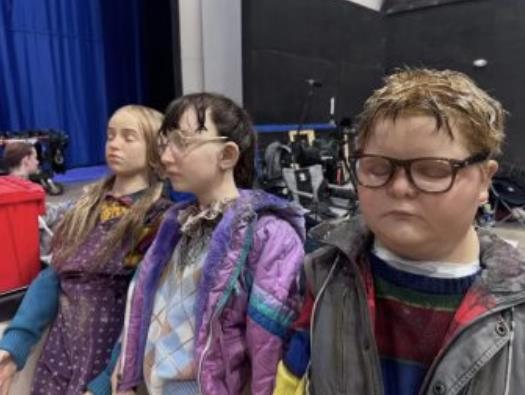
As we’ve recently learned thanks to a social media post by Eryn Krueger Mekash, the production’s makeup department head, 3D printing played a role in bringing the terror and fantasy of the final season to life.
The final season of Netflix’s hit show Stranger Things was nothing short of a media phenomenon, with people organizing elaborate watch parties and tons of anticipation over the fate of the rag-tag teens in the town of Hawkins. A big part of what drew audiences in to the show—and kept them rapt for five seasons—was the look of the production and its incredible sci-fi visual effects. As we’ve recently learned thanks to a social media post by Eryn Krueger Mekash, the production’s makeup department head, 3D printing played a role in bringing the terror and fantasy of the final season to life.
Those familiar with the plot of the final season will know of the Pain Tree, the embodiment of the “Mind Flayer” in the final season of the show that takes the form of an organic, spider-like structure. Crucial to the plot of the show, a number of children get trapped in the Pain Tree and remain in the background while the hero Eleven and villain Vecna battle it out. The actors playing the roles of the trapped children could not safely be suspended in the tree-like structure for the duration of the scene, so the production had to find a convincing solution.
The solution they landed on was creating a series of ultra-realistic dummies that looked just like each of the characters, which could hang in the background while the fight scene was filmed. Mekash and her team worked with Vincent Van Dyke Effects, a special makeup effects studio, to realize the life-sized dolls. According to her social media post, Vincent Van Dyke Effects 3D printed upper bodies based on scans and then custom painted them to resemble the real actors. Other details, like lace brows, wigs, and eyewear, were added by other special effects professionals. The result is uncanny: the life-sized body doubles—all with eyes closed—are nearly identical to the real actors and provide an eery backdrop for the series’ critical finale.
Of course, 3D printing was just one tool of many used in bringing the show’s incredible Upside Down set to life. According to Stranger Things production designer Chris Trujillo, the Pain Tree itself was constructed from sculpted foam with a metal infrastructure and hand finished. The massive set was inspired mainly by organic matter. As Trujillo explained in a Architectural Digest interview, “we did some very deep dive disgusting research into internal organs, flayed bodies, you name it.”
3D printing is increasingly being embraced by movie VFX teams, who can use the technology to create props and set pieces based on 3D scans or digital designs. In Marvel movies, an estimated 100 props per recent film have been 3D printed, including Thor’s hammer in Avengers: Infinity War and headpieces in Black Panther: Wakanda Forever. We also recently covered how Guillermo del Toro’s recent film Frankenstein used 3D printing to make a miniature model of the towering lab for a range of exterior shots. Overall, the technology is finding its place among other more established VFX methods, like injection molding and manual techniques.