Home  >  News

February 27, 2026      News      9062

Oak Ridge National Laboratory (ORNL) recently unveiled a breakthrough multi-material 3D printing technology. Featuring an innovative single-flow extrusion system, it holds the potential to redefine the future of manufacturing.

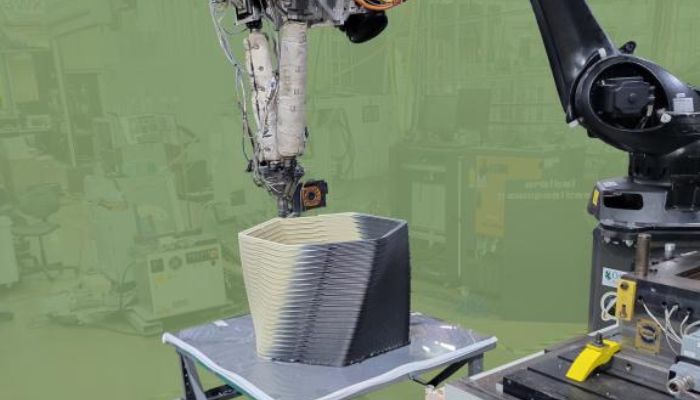
Traditional high-flow extruders face issues such as heavy weight, compromised printing accuracy, and difficulty in achieving flexible multi-material printing. ORNL's solution ingeniously connects multiple smaller extruders in parallel. Using a patented Y-shaped nozzle, it merges multiple material streams into a single, stable, and high-speed extrusion flow. This process is akin to efficiently merging multiple lanes into one畅通的 highway. It not only maintains speed comparable to large extruders but also achieves unprecedented flexibility in material switching and printing precision.
One of the technology's core breakthroughs is its ability to fabricate "core-sheath structures," where one material completely encapsulates another. This addresses the long-standing challenges in polymer 3D printing of weak interlayer adhesion and susceptibility to delamination. By precisely combining different materials, it becomes possible to create differentiated mechanical and functional properties within a single component.
The application prospects are vast: In the aerospace sector, it could manufacture lightweight impact-resistant components or radar-absorbing structures. In the energy field, it could be used to produce fire-resistant enclosures or battery supports. For civil engineering, it enables the creation of stronger bridge decks or automotive parts.
Project leaders stated that this system allows small extruders to maintain their lightweight advantage while matching the output capacity of larger equipment. It also enables dynamic, contamination-free material switching, unlocking new possibilities for the creative design of complex functional parts.


©2025 3dptimes.com All Rights Reserved