A college student has built a low-cost guided rocket system using consumer electronics and 3D printed parts—with total hardware costs coming in at just $96.
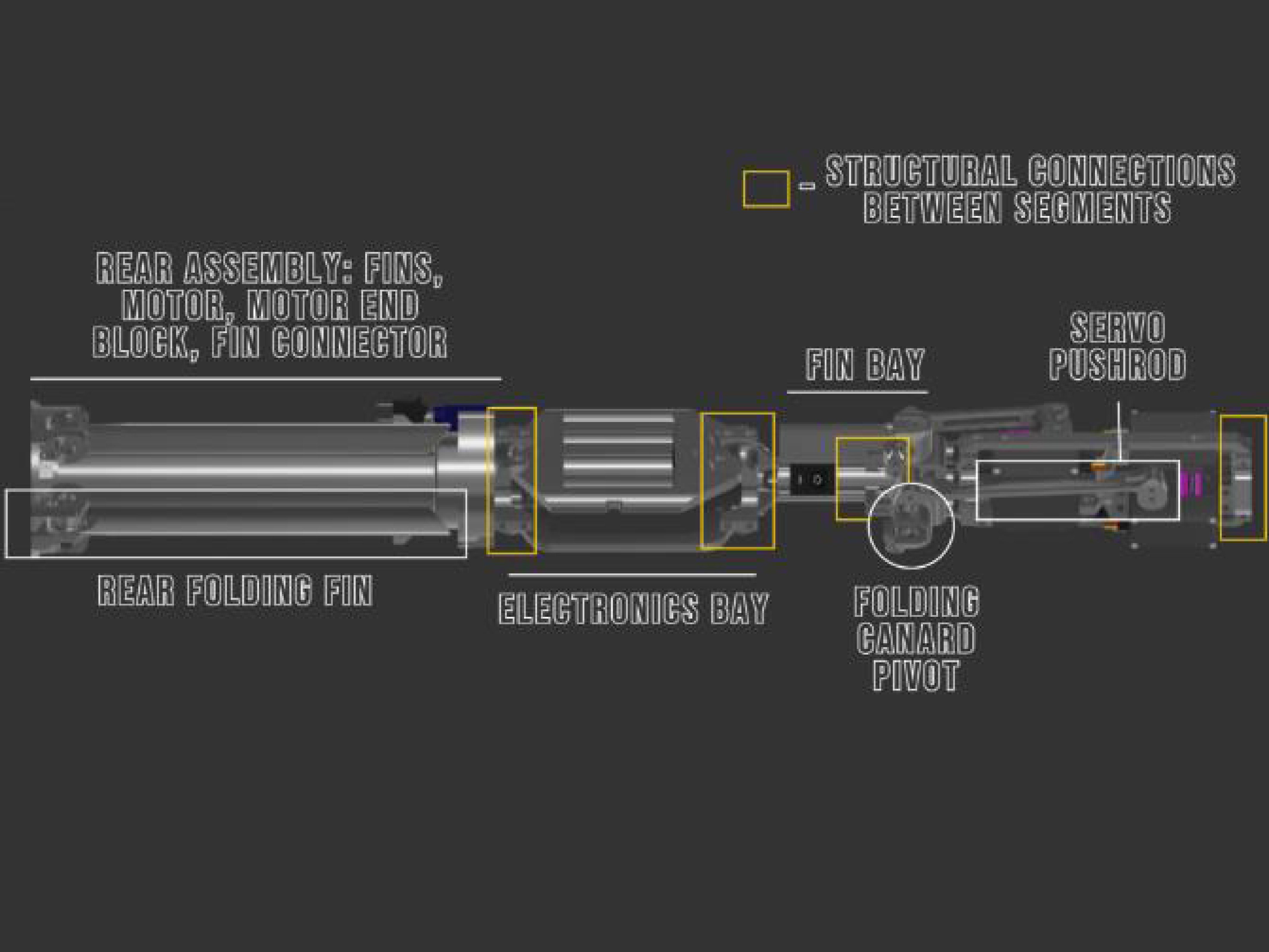
Alisher Khojayev, a student at Los Angeles Valley College, recently unveiled the project. Both the launcher and the rocket rely heavily on 3D printed structures. The rocket features a folding-fin, canard-stabilized design and is equipped with onboard telemetry and a camera-based tracking system. Before launch, the rocket communicates with the launcher via an umbilical cord to receive attitude calibration data. Once airborne, flight control is handled by an ESP32 microcontroller paired with an inertial measurement unit.
The design process began in OpenRocket, an open-source rocket simulation tool used to analyze center of pressure, center of gravity, and overall flight stability. Mechanical modeling was then completed in Fusion 360. Most structural components were fabricated using PLA material on consumer-grade 3D printers, with assembly carried out using heated threaded inserts and custom torsion springs. The project went through multiple rounds of iterative testing—particularly to verify the reliability of the folding-fin mechanism—and several static burn tests were conducted before full system integration.
In addition, the student developed a distributed camera node system that uses multiple low-cost units to achieve spatial triangulation of a target and transmits real-time coordinates to the launcher.
The capabilities of consumer-grade 3D printing extend far beyond this project. One automotive enthusiast segmented and printed a Porsche body shell, running cumulative print times of hundreds of hours to complete a full-scale exterior. Another team used desktop 3D printers to build a racing drone that reached speeds exceeding 650 km/h, enabling rapid iteration through engineering challenges involving thermal management, aerodynamic loads, and multi-material fabrication.
These cases collectively point to a clear trend: consumer-grade 3D printing has evolved beyond a simple prototyping tool and is now directly contributing to the production and engineering validation of high-performance, full-scale products.