Home  >  Software

November 4, 2026      Software      3DPTimes Editors | Sources: 3Dnatives, November 4, 2026; Meshy, October 16, 2026      3

A November 4 hands-on review finds that targeted AI edits can preserve much of a model, while difficult removals and unintended geometry changes remain concerns for printing.

A new hands-on review published by 3Dnatives on November 4, 2026, examines a practical question for AI-assisted 3D printing: can a designer change one feature without rebuilding the rest of a model? The publication tested 36 Meshy Edit operations on 11 models and compared exported geometry after alignment.

Most successful edits retained 88% to 97% of the original surface within the review’s 0.25 mm comparison threshold. That is a geometric similarity measure, not a physical print-success rate. Modest accessory substitutions and thicker mirror stems produced useful results, while attempts to remove a watch strap or a modeled hand and forearm were unsuccessful. Some operations also introduced unwanted geometry. These are findings reported by 3Dnatives; 3DPTimes did not perform the tests.

The distinction matters because the feature being edited is expected to change. A single similarity percentage cannot establish whether that change meets a designer’s intent or whether the exported model is suitable for a particular printer.

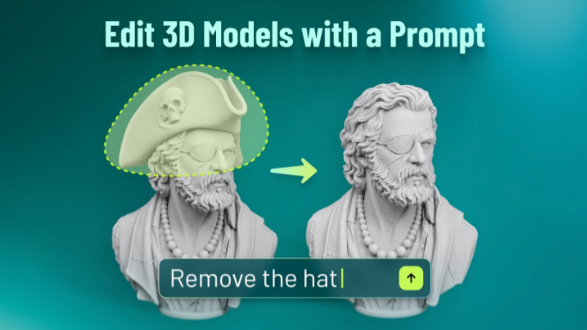
Image: Meshy’s official digital demonstration of removing a hat from a model. This is a software/model illustration, not a photograph of a printed object or evidence from the independent test. Image: Meshy, supplied with the authorized manuscript.

A targeted editing tool, with checks still required

Meshy introduced Edit on October 16, 2026. Its official documentation describes selecting an area with a lasso or brush, then requesting a change through text or reference images. Each operation produces a separate model while retaining the original. The company lists support for high-poly models generated with Meshy 6 and Meshy 7.1, with exclusions including uploaded models and Ultra 4K models.

For 3DPTimes, the practical takeaway is to treat local AI editing as an iterative design aid. Keep the original, compare exports and inspect the specific feature that matters. Before slicing, check scale, wall thickness, holes, disconnected bodies and fit-critical dimensions. Before committing to a production run, validate a representative part in the intended material and process.

A convincing preview can help a designer choose a direction. It cannot establish dimensional accuracy, assembly fit or manufacturing suitability on its own. The November 4 review adds useful evidence about editing behavior, rather than announcing a new product launch.

Sources: Julia Steiner / 3Dnatives, November 4, 2026: https://www.3dnatives.com/en/3dnatives-lab-meshy-edit-04112026/

Meshy, official product explanation, October 16, 2026: https://www.meshy.ai/blog/meshy-edit

Written by 3DPTimes Editors, November 4, 2026.


©2026 3dptimes.com All Rights Reserved