Home  >  News

May 15, 2026      News      9904

4D printing adds a "time" dimension to 3D printing, allowing a printed object to autonomously change its shape or function under external stimuli.

Current 4D printing mostly uses shape memory alloys or polymers, while ceramics – due to their stable structure and lack of flexibility – have been difficult to use for shape transformation.
Polymer-derived ceramics (PDCs) offer a new approach. These materials are produced by pyrolyzing organic precursors at high temperatures. Before pyrolysis, the precursor itself has a certain degree of flexibility and deformability. The team of Wu Shanghua at Guangdong University of Technology developed a flexible precursor slurry suitable for DLP photopolymerization, with the main components being polysilazane and vinyltrimethoxysilane.
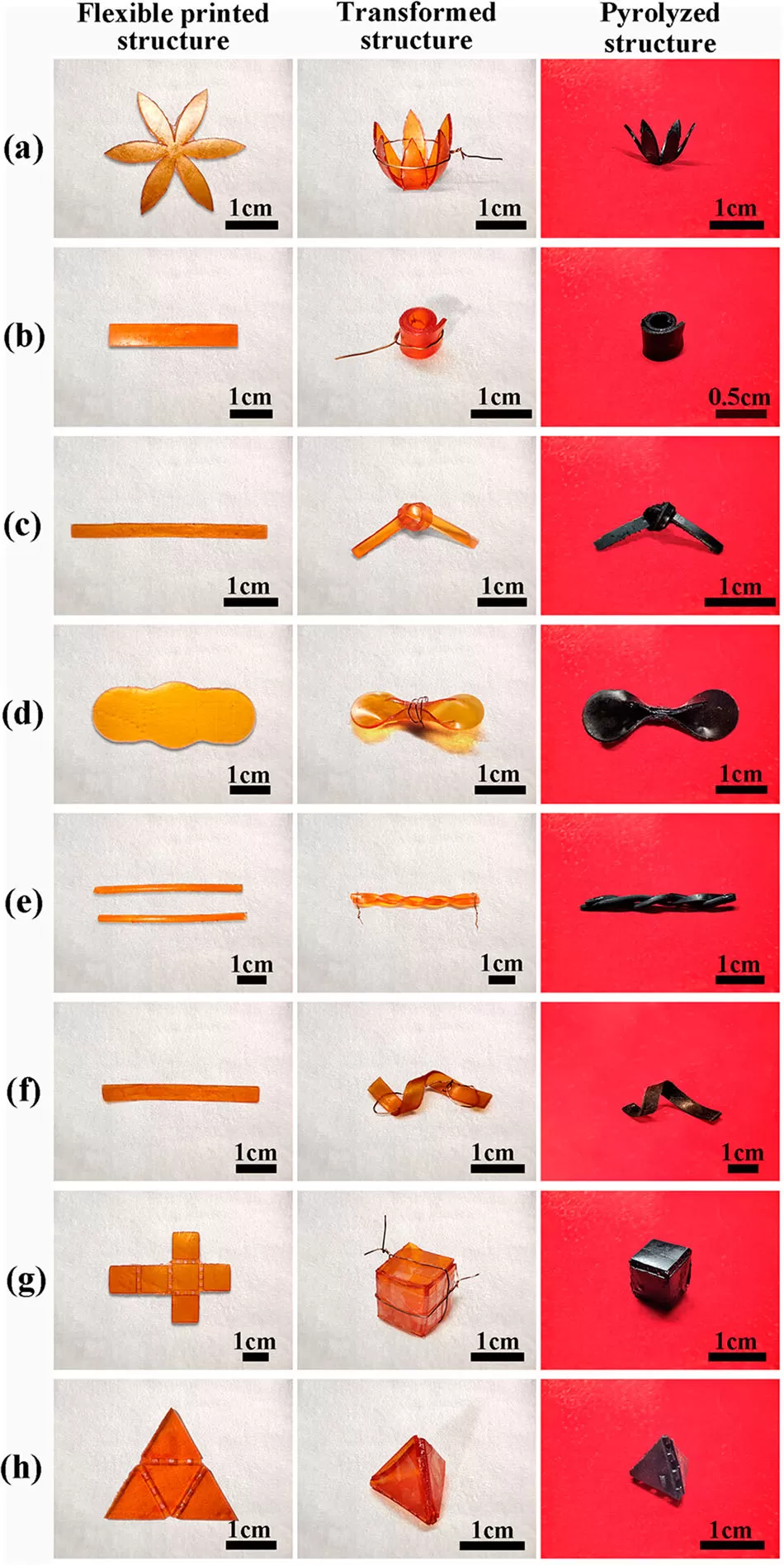
The precursor green parts printed by DLP are highly flexible and can be bent, twisted, folded, compressed, and otherwise deformed under low stress. For example, printed thin sheets can be assembled into polyhedral structures. After pyrolysis at 800–1300°C, the precursor transforms into silicon nitride ceramic, and the deformed shape is well preserved.
The team also introduced silicon nitride powder into the slurry. With 10 wt% silicon nitride doping, the linear shrinkage during pyrolysis was significantly reduced, the ceramic yield increased, and the samples were less prone to collapse. The flexural strength reached 130.61 ± 16.01 MPa, and the Vickers hardness reached 6.43 ± 0.12 GPa.
This research opens a new path for 4D printing of ceramic materials. In the future, flexible polymer-derived ceramics combined with high-precision photopolymerization technologies are expected to enable intelligent, shape-changing ceramic components in fields such as aerospace, soft robotics, and biomedical engineering.


©2025 3dptimes.com All Rights Reserved