Swinburne University studies earth-based 3D printing with natural fibers to address Australia's housing shortage, alongside Luyten 3D and Indigenous partners.
A construction research by Swinburne University of Technology is examining earth-based 3D printing as a response to Australia’s shortage of social and affordable housing.
Funded through the Australian Research Council’s Linkage Projects Scheme, the work is being led by Dr Mohamed Gomaa from Swinburne’s School of Engineering and involves the development of a robotic printing system capable of forming dense structural elements from soil reinforced with natural fibres. The system is designed to precisely extrude these mixtures into high-density structural forms, rather than relying on conventional concrete construction.
According to a news report, industry partner Luyten 3D is contributing expertise in large-scale construction 3D printing, while researchers from the University of New South Wales are involved in technical development. Indigenous knowledge holders are also participating, providing insights drawn from traditional earth-building practices that are being adapted for modern fabrication processes.
Addressing Australia’s housing gap
University estimates place Australia’s future housing shortfall at more than 600,000 social and affordable homes by 2036, a figure cited by the research team as a key motivation for investigating alternative building methods. Areas with limited access to skilled labour or traditional construction materials, including remote and disadvantaged communities, are a particular focus of the work.
For this project, earthen materials are being examined in part because of their environmental profile. Swinburne has noted that traditional concrete construction contributes roughly 8% of global carbon dioxide emissions, while earth-based materials have a near-zero carbon footprint. The research prioritizes the use of locally sourced soil to help reduce overall construction costs and timelines.
Plant-based fibres derived from agricultural by-products, including hemp and rice husks, are being incorporated into the printing mixtures. According to the research team, these fibres improve the strength and durability of earth-based structures while enabling farming waste to be reused for construction purposes. The use of these materials has also been described as supporting circular economy principles.
Swinburne has stated that combining locally sourced earth with automated construction techniques could reduce overall building costs and timelines by as much as 60%. The approach is being tested as a way to deliver housing more rapidly while maintaining structural performance.
What’s more? Laboratory testing and small-scale printed prototypes have already been completed. The next phase involves a full-scale demonstration building planned for Victoria, which will be used to showcase the technology’s potential.
Earth-based 3D printing in practice
Using recycled waste and locally sourced earth in construction provides a lower-impact building approach that relies on readily available materials while reducing overall environmental footprint.
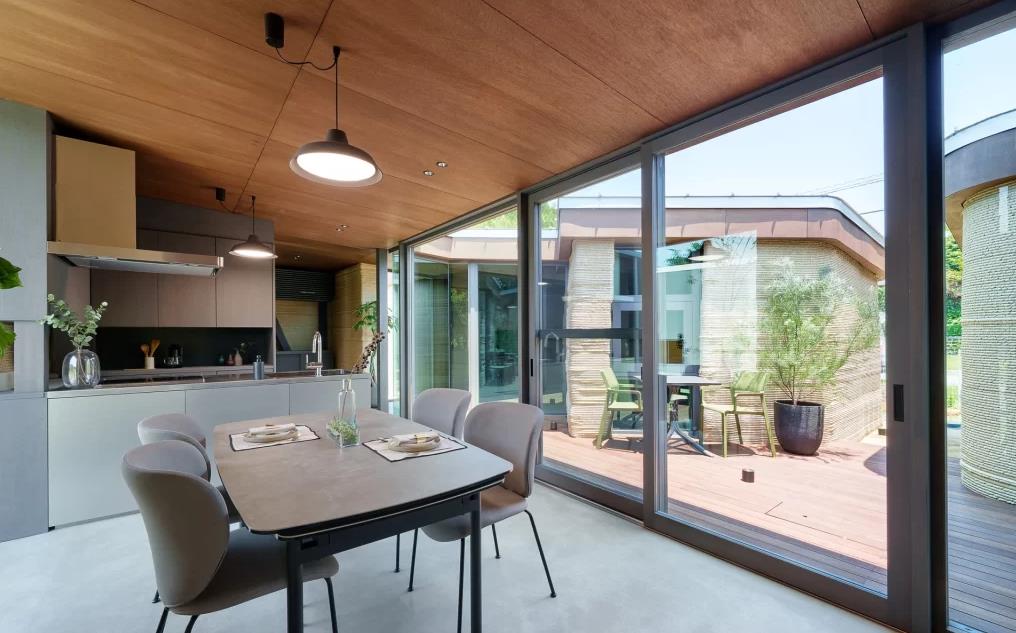
A notable example came from Japanese architecture studio Lib Work who completed a 100 sq m single-storey home in Kumamoto using large-scale 3D printing with a soil-based material rather than concrete. Developed with Arup and printed using equipment from WASP, the structure was extruded from a custom mix of earth, slaked lime and natural fibres, comprising about 65% soil and sand. Lib Work estimates the method reduces construction CO₂ emissions from roughly 45,000 kg to about 22,434 kg, while achieving Japan’s highest earthquake resistance rating.
In other news, international design studio Hassell completed a 3D printed community building in Hope Village, Tanzania, using digitally fabricated walls made from locally sourced earth. The structure features crisscrossing earth walls that merge traditional construction materials with additive manufacturing methods.